
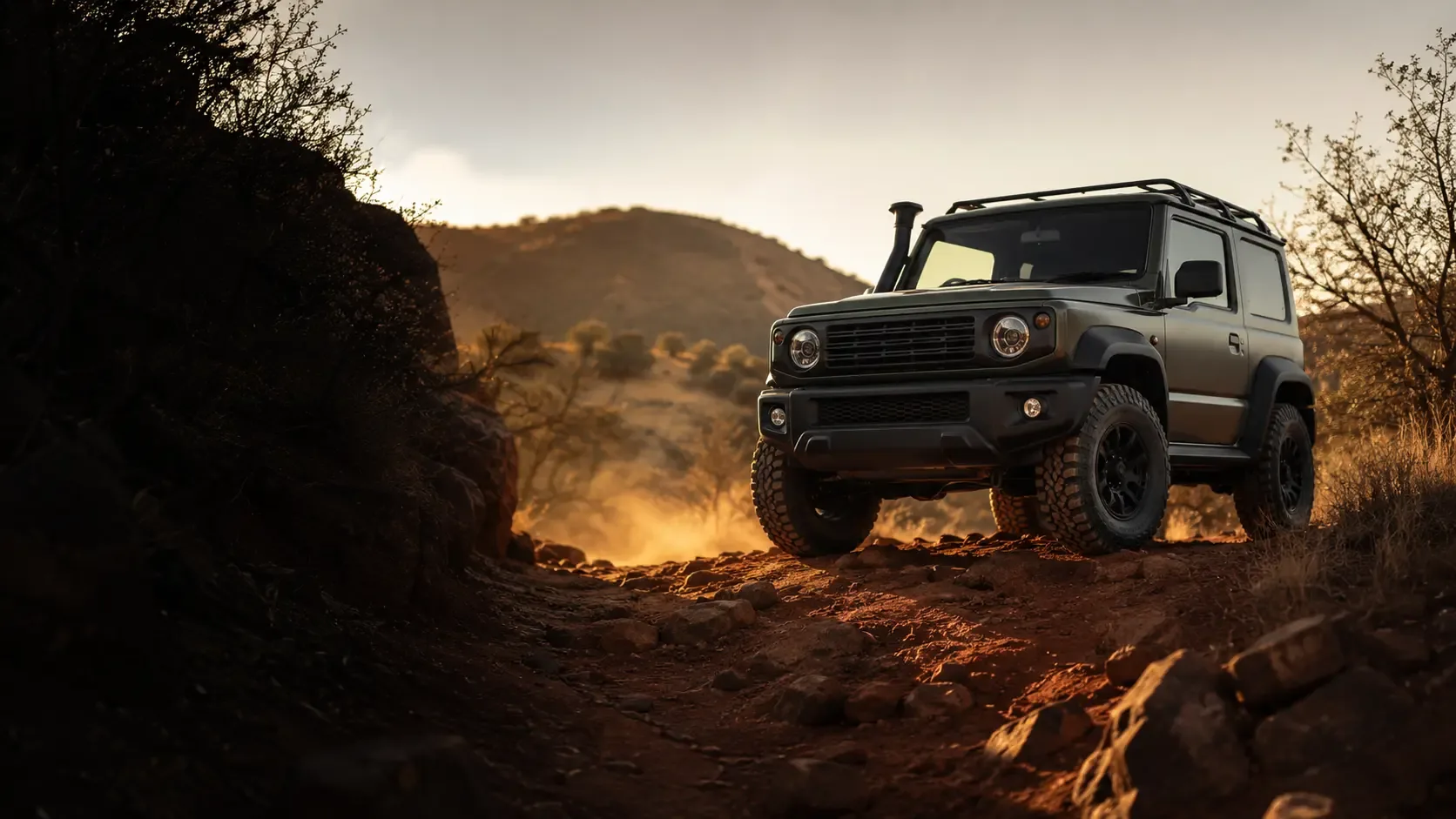
Buying Guide · JB23 (1998–2018)
Suzuki Jimny JB23
Buyer’s Guide
The third-generation, 660 cc turbo kei Jimny is a JDM cult classic — cheap, brilliant off-road and endlessly tunable. Here’s what it is, how the series evolved, and exactly what to check before you buy a used import.
Last updated: 23 June 2026 · A Compact Conqueror buying guide
The JB23 is the Japan-market version of the third-generation Suzuki Jimny, built from 1998 right through to 2018. It’s a kei car: powered by a tiny 660 cc turbocharged three-cylinder, sized to Japan’s compact-car rules, and — outside Japan — almost always a grey-import. Don’t let the small engine fool you; with coil-sprung rigid axles, low-range four-wheel drive and a kerb weight around a tonne, the JB23 is a seriously capable little off-roader and a tuner’s favourite.
If you want the larger 1.3/1.5-litre export version of the same generation, that’s the JB43. For the newer model, see our JB74 Complete Guide. For the wider picture, the Jimny history sets the scene.
In a hurry? Jump to the series breakdown, buying an import, what to check, the verdict or the FAQ. Heading to a viewing? Take the free pre-purchase checklist.
What Is the Suzuki Jimny JB23?
The JB23 introduced the formula the Jimny still uses today: a separate ladder-frame chassis, rigid (solid) axles front and rear, but now suspended on coil springs and a three-link layout instead of the old leaf springs — a huge gain in ride and articulation. Drive comes from a 660 cc K6A turbo triple driving the rear wheels, with selectable part-time four-wheel drive and a low-range transfer case for serious terrain.
Because it’s a kei car it’s tiny, light and frugal, which is exactly why it’s so good off-road and so cheap to run. Over a 20-year production life it received continual updates — so a late JB23 is a notably better, safer car than an early one, even though they look broadly similar.
Understanding the Series
The JB23 ran through roughly ten minor “series” revisions over two decades. Suzuki never made a big fuss about them, and they overlap, so think in three broad eras rather than chasing exact series numbers:
| Era | Approx. years | What changed / what it means for buyers |
|---|---|---|
| Early | 1998–2001 | Launch cars. Round headlamps, simplest equipment, earliest turbo/4WD hardware. Cheapest, but oldest and most basic. |
| Mid | 2002–2008 | Facelifts and equipment upgrades, revised interiors, improved 4WD selection on some cars. The value sweet-spot for many buyers. |
| Late | 2008–2018 | Best safety and equipment — ABS, airbags and refinements. The ones to buy if budget allows; newest, so usually lowest mileage and least rust. |
Series boundaries are approximate and markets/auctions describe them differently — always verify the exact build date and specification of the individual car.
Specifications at a Glance
| Specification | Detail |
|---|---|
| Generation | Third-gen Jimny (JB23, Japan kei) |
| Years | 1998 – 2018 |
| Engine | 0.66L K6A, turbocharged petrol triple |
| Power | ~47 kW (64 hp) — kei limit |
| Torque | ~103 Nm |
| Transmission | 5-speed manual or 4-speed automatic |
| Drivetrain | Part-time 4WD with low range |
| Suspension | 3-link rigid axles, coil springs (front & rear) |
| Length × Width × Height | 3,395 × 1,475 × 1,705 mm |
| Wheelbase | 2,250 mm |
| Kerb weight | ~1,000 kg |
| Ground clearance | ~190 mm |
| Fuel tank | 40 litres |
| Seats | 4 |
Buying a JDM Import
Outside Japan, almost every JB23 is a grey-market import, and that brings a few extra things to check beyond the usual used-car homework:
- Import compliance & paperwork: confirm the car is legally imported and registered for your market, with all duties paid. Rules differ widely by country.
- Mileage verification: ask for the Japanese auction sheet and de-registration documents. Auction sheets grade condition and note the genuine odometer reading.
- Kilometres, not miles: the speedo and odometer read in km/h and km — make sure any conversion is handled for your market.
- Parts & servicing: mechanical parts are cheap and plentiful, but some trim and electrical items are JDM-specific — check availability locally.
- Specification quirks: Japanese-market radios, navigation and warning chimes may be in Japanese; factor in any conversion you want.
Country-specific import nuances are covered in our regional guides — for example the UK buying guide covers used prices and the import angle in detail.
What to Check Before You Buy
The JB23 is mechanically tough, but it’s now an old car, so condition is everything. Focus your inspection here:
- Rust — the number-one killer. Check the rear wheel arches, sills, floor, tailgate and especially the ladder chassis. Structural chassis rot is a walk-away.
- 5th-gear wear — high-mileage manuals can whine in or jump out of 5th; listen on a motorway run.
- Turbo health — no excessive smoke, whistle or lag; boost should build cleanly. Confirm oil changes were regular (turbos hate neglect).
- Timing chain — the K6A uses a chain; listen for rattle on cold start, a sign of a tired chain/tensioner.
- 4WD system — engage 4H and 4L (per the handbook) and confirm they select cleanly with no warning lights or binding.
- Service history & fluids — patchy history is common on imports; budget to do all fluids (engine, transfer case, diffs, gearbox) on purchase.
Take the free, printable Jimny Buyer’s Checklist to the viewing, and read the dedicated JB23 Common Problems guide first. Planning to bring it up to date? The JB23 service schedule lists every interval and fluid.
Living With a JB23
The 660 cc turbo makes its modest power high in the rev range, so you drive it on the boost and keep it spinning — it feels lively in town and fine on back roads, but it’s working hard at sustained motorway speeds. Economy is excellent for a 4×4, the kei dimensions make it hilariously easy to park and place on a trail, and running costs are very low. It is, however, a strict four-seater with a tiny boot.
Want hard numbers for your situation? Try the Running Cost Calculator. Thinking about tyres or a lift? The Tyre Size Calculator shows the speedo and gearing impact, and our modifications guides cover the popular upgrades.
Pricing & Value
JB23 values have firmed up as good ones get harder to find and the model gains cult status. As with any 20-year-old import, condition trumps mileage — a rust-free, well-maintained, higher-mileage car is a far better buy than a tatty low-mileage one. Pay for the best example you can find and budget for catch-up maintenance.
Prices vary widely by country, condition and series, so we don’t quote figures here. For market context see our regional guides and the general Buyer’s Guide, and compare generations with the Comparison Tool.
Is the JB23 Right for You?
The JB23 is the bargain entry into serious Jimny ownership: cheap to buy and run, genuinely capable, and a joy to modify. Just go in knowing it’s an old, small, basic kei car — and that a good one is all about condition and rust.
Why owners love it
- Seriously capable off-road for the money
- Cheap to buy, run and insure; frugal turbo triple
- Tiny and light — brilliant on tight, technical trails
- Huge tuning and aftermarket scene
- Holds its value as a cult JDM classic
Watch-outs
- Only ~64 hp — busy and noisy at motorway speeds
- Rust is common; chassis rot can be terminal
- Strict four seats and a very small boot
- Most are grey imports — extra paperwork to check
- Patchy service history on many cars
Buy the best, rust-free example you can find — on a JB23, condition matters far more than the number on the odometer.
Compact Conqueror verdict
Frequently Asked Questions
What’s the difference between the JB23 and JB43?
They’re the same third-generation Jimny. The JB23 is the Japan-market kei car with a 660 cc turbo engine; the JB43 is the export version with a larger 1.3- or 1.5-litre engine. Outside Japan the JB23 is almost always a grey import.
Is the JB23 a good first off-roader?
Yes — it’s one of the best-value ways into capable four-wheel driving. Low purchase and running costs, genuine low-range ability and a massive support community make it ideal for learning, provided you buy a structurally sound, rust-free car.
How much power does it have?
Around 47 kW (64 hp) — the Japanese kei-car limit — from a 660 cc turbocharged three-cylinder. It’s modest, so you keep the engine on boost; performance is fine in town and on trails but stretched at sustained high speeds.
What are the most common JB23 problems?
Rust (arches, sills and chassis), worn 5th gear on high-mileage manuals, turbo and timing-chain wear from neglected servicing, and the usual age-related electrical niggles. See our dedicated JB23 Common Problems guide.
Is it hard to get parts for an imported JB23?
Mechanical parts are cheap and widely available. Some JDM-specific trim, electronics and badging can be harder to source locally, so check before you buy if originality matters to you.
Which series should I buy?
If budget allows, a later (2008+) car for the best safety and equipment and usually the least rust. Mid-era cars (2002–2008) are the value sweet spot. Whatever the series, prioritise condition and a rust-free chassis.
Next steps
Found one to view? Take the free Jimny Buyer’s Checklist and read the JB23 Common Problems guide. Comparing it with other generations? Use the Comparison Tool or browse all our buying & ownership guides.
This guide is general information only, not buying, mechanical or financial advice. Specifications, equipment, import rules and pricing vary by market, series and model year — always verify the details for the specific vehicle and region you’re considering.
Related: JB23 common problems →