
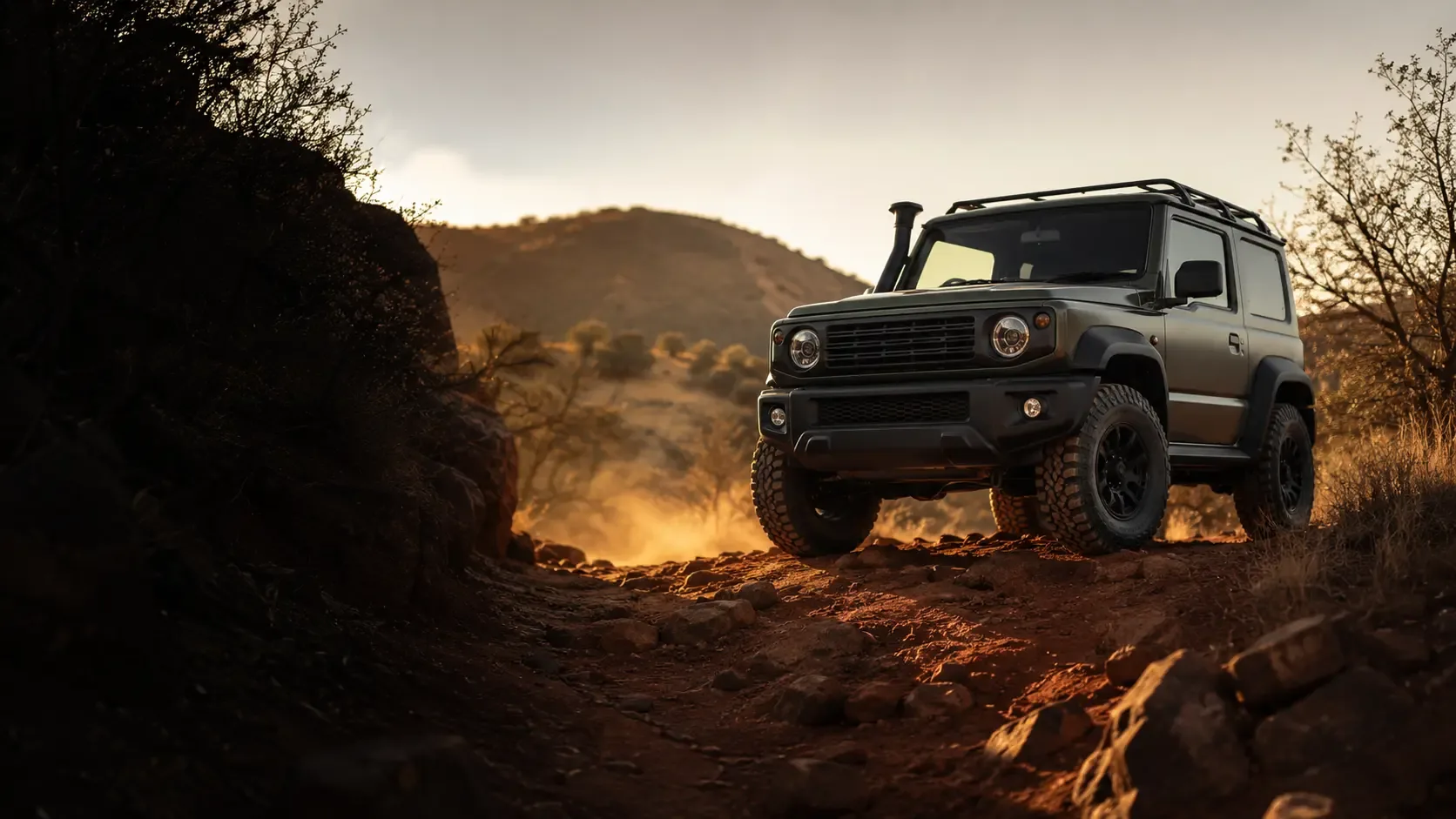
Buying Guide · Samurai / SJ (1981–1998)
Suzuki Samurai (SJ)
Buyer’s Guide
The leaf-sprung original that started it all. The SJ-series Samurai is now a rising classic — simple, charismatic and endlessly fixable. Here’s what the variants are, and exactly what to check before you buy one.
Last updated: 23 June 2026 · A Compact Conqueror buying guide
The SJ-series — sold as the Samurai in many markets, and also badged SJ410, SJ413, Sierra, Santana and others — is the rugged little 4×4 that turned the Jimny into a global icon through the 1980s and 90s. It’s the simplest, most analogue Jimny you can buy: a leaf-sprung, body-on-ladder-frame off-roader with rigid axles, manual free-wheel hubs and low-range four-wheel drive. Today it’s very much a classic — values are climbing, the restoration scene is huge, and condition (especially rust) is everything.
For the later, coil-sprung models in this family see our JB23 and JB74 guides. To place the Samurai in the wider story, read the Jimny history & heritage.
In a hurry? Jump to the variants, specs, what to check, the verdict or the FAQ. Going to view one? Take the free pre-purchase checklist.
What Is the Suzuki Samurai (SJ)?
Launched in 1981 (replacing the original LJ), the SJ generation was the first Jimny sold widely around the world. It paired a tough ladder chassis with leaf-sprung rigid axles front and rear and a part-time four-wheel-drive system with low range and manual locking front hubs. It’s crude by modern standards — a firm, bouncy ride, basic interior and modest power — but that simplicity is exactly the appeal: there’s very little to go wrong, and almost anything can be fixed in a driveway.
It was sold in a huge range of body styles and names depending on market and era, which is the first thing to get straight before you shop.
Models, Variants & Names
“Samurai” is the best-known name, but this family wore many badges. Broadly:
| Variant | Engine / body | What it means for buyers |
|---|---|---|
| SJ410 | 1.0L (970 cc) F10A carburettor | The early, smallest-engined version. Charming but slow; least powerful. |
| SJ413 / Samurai | 1.3L (1,324 cc) G13 petrol | The bigger-engined, more usable version — the one most people want. Later cars gained fuel injection (G13BB). |
| Body styles | Soft-top, hard-top, and pickup; short- and long-wheelbase | Soft-tops are the icon; hard-tops are more practical and secure; LWB/pickups are rarer. |
| Other badges | Sierra, Santana, Holden Drover, Maruti Gypsy and more | Same basic vehicle, built/badged for local markets — spec and trim vary. |
Names, engines and specifications vary widely by market and year — some late Spanish-built (Santana) cars even switched to coil springs. Always confirm exactly what the individual car is.
Specifications at a Glance
Indicative figures across the SJ410/SJ413 range — these spanned many years and markets, so treat them as ballpark and verify the specific car.
| Specification | Detail |
|---|---|
| Generation | SJ-series (second-gen Jimny family) |
| Years | ~1981 – 1998 (later in some markets) |
| Engine | 1.0L F10A or 1.3L G13 petrol |
| Power | ~45–51 kW (60–70 hp), depending on engine |
| Transmission | 4- or 5-speed manual |
| Drivetrain | Part-time 4WD, low range, manual free-wheel hubs |
| Suspension | Leaf-sprung rigid axles (front & rear) |
| Length | ~3,430 mm (SWB); LWB variants longer |
| Wheelbase | ~2,030 mm (SWB) |
| Kerb weight | ~900–1,050 kg |
| Ground clearance | ~190–210 mm |
| Seats | 2–4 depending on body |
What It’s Like to Drive
Manage your expectations and you’ll love it. The leaf springs give a firm, jiggly ride and the tall, narrow body leans in corners, so it’s happiest at relaxed speeds. Power is modest — the 1.3 is adequate, the 1.0 leisurely — and refinement is minimal. But off-road, the light weight, short overhangs, low range and locking hubs make it astonishingly capable, and the whole thing feels honest and mechanical in a way modern cars don’t.
Safety note: the Samurai is a tall, narrow, lightweight vehicle from a different safety era with no modern crash protection. It famously attracted rollover criticism in the late 1980s. None of that makes it unusable — but drive it smoothly, within its limits, and don’t expect it to behave like a modern car.
What to Check Before You Buy
With a classic this old, condition is the whole game — and on a Samurai that means rust, rust and more rust. A mechanically tired but solid car is a far better buy than a shiny one hiding chassis rot.
- Chassis & bulkhead — the Samurai rusts everywhere. Probe the ladder rails, outriggers, bulkhead/firewall and rear cross-member. Structural rot is a walk-away or a full restoration.
- Floors, sills & arches — lift the mats and carpets; check the footwells, sills, wheel arches and tailgate.
- Engine & carburettor — carbed cars need correct tuning; check for smooth cold-start and idle. Injected (G13BB) cars are easier to live with.
- Drivetrain & hubs — engage 4H and 4L, lock and unlock both manual front hubs, and listen for clunks from worn UJs, diffs and the transfer case.
- Originality vs modification — many have been lifted, re-engined or heavily modified; assess the quality of the work and whether it’s declared for insurance.
- Paperwork — matching numbers, clear history and (for imports) proper registration. Restorations should come with receipts.
Take the free, printable Jimny Buyer’s Checklist to every viewing, and read the SJ & Samurai Common Problems guide so you know the weak spots before you go.
Classic Ownership & Running Costs
Running a Samurai is more classic-car hobby than everyday transport. The good news: it’s mechanically simple, parts (especially for the 1.3) are cheap and well-supported, the aftermarket and club scene is enormous, and you can do most jobs yourself. The catch: expect to fettle, and budget for rust repair and recommissioning on anything that hasn’t been cared for.
Thinking about tyres or a lift for yours? The Tyre Size Calculator shows the speedo and gearing effect, and our modifications guides cover the popular upgrades.
Pricing & Value
The Samurai has firmly entered appreciating-classic territory. Clean, rust-free and original (or well-restored) examples now command real money, while rough project cars are cheap — but those projects can swallow far more in rust repair than the finished value. As always, buy the best, most solid car you can afford rather than the cheapest.
Values vary hugely by variant, condition and market, so we don’t quote figures here. Compare it with the later generations in the Comparison Tool, and see the general Buyer’s Guide for the wider market.
Is the Samurai Right for You?
Buy a Samurai with your heart as much as your head — but buy the chassis, not the paint. If you want a simple, charismatic, genuinely capable classic that you can wrench on yourself and that’s only going up in value, it’s hard to beat. If you want a comfortable, safe, practical daily driver, look to a newer Jimny.
Why owners love it
- Pure, simple, mechanical classic charm
- Light and capable off-road on the right tyres
- Cheap, well-supported parts and a huge club scene
- Easy to work on at home
- Rising values — a solid one is an appreciating asset
Watch-outs
- Rust is rampant — chassis rot can be terminal
- Slow, firm-riding and unrefined by modern standards
- Tall, narrow and from a pre-modern-safety era
- Carbed cars need tuning know-how
- Many have been heavily (and variably) modified
On a Samurai, you’re buying the chassis first and everything else second — find a solid, rust-free one and the rest is just maintenance.
Compact Conqueror verdict
Frequently Asked Questions
Is the Suzuki Samurai the same as the Jimny?
Yes — the Samurai is the SJ-series Jimny, sold under the Samurai name (and others like Sierra and Santana) in various markets. It’s the second-generation Jimny family that preceded the JB23/JB43 and today’s JB64/JB74.
SJ410 or SJ413 — which should I buy?
The SJ413 (1.3-litre) is the more usable and sought-after choice, with enough power to keep up with traffic; later fuel-injected cars are the easiest to live with. The SJ410 (1.0-litre) is charming but noticeably slower.
Does the Samurai really roll over easily?
It attracted high-profile rollover criticism in the late 1980s. It’s a tall, narrow, light vehicle, so it doesn’t handle like a modern car — drive it smoothly and within its limits and it’s perfectly usable, but treat sudden manoeuvres at speed with respect.
What’s the biggest thing to check when buying one?
Rust. The chassis, bulkhead, floors, sills and arches all corrode, and structural chassis rot can write a car off. Always inspect underneath thoroughly — condition matters far more than mileage.
Are parts easy to get?
Mechanical parts, especially for the 1.3-litre G13, are cheap and widely available thanks to the huge global following. Some body, trim and market-specific items can be harder to find.
Is a Samurai a good daily driver?
It can be a fair-weather runabout, but it’s really a classic and hobby vehicle — slow, basic and from a different safety era. For everyday use, a newer JB23 or JB74 is far more suitable.
Next steps
Found one to view? Take the free Jimny Buyer’s Checklist and read the SJ & Samurai Common Problems guide. Comparing the generations? Use the Comparison Tool or browse all our buying & ownership guides.
This guide is general information only, not buying, mechanical or financial advice. Specifications, equipment, names and pricing vary enormously by market, variant and model year — always verify the details for the specific vehicle and region you’re considering.
Related: Suzuki SJ & Samurai common problems →