
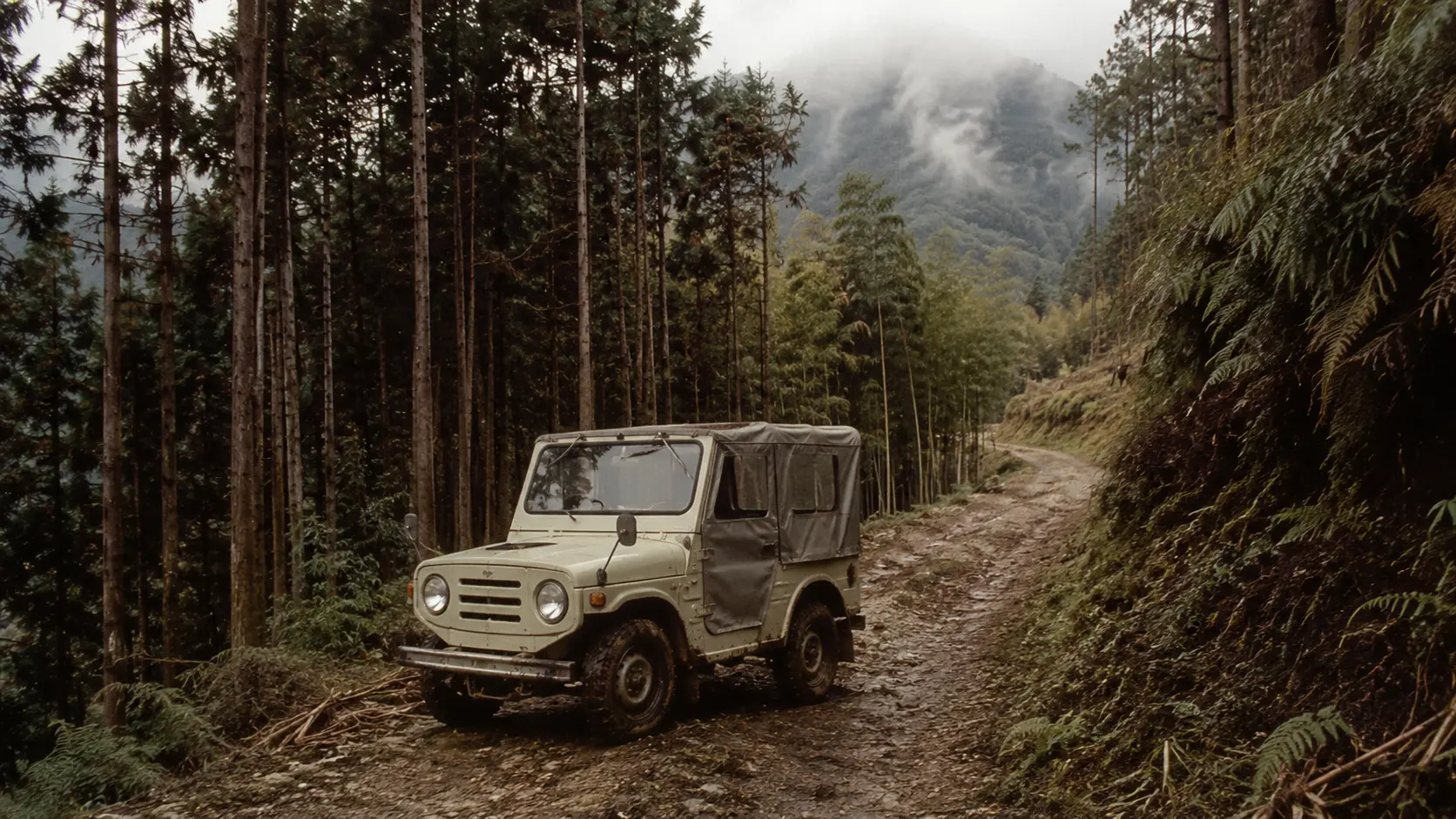
The Suzuki Jimny has a lineage stretching back more than half a century — from a tiny 360cc kei-class oddity in 1970 to the global cult icon of today. Understanding that history explains why the modern Jimny is the way it is: stubbornly true to a formula that has barely changed because it was right from the start. This is the story of the Jimny, generation by generation.
1970: The LJ10 — Where It All Began
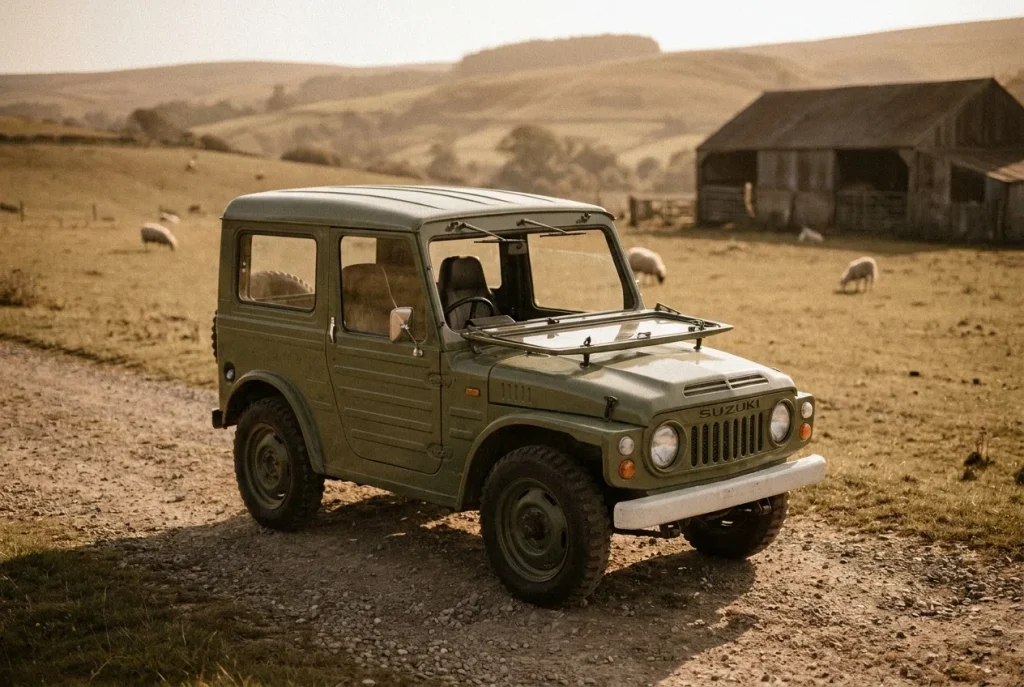
The Jimny story starts in 1970 with the Suzuki LJ10 — the first of the line. It was a tiny vehicle built to Japan’s kei-car regulations, powered by a small air-cooled, two-stroke engine of around 359cc driving all four wheels through a low-range transfer case. It was crude, minimal, and astonishingly capable for its size — establishing the formula that every Jimny since has followed: keep it small, keep it light, give it genuine four-wheel-drive hardware, and let its dimensions do what brute force can’t.
The genius of the 1970 LJ10 was a formula so right that 55 years later, Suzuki is still essentially building the same idea.
James Crawford, Compact Conqueror
The 1970s: LJ20, LJ50 and Growing Up
The early Jimny evolved quickly. The LJ20 brought a water-cooled engine, improving reliability and refinement over the original air-cooled two-stroke. As the decade progressed, larger engines followed — the LJ50 era introduced a bigger two-stroke, and the line continued to grow in capability and usability while staying true to its compact, go-anywhere character. These early Jimnys built the reputation that would carry the model worldwide.
1981: The SJ410 and SJ413 — The Samurai Era


The 1981 SJ generation was a major step. The SJ410 introduced a 1.0-litre (970cc) four-stroke engine, and the later SJ413 brought a 1.3-litre engine — sold in many markets, including the United States and Europe, under the famous “Samurai” name (and as the Sierra and, in India, the Gypsy in related forms). This generation, with its leaf-spring suspension and rugged simplicity, took the Jimny global and cemented its cult status. The Samurai became an icon of affordable, characterful off-roading. (For buying one today, see our SJ & Samurai buyer’s guide.)
1998: The Third Generation — Modernisation
In 1998, the Jimny was comprehensively modernised. The third generation (the JB-series) moved to coil-spring suspension in place of the old leaf springs, dramatically improving ride and articulation while keeping the ladder-frame chassis and genuine 4WD. It came in several forms: the 658cc turbocharged JB23 for Japan’s kei-car class, and the 1.3-litre JB43/M13A for export markets including South Africa. This generation ran for an extraordinary two decades, until 2018, building a vast owner base and the deep parts and aftermarket support that make it such good value today. (See our JB23 buyer’s guide.)
2018: The Fourth Generation — The Cult Goes Global
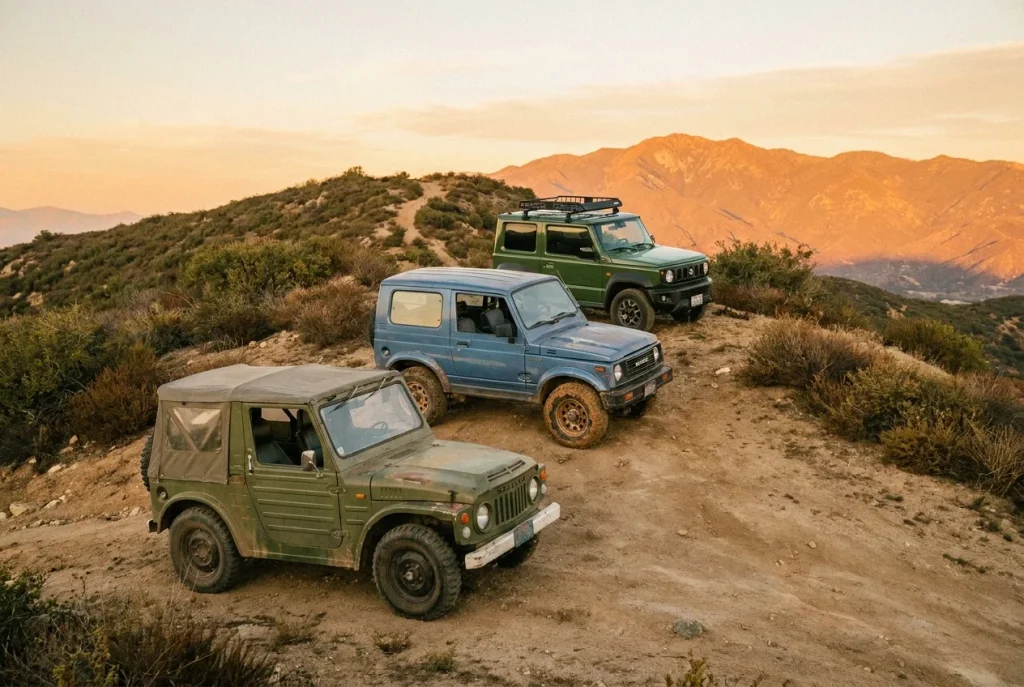

In 2018, Suzuki launched the fourth generation — the JB64 (kei, 660cc) and the JB74 (1.5-litre, export) — and the Jimny became a global phenomenon. Its bold, retro-modern styling, referencing the classic Jimnys and a certain boxy German icon at a fraction of the size, struck a chord worldwide. Waiting lists formed; the model sold out in market after market. Crucially, beneath the modern styling and equipment, the formula was unchanged: ladder frame, rigid axles, low-range 4WD, tiny dimensions. Suzuki had modernised the Jimny without betraying it.
The fourth generation also brought, from 2023, the first factory five-door Jimny — built in India and exported globally — adding practicality without abandoning the character. (See our JB74 complete guide and 3-door vs 5-door comparison.)
The Jimny Timeline at a Glance
| Year | Model | Significance |
|---|---|---|
| 1970 | LJ10 | The first Jimny — ~359cc air-cooled two-stroke kei 4×4; the formula is born |
| 1972 | LJ20 | Water-cooled engine — improved reliability |
| mid-1970s | LJ50 era | Larger engines; growing capability |
| 1981 | SJ410 / SJ413 | 1.0L then 1.3L; the global “Samurai” era; leaf-sprung |
| 1998 | Third generation (JB23 / JB43) | Coil springs; modernised; ran 20 years to 2018 |
| 2018 | Fourth generation (JB64 / JB74) | Retro-modern styling; global cult phenomenon |
| 2023 | JB74 5-door | First factory five-door; built in India, exported globally |
Why the History Matters
The Jimny’s heritage isn’t just trivia — it explains the car. Every modern Jimny carries the DNA of that 1970 original: the conviction that a small, light, genuinely capable 4×4 is a better answer than a big, heavy, powerful one for a huge range of real-world off-roading. While rivals grew larger, heavier, softer, and more road-focused, the Jimny held its course. That stubbornness is exactly why it has such a devoted following — and why, more than five decades on, nothing else on the market quite replaces it.
Frequently Asked Questions
When was the first Suzuki Jimny made?
The first Suzuki Jimny — the LJ10 — was introduced in 1970. It was a tiny kei-class vehicle powered by a small air-cooled two-stroke engine of around 359cc, with four-wheel drive and a low-range transfer case. It established the formula every Jimny since has followed: small, light, and genuinely capable off-road. The Jimny has been in continuous production and development for more than 50 years.
What is the difference between the Jimny and the Samurai?
The Samurai was the name used in many markets — including the United States and Europe — for the 1981 SJ-generation Jimny, particularly the 1.3-litre SJ413. So the Samurai is a Jimny: a specific generation sold under a different name in certain markets. The same era was also sold as the Sierra and, in related forms in India, as the Gypsy. The “Jimny” name is the through-line across all generations.
How many generations of Suzuki Jimny are there?
Broadly, the Jimny spans several eras: the early LJ-series (from 1970), the SJ/Samurai generation (from 1981), the third generation (the JB-series, from 1998 to 2018), and the current fourth generation (JB64/JB74, from 2018). Within these, there were numerous model variants and engine changes. The lineage is continuous, with each generation refining the same core formula.
Why does the modern Jimny look retro?
The fourth-generation Jimny (2018) deliberately references its own heritage — the round headlamps, upright stance, clamshell bonnet and flat panels echo the classic Jimnys, while also evoking larger boxy 4×4 icons at a fraction of the size. The retro-modern design was a major factor in the Jimny becoming a global cult phenomenon, striking a chord with buyers worldwide and contributing to the waiting lists that formed in market after market.
Has the Jimny’s basic design really stayed the same?
In its fundamentals, remarkably so. Across more than 50 years and four generations, the Jimny has retained a separate ladder-frame chassis, genuine four-wheel drive with a low-range transfer case, compact kei-influenced dimensions, and a light weight. Suspension evolved (leaf springs to coil springs in 1998) and engines modernised, but the core conviction — that small and light beats big and heavy off-road — has never changed. That consistency is central to the Jimny’s identity.
When did the five-door Jimny first appear?
The first factory five-door Jimny arrived in 2023, as part of the fourth generation. It is built in India and exported to markets around the world (sold as the Jimny XL in Australia, for example, and as the only Jimny offered in India). It stretches the wheelbase to add rear doors and significantly more space, adding practicality while retaining the Jimny’s character — the first time in the model’s history a factory five-door has been offered.
Related Reading
Free Newsletter
The Compact Conqueror Newsletter
Community news, event announcements, build features and Jimny stories — free, every week.
Free Jimny Tool
Not sure which Jimny to buy?
Compare the Samurai, JB23, JB43 and JB74 side by side — engines, dimensions, kit and what changed between generations.