
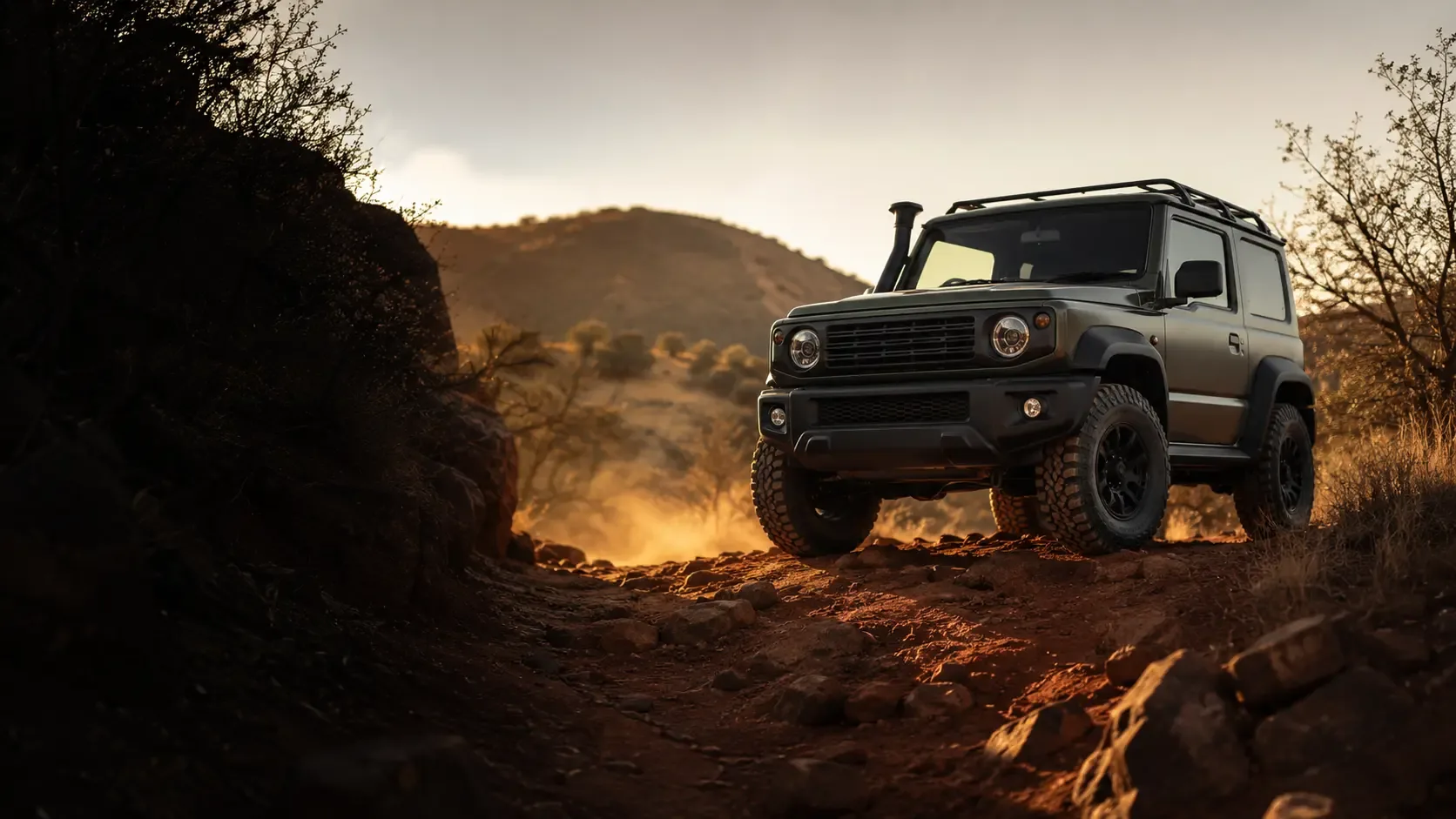
Buying Guide · JB74 (2018–present)
Suzuki Jimny JB74:
The Complete Guide
Everything you need to know about the fourth-generation 1.5-litre Jimny — specs, the ALLGRIP PRO 4WD system, what it’s like to live with, pricing, reliability and whether it’s the right buy for you.
Last updated: 23 June 2026 · A Compact Conqueror buying guide
The JB74 is the export, 1.5-litre version of Suzuki’s fourth-generation Jimny (the Japan-market kei car is the 660 cc JB64). Launched in 2018, it took the Jimny’s go-anywhere, body-on-ladder-frame formula and wrapped it in retro-modern styling, a stiffer chassis and modern safety kit — and promptly sold out almost everywhere. This guide covers what makes it special, the numbers that matter, and the things to check before you buy.
In a hurry? Jump to the specs, pricing & buying, the verdict, or the FAQ. New to Jimny shopping? Grab the free pre-purchase checklist first.
What Is the Suzuki Jimny JB74?
The JB74 is a compact, dedicated off-roader — not a soft-roader crossover. It keeps the three ingredients that define a real Jimny: a separate ladder-frame chassis, rigid (solid) axles front and rear, and a part-time four-wheel-drive system with low range. At well under 3.7 metres long and around 1.1 tonnes, it’s tiny and light, which is exactly why it punches so far above its weight on a trail.
Compared with the third-generation Jimny it replaced, the JB74 gained a stiffer chassis, more aggressive boxy styling with round headlamps, a much-improved interior with a proper infotainment screen, and a suite of driver-assistance features. The trade-off: it remains a strictly four-seat, short-wheelbase machine that prioritises capability over outright comfort and cabin space.
Specifications at a Glance
Headline figures for the three-door JB74. Exact numbers vary slightly by market, model year and trim — always confirm against the spec sheet for your specific car.
| Specification | Detail |
|---|---|
| Generation | Fourth-gen Jimny (JB74, export 1.5L) |
| Years | 2018 – present |
| Engine | 1.5L K15B, naturally aspirated petrol |
| Power | 75 kW (101 hp) @ 6,000 rpm |
| Torque | 130 Nm @ 4,000 rpm |
| Transmission | 5-speed manual or 4-speed automatic |
| Drivetrain | Part-time 4WD (ALLGRIP PRO) with low range |
| Suspension | 3-link rigid axles, coil springs (front & rear) |
| Length × Width × Height | 3,645 × 1,645 × 1,720 mm |
| Wheelbase | 2,250 mm |
| Kerb weight | ~1,090–1,135 kg |
| Ground clearance | 210 mm |
| Approach / breakover / departure | 37° / 28° / 49° |
| Fuel tank | 40 litres |
| Seats | 4 |
Figures are indicative and market-dependent. Fuel economy is typically around 6.5–7.5 L/100 km in real-world use depending on tyres, gearing and driving style.
Engine & Performance
The 1.5-litre K15B is honest rather than fast. Its 75 kW and 130 Nm have to haul a boxy, four-wheel-drive body, so 0–100 km/h takes a leisurely 12 seconds-plus and motorway cruising is busy and a little buzzy — the short gearing and tall, brick-like shape mean it’s happiest below 110 km/h.
Where it shines is low down and off-road: there’s enough torque and, crucially, a proper low-range transfer case that multiplies it for crawling. The five-speed manual is the enthusiast’s pick for control and engagement; the four-speed automatic is more relaxed in traffic but blunts performance and economy further. There’s no diesel and no hybrid in the JB74.
The ALLGRIP PRO 4WD System
This is the heart of the Jimny. ALLGRIP PRO is a part-time system, meaning you drive in two-wheel drive (rear) on the road and select four-wheel drive only when you need it:
- 2H — rear-wheel drive for normal tar driving.
- 4H — high-range four-wheel drive for loose surfaces, gravel, snow and sand at speed.
- 4L — low-range four-wheel drive for steep, slow, technical terrain and maximum torque.
Combined with rigid axles, a brake-based limited-slip function (which brakes a spinning wheel to send drive across the axle), hill-hold and hill-descent control, the little Jimny will follow much larger, more expensive 4×4s up surprisingly difficult trails straight off the showroom floor. Note there is no centre or rear locking differential as standard — the brake-LSD does the heavy lifting.
Off-road tip: because it’s part-time 4WD, don’t leave it in 4H on dry tar — the lack of a centre differential causes transmission “wind-up.” Engage 4WD on loose surfaces only.
On-Road Manners & Practicality
Be honest with yourself about the compromises. Solid axles and a short wheelbase give the JB74 a bouncy, fidgety ride and vague, slow steering that needs constant small corrections at speed. Wind and road noise are ever-present. None of this matters much around town or on a trail, but a long motorway commute will wear thin.
Practicality is similarly Jimny-sized: it’s a strict four-seater, and with the rear seats up the boot is tiny (around 85 litres). Fold the 50/50 rear seats and you get a usefully square load bay (roughly 377 litres) — fine for two people and gear, but this is not a family car. If you regularly carry rear passengers and luggage, look at the longer five-door (see below).
Trims, Markets & the Five-Door
Exact trim names differ by market (for example GL and GLX in many regions, or Pro and other badges elsewhere), but the mechanical package is broadly the same. Higher trims add infotainment with smartphone mirroring, climate control, alloy wheels, cruise control and more driver-assist features. The choice that matters most is manual vs automatic, and increasingly three-door vs five-door.
The long-wheelbase five-door Jimny (launched from 2023 in markets such as India and others, and sold under names like “5-Door” or “Nomade”) stretches the wheelbase and adds rear doors and a bigger boot, making it far more usable day-to-day at the cost of a little ultimate agility and breakover clearance. If you want the full breakdown, read our 3-door vs 5-door comparison.
Pricing & Where to Buy
The JB74’s biggest quirk isn’t mechanical — it’s demand. Supply has been tight in most markets since launch, which means long waiting lists for new cars and unusually strong used prices; lightly-used examples often sell for close to, or even above, new list. That’s frustrating to buy into, but it’s also why the Jimny holds its value so well (more in our resale value guide).
- Buying new: expect a waiting list. Order early and be wary of dealers adding mark-ups over list.
- Buying used: you’ll pay a premium, so condition and history are everything — budget for a proper inspection.
- Grey/JDM imports: the kei JB64 can be imported in some markets; check homologation, parts and insurance before committing.
Pricing varies enormously by country and over time, so we don’t quote figures here. For market-specific numbers see our regional guides (for example the Australia buying guide) and our general Buyer’s Guide.
Reliability & Common Problems
The JB74 is mechanically simple and generally robust, which is part of its appeal. Most issues owners report are minor or known niggles rather than serious faults, and a full service history goes a long way. Crash-safety is a genuine consideration, though — the Jimny scored a modest rating in independent crash tests, a function of its size and old-school construction.
We keep a dedicated, regularly-updated rundown of what to watch for: read the JB74 Common Problems & Reliability Guide before you buy, and use the free pre-purchase checklist at the viewing.
Running Costs
Running costs are low to moderate. Fuel economy is reasonable rather than remarkable (the brick-on-wheels aerodynamics see to that), insurance is usually sensible for such a small car, servicing is cheap thanks to the simple mechanicals, and — crucially — depreciation is famously low. Add bigger tyres or a lift and you’ll trade some economy for capability.
Want your own numbers? Plug your mileage, fuel price and costs into our Running Cost Calculator, or read the real annual ownership breakdown.
Modifications
Few cars respond to modification as rewardingly as the Jimny — and few need so little to be brilliant. The usual first steps are quality all-terrain tyres, underbody protection, rated recovery points and a modest suspension lift. Go too big and you’ll hurt the on-road manners and upset the speedo and gearing.
Start with our free First 10 Mods guide, check fitment with the Tyre Size Calculator, and see our best tyres for the JB74.
Is the JB74 Right for You?
Buy a JB74 with your eyes open. If you want a genuinely capable, characterful, easy-to-own off-roader and you can live with the compromises, nothing else at the size or price comes close. If you want a comfortable, spacious daily driver, it will frustrate you.
What we love
- Genuine, low-range off-road ability out of the box
- Tiny, light and brilliant on tight trails
- Iconic looks and a huge enthusiast following
- Cheap to service; holds its value extraordinarily well
- Endlessly modifiable
Watch-outs
- Slow, busy and noisy at motorway speeds
- Strict four seats and a very small boot
- Firm, fidgety ride and vague steering
- Modest crash-safety rating
- Often hard to buy at a fair price
As a second car, a trail toy or a characterful runabout, the JB74 is hard to beat. As your only family car, think twice.
Compact Conqueror verdict
Frequently Asked Questions
What’s the difference between the JB74 and JB64?
They’re the same fourth-generation Jimny built for different markets. The JB64 is the Japan-only kei car with a 0.66-litre turbo engine; the JB74 is the export model with the larger 1.5-litre naturally-aspirated engine. The JB74 is the one sold in most countries.
Is the Jimny JB74 good off-road?
Yes — exceptionally so for its size and price. Thanks to a ladder chassis, rigid axles, low-range 4WD and a featherweight body, it tackles terrain that embarrasses much larger SUVs, even on standard tyres.
Manual or automatic?
The five-speed manual is the keen driver’s choice and is slightly better on performance and economy. The four-speed automatic is easier in traffic but blunts the already-modest performance. Both are equally capable off-road.
Is it a good daily driver?
It can be, in town. On long motorway commutes the noise, busy ride and slow steering wear thin, and the tiny boot and four seats limit family use. Many owners run it as a second car or weekend vehicle.
Why is the Jimny so hard to buy?
Demand has hugely outstripped supply since 2018, creating long new-car waiting lists and very strong used prices. The upside is class-leading resale value.
Should I get the three-door or five-door?
Choose the three-door for ultimate agility and the classic look, or the longer five-door for rear doors, more space and easier everyday use. See our dedicated 3-door vs 5-door comparison.
Next steps
Heading to a viewing? Take the free, printable Jimny Buyer’s Checklist so you don’t miss anything. Still deciding which generation suits you? Use the Comparison Tool, or browse all our buying & ownership guides.
This guide is general information only, not buying, mechanical or financial advice. Specifications, equipment and pricing vary by market and model year — always verify the details for the specific vehicle and region you’re considering.
Related: JB74 common problems & reliability →