

The Jimny is cheap to buy by 4×4 standards — but the purchase price is only part of the picture. Fuel, insurance, servicing, tyres, and depreciation all add up over a year of ownership. The good news: the Jimny is genuinely affordable to run, and its exceptional resale value offsets much of the cost. Here is the realistic annual budget, broken down line by line.
The Big Picture
For a JB74 driven a typical 15,000 km per year in South Africa, real-world running costs (excluding finance repayments) fall in the region of R45,000–R65,000 per year. The biggest variable is insurance, which swings widely by driver profile and region. The smallest is servicing, thanks to the Jimny’s long 15,000 km / 12-month interval.
| Cost Category | Annual Estimate (15,000 km) | Notes |
|---|---|---|
| Fuel | R18,000–R22,000 | At ~6.8–7.5 L/100 km real-world |
| Insurance (comprehensive) | R13,000–R19,000 | Gauteng, varies hugely by profile |
| Servicing | R2,500–R5,000 | Long 15,000 km intervals help |
| Tyres (amortised) | R2,000–R3,000 | AT tyres last ~50,000 km |
| Licensing & sundries | R800–R1,500 | Annual licence, wipers, bulbs |
| Total (excl. finance & depreciation) | ~R36,000–R50,000 | Depreciation is unusually low — see below |
The Jimny’s secret weapon isn’t low running costs — it’s low depreciation. The car you sell is worth far more than equivalent rivals.
Compact Conqueror
Fuel
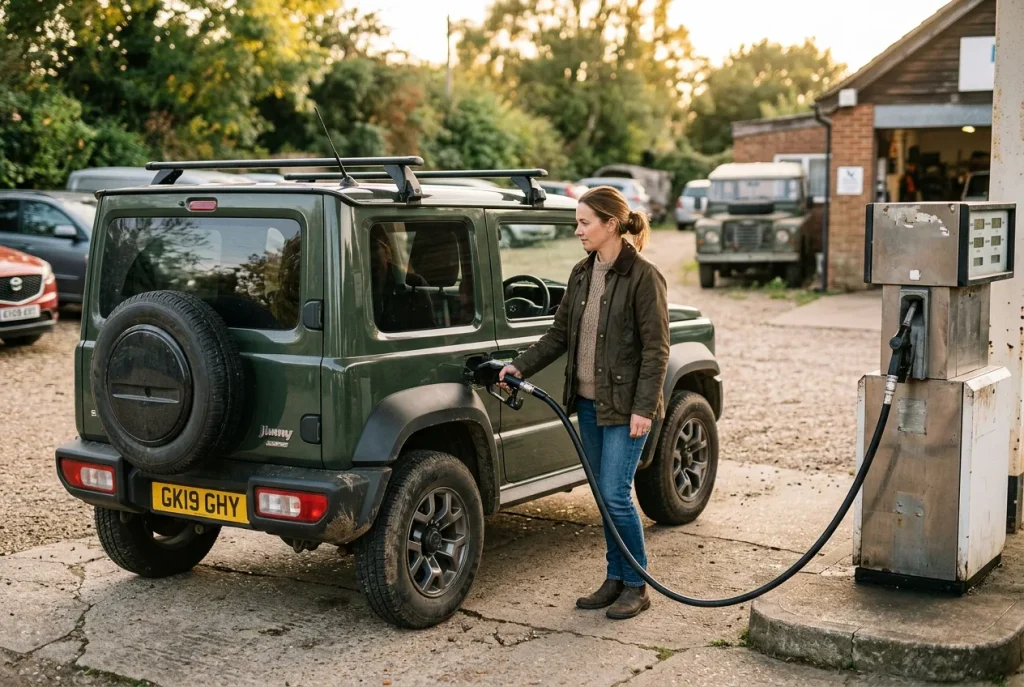
The JB74’s official combined figure is 6.4 L/100 km (manual) and 6.9 L/100 km (automatic). Real-world consumption is typically 6.8–7.5 L/100 km, rising with larger tyres, roof loads, and trail use. Over 15,000 km per year at current South African pump prices, that works out to roughly R18,000–R22,000 annually.
Fitting larger all-terrain tyres (215/75R15) adds approximately 0.5–1.0 L/100 km due to increased rolling resistance and weight — budget an extra R1,500–R3,000 per year if you upgrade. The naturally aspirated 1.5-litre engine is most efficient at steady speeds; the short wheelbase and boxy shape mean highway economy does not improve dramatically over town driving.
Free Jimny Tool
What will your Jimny really cost to own?
Fuel, insurance, tyres and servicing — get a realistic monthly and annual running-cost estimate in under a minute.
Insurance
Insurance is the largest swing factor in Jimny running costs. The vehicle’s small size, popularity, and enthusiast following make it a theft target in some areas, which pushes premiums up. Comprehensive cover for a new JB74 in Gauteng typically runs R1,100–R1,600 per month depending on driver age, claims history, security measures, and area.
To reduce premiums: fit an approved tracker and immobiliser before requesting a quote, park in a locked garage where possible, and shop around — insurers price the Jimny very differently. Declare any modifications (bull bars, roof racks, lifts) so fitted accessories are covered and claims are not complicated.
Servicing
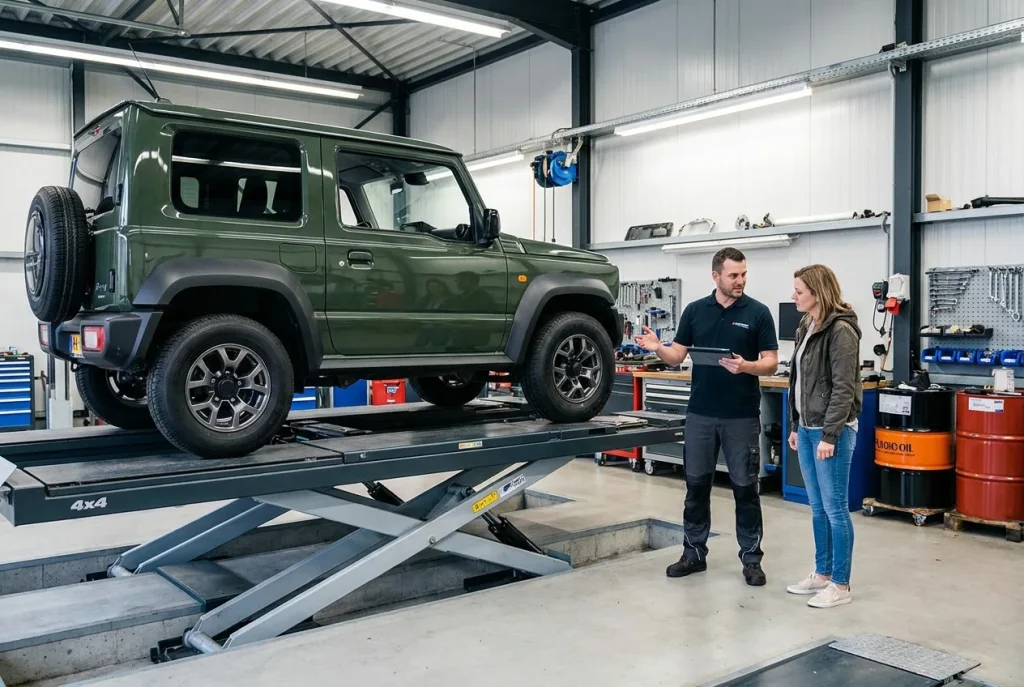
The Jimny’s 15,000 km / 12-month service interval is among the longest in its class, which keeps servicing costs low. A standard interim service (oil, filter, inspection) runs approximately R2,200–R3,500 at a Suzuki dealer. The major 60,000 km service (spark plugs, air filter, brake fluid, drivetrain fluids) is closer to R5,500–R7,500.
| Service | Interval | Approx. Cost |
|---|---|---|
| Interim service | 15,000 km / annual | R2,200–R3,500 |
| 30,000 km service | 30,000 km | R2,800–R4,200 |
| Major service (60,000 km) | 60,000 km | R5,500–R7,500 |
| Brake fluid | Every 2 years | Included in some services / R600–R900 standalone |
Owners comfortable with basic maintenance can reduce costs further. Oil changes, air filters, and cabin filters are straightforward DIY jobs — see our service schedule and maintenance guide. The third-generation JB23 is even cheaper to service thanks to its mechanical simplicity.
Tyres
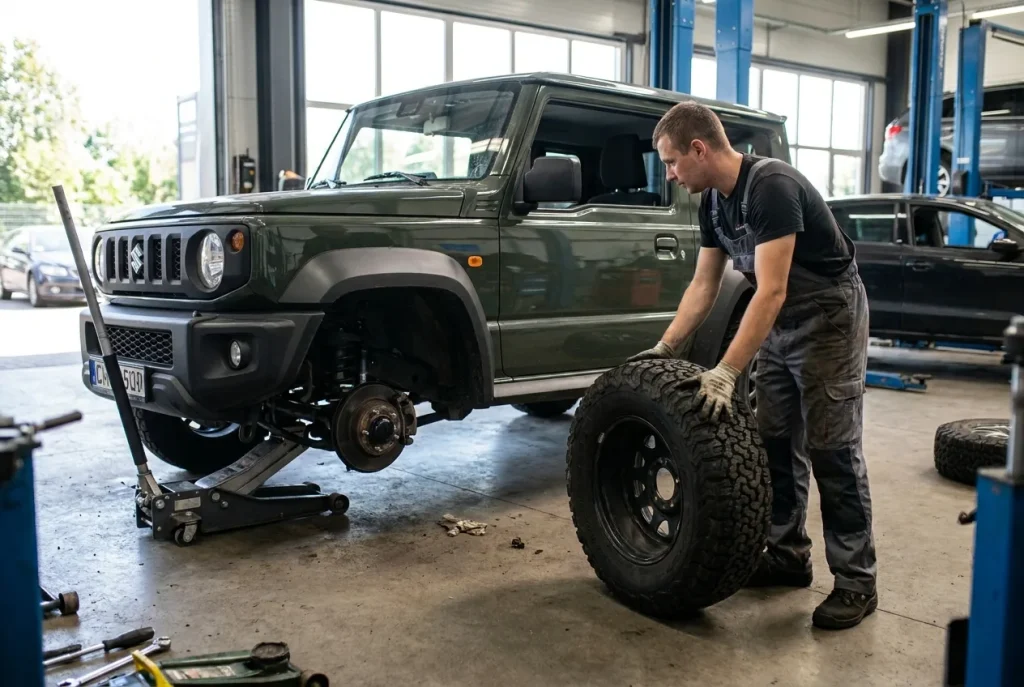
A quality all-terrain tyre set (215/75R15, five tyres including the spare) costs R9,500–R12,000 and lasts approximately 50,000 km under mixed use. Amortised over the tyre life and a 15,000 km annual mileage, that is roughly R2,000–R3,000 per year. Mud-terrain tyres wear faster (30,000–45,000 km) and cost more per kilometre — another reason all-terrains suit most owners.
Rotate tyres every 12,000–15,000 km to maximise life, and include the spare in a five-tyre rotation every 30,000 km. Correct tyre pressure (and avoiding sustained highway driving at off-road pressures) significantly extends tyre life.
Depreciation: The Jimny’s Hidden Advantage
Here is where the Jimny rewrites the running-cost equation. Most vehicles lose 40–60% of their value over five years. The Jimny loses far less — in periods of high demand and dealer waiting lists, low-mileage used examples have sold close to, or even above, their original new price.
This exceptional resale value means that while the Jimny’s month-to-month running costs are merely competitive, its total cost of ownership over several years is outstanding. The money you “lose” to depreciation — usually the single largest cost of car ownership — is minimal. For a detailed analysis, see our resale value guide.
Total Cost of Ownership Example
A realistic five-year ownership scenario for a new JB74 GLX in South Africa, driven 15,000 km annually:
| Cost over 5 years | Estimate |
|---|---|
| Fuel | R90,000–R110,000 |
| Insurance | R65,000–R95,000 |
| Servicing | R18,000–R28,000 |
| Tyres (1.5 sets) | R14,000–R18,000 |
| Licensing & sundries | R4,000–R7,500 |
| Depreciation (unusually low) | R40,000–R90,000 |
| Total 5-year cost of ownership | ~R231,000–R348,500 |
Compare this to most rivals, where depreciation alone over five years frequently exceeds R150,000–R250,000, and the Jimny’s total-cost advantage becomes clear. The numbers above are indicative — verify current fuel, insurance, and service pricing for your specific situation.
Frequently Asked Questions
How much does it cost to run a Suzuki Jimny per year?
For a JB74 driven 15,000 km per year in South Africa, realistic annual running costs (excluding finance and depreciation) are approximately R36,000–R50,000 — covering fuel, insurance, servicing, tyres and licensing. Insurance is the biggest variable, swinging widely by driver profile and region. When you factor in the Jimny’s exceptionally low depreciation, its total cost of ownership is outstanding for a capable 4×4.
What is the Jimny’s real-world fuel consumption?
The official combined figure is 6.4 L/100 km (manual) and 6.9 L/100 km (auto). Real-world consumption is typically 6.8–7.5 L/100 km depending on driving style, load and tyre size. Fitting larger all-terrain tyres adds roughly 0.5–1.0 L/100 km. The naturally aspirated 1.5-litre engine is most efficient at steady moderate speeds.
Why is Jimny insurance expensive?
The Jimny’s small size, popularity and enthusiast following make it a theft target in some areas, which pushes premiums up relative to its purchase price. To reduce costs, fit an approved tracker and immobiliser before requesting quotes, park in a locked garage where possible, and shop around — insurers price the Jimny very differently.
Is the Suzuki Jimny cheap to service?
Yes, relatively. The 15,000 km / 12-month service interval is among the longest in its class, keeping costs down. An interim service runs roughly R2,200–R3,500; the major 60,000 km service is R5,500–R7,500. The third-generation JB23 is even cheaper thanks to its mechanical simplicity, and basic maintenance is well within DIY reach.
Does the Jimny hold its value?
Exceptionally well — this is the Jimny’s standout ownership advantage. While most vehicles lose 40–60% over five years, the Jimny loses far less, and during periods of high demand low-mileage used examples have sold close to or above their new price. Low depreciation means the Jimny’s total cost of ownership is outstanding despite merely competitive month-to-month costs.
How much do Jimny tyres cost?
A quality all-terrain set of 215/75R15 tyres (five including the spare) costs R9,500–R12,000 and lasts around 50,000 km under mixed use — roughly R2,000–R3,000 per year amortised. Mud-terrain tyres cost more and wear faster. Regular rotation and correct tyre pressure significantly extend tyre life.
This article provides general information, not financial advice. Insurance, fuel and service costs vary by individual circumstances and over time — verify current figures for your situation before making a purchase decision.
Related Reading
Service Schedule & Maintenance
Keep servicing costs down with the right intervals and DIY jobs.
Free Newsletter
The Compact Conqueror Newsletter
Buying tips, mod guides, trail reports and Jimny news — free, every week.