

The Suzuki Jimny is unlike any other small 4×4 on the market. With a proper ladder-frame chassis, a part-time 4WD system with low-range transfer case, and three-link rigid axle suspension, it genuinely goes where most SUVs can not follow — and it does it in a body that fits in the tightest city parking bay.
Why the Jimny Stands Apart
Most modern soft-roaders are car-derived crossovers with traction control doing the heavy lifting. The Jimny is built on an entirely different philosophy: mechanical simplicity, real low-range gearing, and a body-on-frame construction that can be repaired in the field. That’s why Jimny owners talk about their cars the way Land Cruiser devotees talk about theirs.
The current JB74 generation (launched 2018) brought that philosophy into the modern era with a fuel-injected 1.5-litre K15B engine, LED lighting, a touchscreen head unit, and Euro 6-level emissions — without compromising the off-road hardware that made earlier generations legendary.
Every generation of Jimny has been over-engineered for the job it was sold to do. That’s not a flaw — it’s the whole point.
Compact Conqueror
Jimny Generations at a Glance
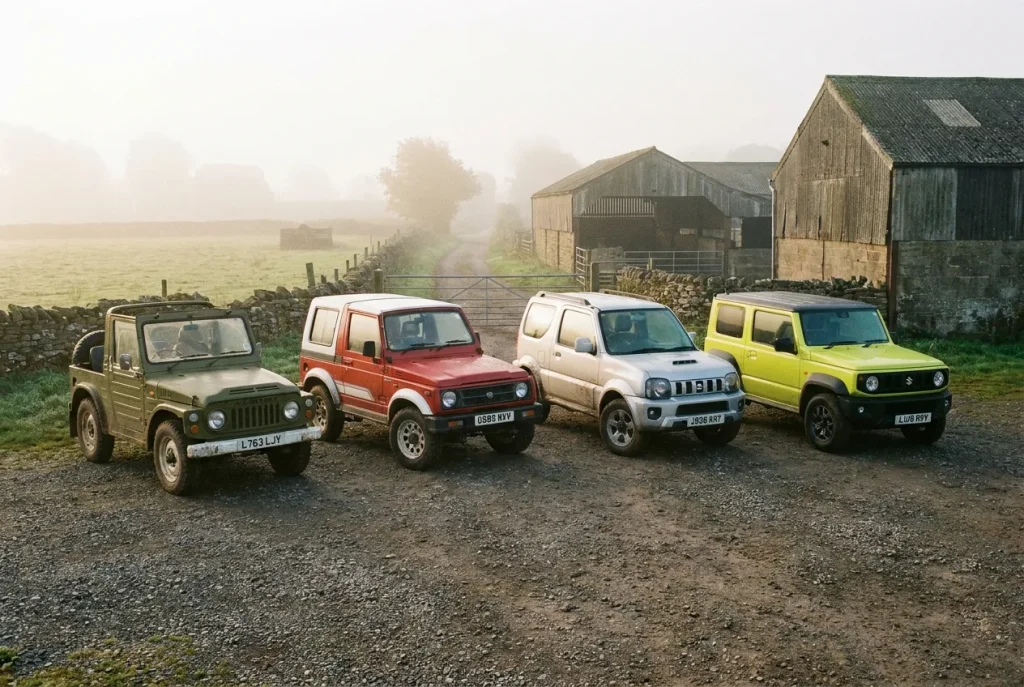
Understanding which generation you’re looking at is the first step in making a smart purchase. Each generation has its strengths, its quirks, and its common failure points.
| Generation | Years | Engine | Key Strengths | Watch Out For |
|---|---|---|---|---|
| SJ / Samurai | 1981–1998 | 1.0L carb / 1.3L EFI | Ultra-simple, parts everywhere, proven 4WD | Rust, carburettor issues, crash safety |
| JB23 | 1998–2018 | 1.3L K13B | Reliable, widely available, great aftermarket | Turbo conversions, 5th gear wear, rust sills |
| JB43 / Vitara | 2002–2013 | 1.6L | More power, better road manners | Less aftermarket, heavier body |
| JB64/74 | 2018–present | 1.5L K15B | Modern safety, LED, digital, Euro 6 | Waiting lists, 3-door only in some markets |
In South Africa the JB74 is the current market car. The JB23 market is active, with many examples still in daily use. SJ Samurais occupy a dedicated enthusiast niche with strong club support.
Free Jimny Tool
Not sure which Jimny to buy?
Compare the Samurai, JB23, JB43 and JB74 side by side — engines, dimensions, kit and what changed between generations.
New vs Used: How to Decide
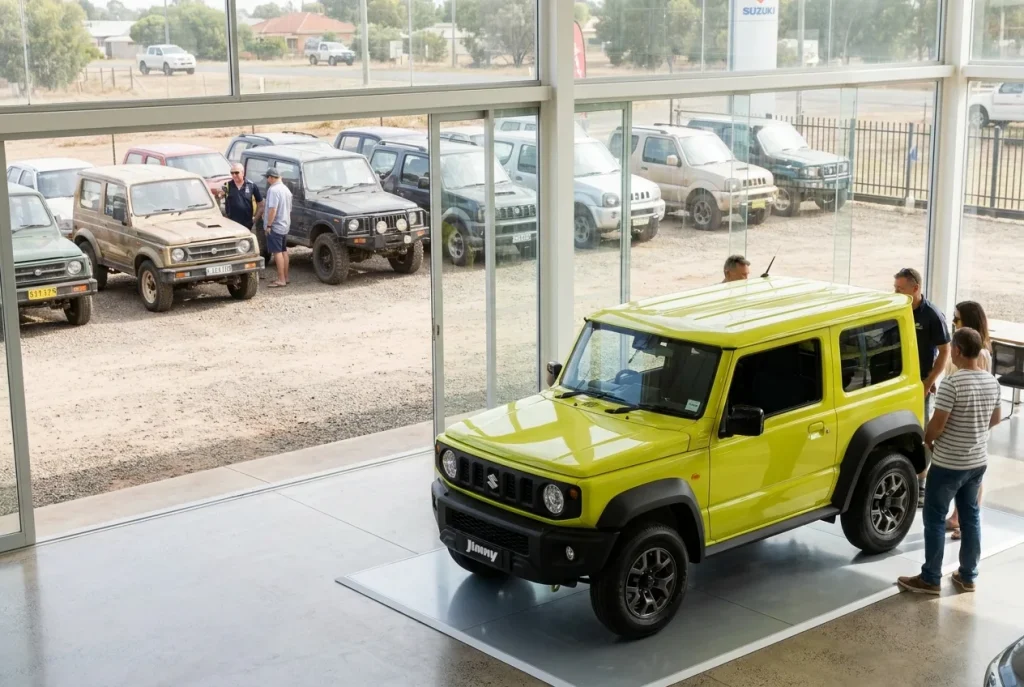
The right choice depends on your budget, how you plan to use the Jimny, and your appetite for maintenance projects.
Buying New (JB74)
A new JB74 gives you a full factory warranty (five years or 200,000 km in South Africa, for example), modern safety equipment (ABS, ESP and at least two airbags) and, on upper trims, Apple CarPlay / Android Auto and LED headlights. It scored three stars when Euro NCAP and ANCAP tested it in 2018, a rating that has since expired (the previous generation was never rated); our Jimny safety rating guide explains what that means. The K15B engine has a strong service record.
- Full manufacturer warranty — essential if you plan to finance
- Modern safety features including ESP and hill-hold
- Better fuel consumption than older generations (approx. 6.5–7.5 L/100 km)
- Access to Suzuki’s Official Accessories range for bolt-on upgrades
- Resale value has held remarkably well — JB74s retain value better than most competitors
Buying Used (JB23 or older JB74)
A well-maintained JB23 represents excellent value — especially in the R80,000–R140,000 bracket. The K13B engine is famously long-lived if it’s been serviced on time. Key pre-purchase checks:
- Rust inspection: sill panels, floor sections, spare-wheel carrier, and rear crossmember
- 5th gear engagement: JB23 5th gear can wear — check for jumping out under light load
- Service history: the K13B needs regular oil changes; neglected examples develop cam-chain noise
- 4WD engagement: test both 4H and 4L — they should engage cleanly and without grinding
- Check that the spare wheel mount is structurally sound — common rust trap
JB74 Variants Explained
Every JB74 shares the same drivetrain: the 1.5-litre K15B petrol engine (75 kW), AllGrip Pro part-time 4WD with low range, and a 5-speed manual or 4-speed automatic gearbox. What changes from one market to the next is the body, the trim names and the equipment.
- Body. The original 3-door is built in Japan. The longer 5-door, built in India since 2023, adds rear doors, more rear legroom and a far bigger boot for a little less agility off road. Our 3-door vs 5-door comparison covers the trade-off.
- Trim. Trim names differ by country (GL and GLX in South Africa, for example). Upper trims typically add a larger touchscreen with Apple CarPlay and Android Auto, LED headlights and extra airbags; the drivetrain never changes.
- Driver assistance. Some markets offer an optional safety pack with adaptive cruise control and emergency brake support, such as South Africa’s DSBS II pack on the 3-door GLX.
Because line-ups, equipment and prices vary so much by country, we cover them market by market in our buying guides for South Africa, the UK, Australia and India.
One naming note before you shop: in Japan the JB74 is sold as the Jimny Sierra, while the plain “Jimny” there is the narrower 660 cc kei-car JB64. If you are comparing imported listings or overseas reviews, our guide to the Jimny vs the Jimny Sierra explains what changes.
Financing and Total Cost of Ownership
The Jimny’s purchase price is only part of the picture. Smart buyers factor in insurance, fuel, service costs, and tyre wear before committing.
Service Costs
The JB74’s 15,000 km / 12-month service interval is among the longest in the segment. A standard Suzuki dealer service (oil, filter, inspection) runs approximately R2,200–R3,500 in South Africa depending on dealer and location. The 60,000 km major service (spark plugs, air filter, brake fluid, transmission oil) is closer to R5,500–R7,500.
Insurance Considerations
The Jimny’s small body, high ground clearance, and enthusiast community make it a target for theft in certain areas. Fit a quality immobiliser and tracker before your insurer even asks. Comprehensive insurance premiums in Gauteng typically run R1,100–R1,600 per month for a new JB74 depending on driver profile and security measures.
Fuel Costs
At 6.8 L/100 km combined (a realistic real-world figure for a JB74 with stock tyres), a 15,000 km annual driving pattern costs approximately R18,000–R21,000 in fuel at current South African pump prices. Fitting larger tyres adds rotational mass and aerodynamic drag — budget for an additional 0.5–1 L/100 km depending on tyre size.
Aftermarket Support and Community
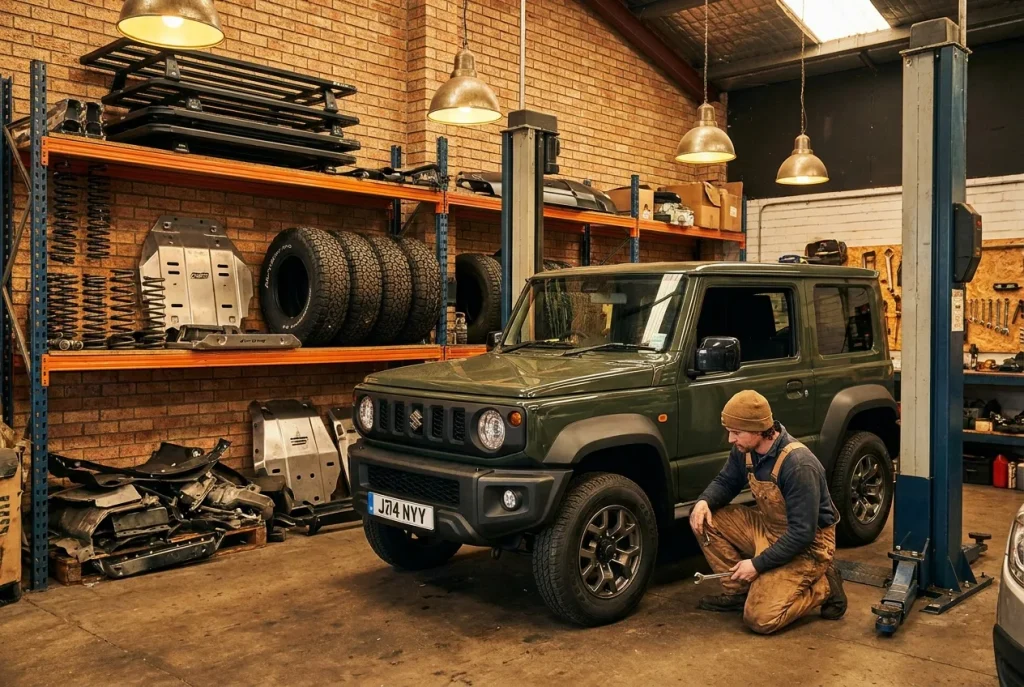
The Jimny’s global community is one of the most active of any 4×4 platform. South Africa has several dedicated Jimny clubs — Cape 4×4, Suzuki Jimny Club of South Africa, and numerous regional WhatsApp communities — that provide trail advice, technical support, and group buy access to imported accessories.
Aftermarket parts availability is excellent for the JB74. South African suppliers carry suspension lift kits, bash plates, roof rack systems, bull bars, and tyre upgrade packages. Japanese-spec JB74 parts (JB74W) are interchangeable with South African-spec cars, opening access to a massive global parts pool.
Read our Modifications hub for a full breakdown of the upgrade path, or start with our first-mods priority list if you’ve just taken delivery.
Should You Buy a Jimny?
The Jimny is not the right car for everyone. It has a small rear seat, limited luggage space, a choppy ride on tar at highway speeds, and a 1.5-litre engine that works hard on long climbs. If you need to carry four adults in comfort or tow a trailer regularly, look elsewhere.
But if you want a genuinely capable off-road machine that fits in a parking bay, costs less to run than a Defender, and connects you to one of the most passionate communities in motorsport — the Jimny is hard to beat at any price point.
Frequently Asked Questions
Is the Suzuki Jimny good for daily driving?
Yes, with caveats. The JB74 is comfortable for urban commuting and short highway runs. The small engine (75 kW) becomes noticeable on steep gradients or when fully loaded. For drivers whose daily route includes a long highway stretch, the automatic gearbox smooths the experience significantly. Most owners report that the Jimny’s compact dimensions and parking ease more than compensate for the highway limitations.
How reliable is the Suzuki Jimny?
Extremely reliable for a modern vehicle. The K15B engine shares architecture with Suzuki’s proven Swift platform. JB23s with 300,000+ km on original engines are well-documented. The main reliability factors are: regular oil changes (do not stretch intervals), prompt attention to timing chain noise, and rust prevention on body panels and underbody.
Can the Jimny tow a trailer?
The JB74 has a 1,300 kg braked tow rating (350 kg unbraked), which is enough for a light boat, a bike trailer or a small camper. The 1.5-litre engine will feel the load on mountain passes. JB74 towbars are typically rated for 75 kg on the ball, so check the plate on yours, and run the fully laden tyre pressures on tar. Do not use 4WD on tar while towing. Our Jimny towing guide covers the South African trailer-brake and licence rules.
What is the difference between 4H and 4L on the Jimny?
4H (4 High) is for loose, slippery, or uneven surfaces at normal speeds — sand, gravel, light mud, wet grass. 4L (4 Low) provides additional torque multiplication for very steep climbs, rock crawling, deep mud, or recovery situations. The Jimny’s AllGrip Pro system is a part-time setup: only use 4WD on surfaces where wheel slip is expected — engaging 4WD on dry tar causes drivetrain stress.
How much does a new Jimny cost?
It depends on the country and the body style. In South Africa, Suzuki Auto SA list prices run from R439,900 to R489,900 (October 2026). Our buying guides for South Africa, the UK, Australia and India break the prices down by derivative. Wherever you buy, ask the dealer about waiting lists for popular colours.
What is the Jimny’s fuel consumption?
The official combined cycle figure is 6.4 L/100 km for the manual and 6.9 L/100 km for the automatic. Real-world consumption typically comes in at 6.8–7.5 L/100 km depending on driving conditions, tyre size, and load. Fitting 215/75R15 all-terrain tyres will add approximately 0.5–1 L/100 km versus stock.
Is the Jimny good for off-road beginners?
Yes. The Jimny’s compact dimensions mean it rarely encounters obstacles too large to manage, and the AllGrip Pro low-range system is progressive and forgiving. The enthusiast community actively mentors new owners — joining a club or group trail run is the fastest way to learn the car’s capabilities. Start with graded dirt roads and build from there.
Related Reading
First Jimny Mods: The Priority List
Exactly which upgrades to buy first, in what order, and why — with budgets for every bracket.
Jimny Service Schedule & Maintenance Guide
Every service interval, fluid spec, and DIY job explained for the JB74 and JB23.
Jimny Off-Road Technique Guide
From sand driving to rock crawling — use the Jimny’s hardware to its full potential.
Free Newsletter
The Compact Conqueror Newsletter
Mod guides, trail reports, maintenance reminders and Jimny news — free, every week.
Generation-Specific Buyer’s Guides
Ready to go deeper on a specific generation? Each guide covers prices, common faults and what to check: