
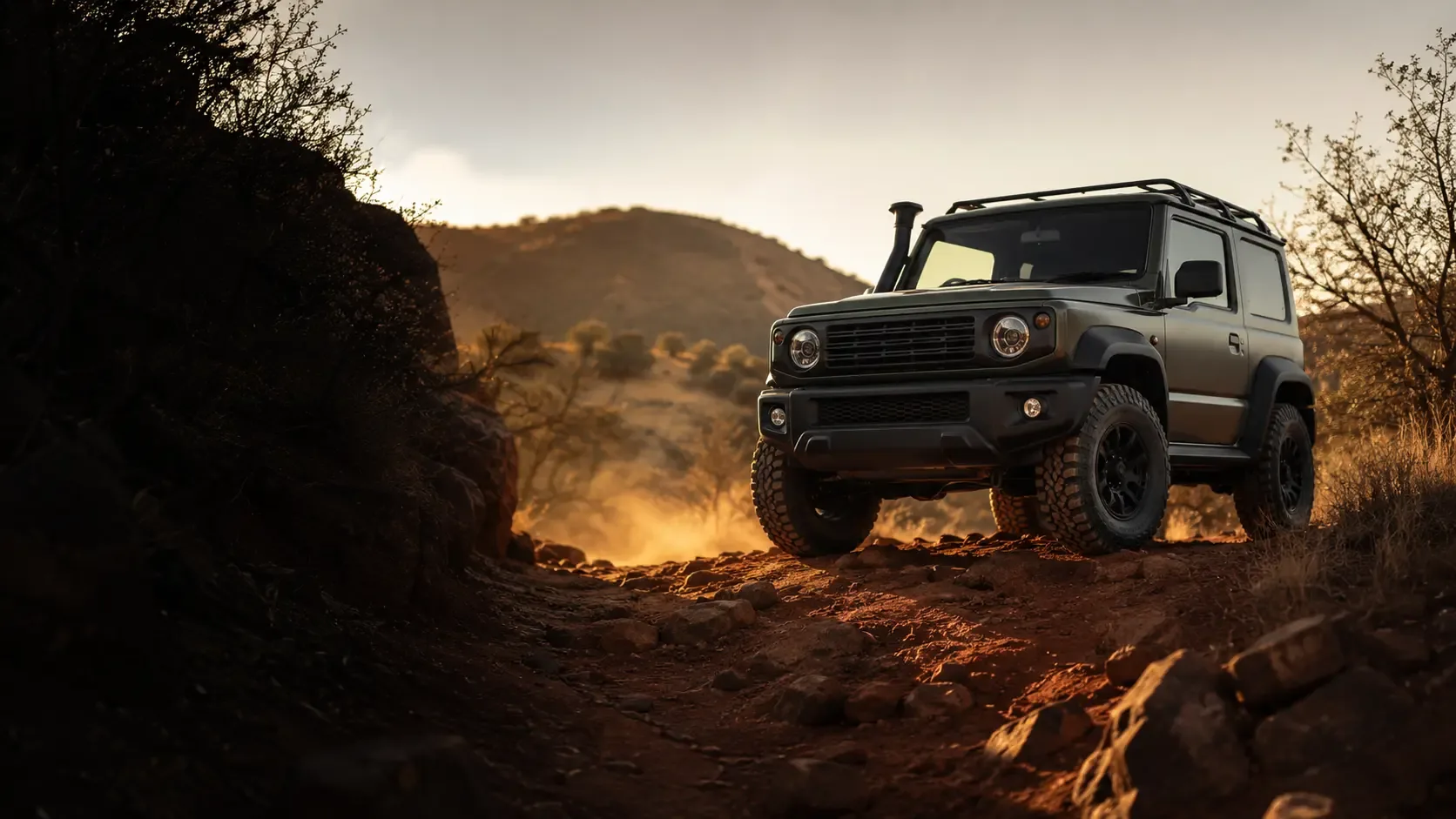
Buying Guide · JB43 (1998–2018)
Suzuki Jimny JB43
Buyer’s Guide
The export, bigger-engined third-generation Jimny — the sensible used buy. More usable than the kei JB23, sold new around the world (so no import faff), and now great value. Here’s what to know and what to check.
Last updated: 23 June 2026 · A Compact Conqueror buying guide
The JB43 is the export version of the third-generation Suzuki Jimny — the same coil-sprung, rigid-axle, low-range platform as the Japanese kei JB23, but fitted with a larger 1.3-litre four-cylinder petrol engine instead of the 660 cc turbo triple. It was sold new across Europe, Australia and many other markets from 1998 to 2018, simply badged “Jimny.” That makes it the easy-to-own third-gen: more flexible to drive, and (unlike the JB23) usually a locally-sold used car with proper paperwork rather than a grey import.
For the kei sibling see the JB23 guide; for the original leaf-sprung classic, the Samurai (SJ) guide; and for the current model, the JB74 Complete Guide.
In a hurry? Jump to the specs, what to check, the verdict or the FAQ. Heading to a viewing? Take the free pre-purchase checklist.
What Is the Suzuki Jimny JB43?
Mechanically, the JB43 is pure Jimny: a separate ladder chassis, rigid (solid) axles front and rear on coil springs with a three-link layout, and a part-time four-wheel-drive system with low range (many cars use Suzuki’s push-button “Drive Action 4×4” selection). The difference from the JB23 is under the bonnet: a normally-aspirated 1.3-litre four cylinder in place of the kei turbo triple, giving more relaxed, flexible performance without needing to be revved on boost.
It’s a little longer and heavier than the kei car, which slightly softens the ultimate agility but makes it more comfortable to live with. Over its long life it received facelifts, equipment updates and emissions changes, so later cars are better equipped and usually less rusty.
Specifications at a Glance
Indicative figures for the export third-gen JB43. Exact engine, equipment and dimensions vary by market and year — always confirm for the specific car.
| Specification | Detail |
|---|---|
| Generation | Third-gen Jimny (JB43, export) |
| Years | 1998 – 2018 |
| Engine | 1.3L four-cylinder petrol (M13A; earlier cars used the 1.3 G13BB) |
| Power | ~63 kW (85 hp) |
| Torque | ~110 Nm |
| Transmission | 5-speed manual or 4-speed automatic |
| Drivetrain | Part-time 4WD with low range |
| Suspension | 3-link rigid axles, coil springs (front & rear) |
| Length × Width × Height | ~3,645 × 1,600 × 1,705 mm |
| Wheelbase | 2,250 mm |
| Kerb weight | ~1,060 kg |
| Ground clearance | ~190 mm |
| Fuel tank | 40 litres |
| Seats | 4 |
Figures are indicative and market-dependent. Engine badging in particular varied across the JB43’s long production run.
Engine & Driving
The 1.3-litre is the JB43’s headline advantage over the kei JB23. It’s still modest — around 63 kW — and the boxy, four-wheel-drive body means it’s no quicker than brisk, but it delivers its power more naturally across the rev range, so you don’t have to keep it on the boil. Around town and on back roads it feels adequate; at sustained motorway speeds it’s working hard and gets noisy, like every Jimny. Off-road, the coil-sprung axles, low range and light weight make it genuinely capable.
Off-road tip: the JB43 is part-time 4WD with no centre differential — engage four-wheel drive on loose surfaces only, and stay in 2WD on dry tar to avoid transmission wind-up.
What to Check Before You Buy
The JB43 is mechanically tough, but it’s an older car now, so condition decides everything. Concentrate here:
- Rust — the number-one issue. Check the rear arches, sills, floors, tailgate and especially the ladder chassis. Structural chassis rot is a walk-away.
- Timing chain — the 1.3 (M13A) uses a chain; listen for a rattle on cold start that signals a tired chain or tensioner.
- 5th-gear wear — high-mileage manuals can whine in or jump out of fifth on a motorway run.
- 4WD system — select 4H and 4L (per the handbook), confirm clean engagement with no warning lights, and that it returns to 2WD properly.
- Service history & fluids — look for evidence of regular oil changes; budget to refresh transfer case and diff oils if there’s no record.
- Modifications — many have lifts, tyres or bull bars fitted; check the quality of the work and that it’s declared to your insurer.
Take the free, printable Jimny Buyer’s Checklist to every viewing. Many third-gen weak points are shared with the kei car, so the JB23 Common Problems guide is a useful companion read.
Living With a JB43 & Running Costs
As an everyday proposition the JB43 is the pick of the third-gen Jimnys: usable performance, simple cheap mechanics, low insurance and famously strong resale value. The trade-offs are the usual Jimny ones — a firm, bouncy ride, busy motorway manners, four seats and a small boot. Fuel economy is reasonable rather than great for the engine size, thanks to the brick-like aerodynamics.
Want your own numbers? Use the Running Cost Calculator. Considering bigger tyres or a lift? The Tyre Size Calculator shows the speedo and gearing impact, and our modifications guides cover the popular upgrades.
Pricing & Value
Because it was sold new in so many markets, the JB43 is generally easier and cheaper to buy than an imported JB23, with the bonus of local history and parts support. Like every Jimny it holds its value strongly, so good ones aren’t cheap — and as always, condition beats mileage: a rust-free, well-kept higher-mileage car is a far better buy than a tatty low-mileage one.
Prices vary widely by country, condition and year, so we don’t quote figures here. Compare the generations with the Comparison Tool, and see the general Buyer’s Guide for the wider market.
Is the JB43 Right for You?
If you want a usable, affordable, genuinely capable third-generation Jimny without the import paperwork of a kei JB23 — and you can live with the Jimny compromises — the JB43 is the sensible sweet spot. If you want maximum fuel-sipping kei character (or maximum tuning potential), the turbo JB23 still tempts; for modern safety and equipment, step up to the JB74.
Why owners love it
- More flexible 1.3 engine than the kei turbo
- Sold new locally — proper history, no import faff
- Coil-sprung rigid axles: capable and comfier than the Samurai
- Cheap, simple mechanics; strong resale value
- Big aftermarket and owner community
Watch-outs
- Still modest power — busy and noisy at speed
- Rust is common; chassis rot can be terminal
- Four seats and a small boot
- Firm, bouncy ride and vague steering
- Thirstier than the engine size suggests
The JB43 is the easy-to-own third-gen Jimny — just buy the most rust-free, best-documented car you can find.
Compact Conqueror verdict
Frequently Asked Questions
What’s the difference between the JB43 and JB23?
They’re the same third-generation Jimny. The JB43 is the export model with a 1.3-litre four-cylinder engine; the JB23 is the Japan-market kei car with a 660 cc turbo triple. The JB43 was sold new in many countries, so it’s usually a local used car rather than a grey import.
Is the JB43 a good first 4×4?
Yes. It’s affordable, simple, cheap to run and genuinely capable off-road, with a huge support community — ideal for learning, provided you buy a structurally sound, rust-free example.
How much power does the JB43 have?
Around 63 kW (85 hp) from its 1.3-litre engine. It’s modest but usable, and more flexible to drive than the kei JB23’s peaky turbo triple.
What are the common JB43 problems?
Rust (arches, sills and chassis above all), timing-chain rattle on the 1.3, worn fifth gear on high-mileage manuals, and the usual age-related niggles. Inspect underneath thoroughly before buying.
Manual or automatic?
The five-speed manual is the keen choice and is a little better on performance and economy; the four-speed automatic is easier in traffic but blunts the already-modest performance. Both are equally capable off-road.
Is the JB43 a good daily driver?
In town, yes. On long motorway commutes the noise, busy ride and small boot wear thin. Many owners use it as a second car, weekend vehicle or capable runabout.
Next steps
Found one to view? Take the free Jimny Buyer’s Checklist and read the third-gen common problems. Comparing the generations? Use the Comparison Tool or browse all our buying & ownership guides.
This guide is general information only, not buying, mechanical or financial advice. Specifications, equipment and pricing vary by market and model year — always verify the details for the specific vehicle and region you’re considering.