

A Jimny is a simple, robust vehicle — but a used one can hide expensive surprises if you don’t know where to look. This is the exact inspection process we use, broken into the areas that matter most: chassis and rust, drivetrain, engine, off-road wear, and paperwork. Take this checklist to every viewing. The 30 minutes it takes can save you tens of thousands of rand.
Before You Go: Three Rules
- Always inspect in daylight and dry conditions. Rain hides paint defects and rust; darkness hides everything. Reschedule rather than viewing a wet car at dusk.
- Insist on a cold start. Ask the seller not to warm the engine before you arrive. Many faults — timing chain rattle, smoke, rough idle — only show on a genuinely cold engine.
- Bring a torch, a magnet (wrapped in cloth), and old clothes. You will be getting underneath the vehicle. A magnet helps detect body filler over rust repairs.
The most expensive Jimny is the cheap one that needed everything. Condition beats price every time — walk away from a bargain hiding rust.
Compact Conqueror
1. Chassis & Rust (Priority #1)
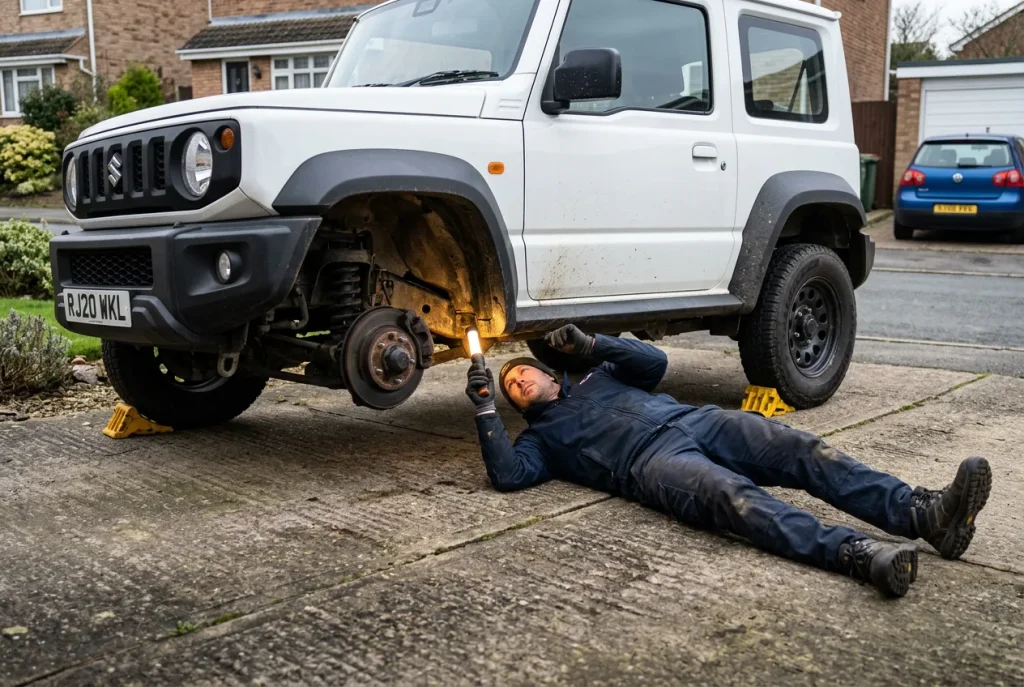
On any Jimny — and especially older JB23 and SJ examples — rust is the single most important inspection. Structural rust in the ladder-frame chassis is expensive or terminal. Check every item:
- ☐ Ladder-frame chassis rails — probe for scale rust, flaking, and perforation
- ☐ Chassis crossmembers — particularly where mud and water collect
- ☐ Sill panels (rockers below the doors) — press firmly for soft, bubbling metal
- ☐ Floor pans — lift the carpets and mats and inspect underneath
- ☐ Rear wheel arches and quarter panels — common rust origin
- ☐ Tailgate-mounted spare wheel carrier point — a classic Jimny rust trap
- ☐ Suspension mounting points — check for corrosion around bolts and brackets
- ☐ Body mounts — where the body attaches to the chassis frame
2. Drivetrain & 4WD System
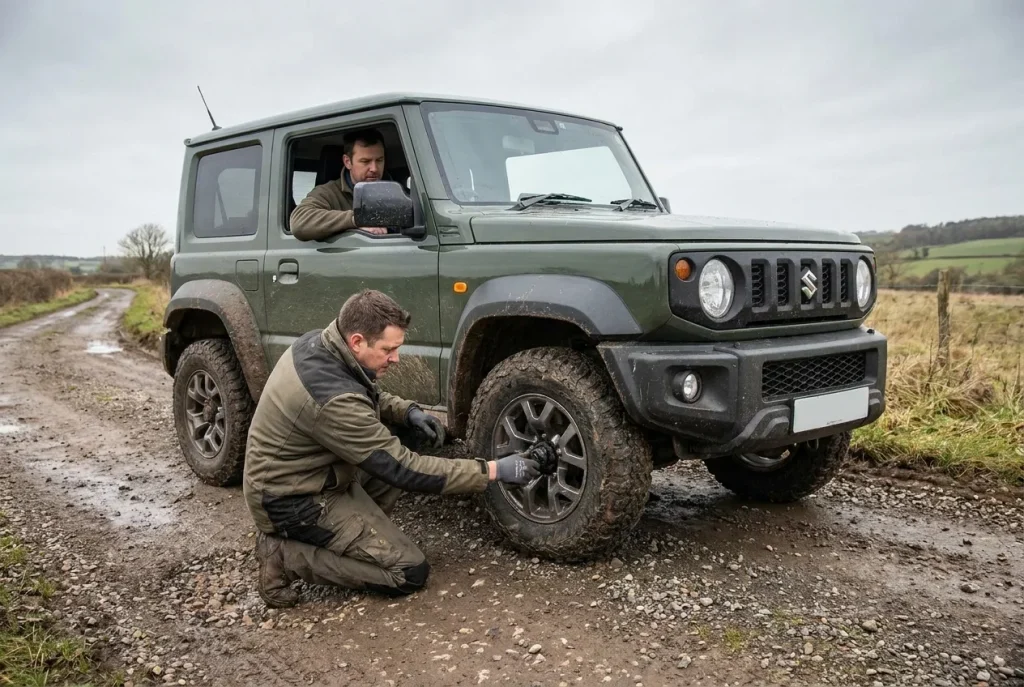
The Jimny’s 4WD hardware is robust but expensive to repair. Confirm it all works:
- ☐ Engage 2H, 4H and 4L — each should select cleanly without grinding (test 4L stationary or at walking pace)
- ☐ Listen for clunks or whining from the transfer case during the test drive
- ☐ On manuals: test 5th gear at highway speed under light load — confirm it does not pop out
- ☐ Check the clutch bite point (manual) — high or slipping bite suggests wear
- ☐ Automatic: confirm smooth shifts with no flaring or harsh engagement
- ☐ Listen for differential whine front and rear at steady speed
- ☐ Check freewheeling hubs (older models) operate correctly
3. Engine & Mechanical
- ☐ Cold start — listen for timing/cam chain rattle that persists beyond a few seconds
- ☐ Check exhaust smoke on start and under acceleration (blue = oil, white = coolant, black = fuelling)
- ☐ Inspect the oil cap and dipstick for milky residue (head gasket / coolant ingress)
- ☐ Check coolant condition and level — rusty or low coolant is a warning sign
- ☐ Listen for tappet noise, knocking, or rough idle
- ☐ Confirm the service history — regular oil changes are critical for Jimny longevity
- ☐ Check for oil leaks around the sump, rocker cover and transfer case
4. Off-Road Use & Modifications
A Jimny that has been off-roaded hard, or modified poorly, carries hidden costs. Inspect for evidence:
- ☐ Underbody impact marks, bent skid plates, or scraped sills (hard trail use)
- ☐ Damaged or leaking differentials and transfer case (rock strikes)
- ☐ If lifted: confirm the work was done professionally and CV angles / brake lines are appropriate
- ☐ Aftermarket tyres — check whether they affect the speedo reading and whether the spare matches
- ☐ Wiring quality for any auxiliary lights or accessories (poor wiring is a fire risk)
- ☐ Suspension condition — leaking shocks, sagging springs, worn bushes
5. Body, Interior & Electrics
- ☐ Panel gaps — uneven gaps suggest accident repair
- ☐ Use the magnet on lower panels — reduced magnetic pull indicates body filler over rust
- ☐ Test all electric windows, central locking, and the air conditioning (cooling performance)
- ☐ Test the infotainment, CarPlay/Android Auto, and all dashboard warning lights
- ☐ Check the condition of seats, seatbelts (including retraction) and trim
- ☐ Confirm both keys are present and the immobiliser functions
6. Paperwork & Legal

- ☐ Confirm the VIN matches the registration document and the chassis plate
- ☐ Verify the service history and any major work invoices
- ☐ Check for outstanding finance (a verification check protects you from inheriting debt)
- ☐ For grey imports: confirm legal registration, roadworthy status, and parts availability
- ☐ Confirm the roadworthy certificate status and licence currency
- ☐ Cross-check the odometer reading against service records for consistency
Free Download
Get the Printable Pre-Purchase Checklist
Take all 27 inspection points to the viewing on one page. Free with newsletter signup.
After the Inspection: The Test Drive
A structured test drive confirms what the static inspection suggested. Cover these conditions:
- Cold pull-away: Listen and feel for clutch, gearbox, and engine behaviour from cold
- Highway speed: Test for vibration, tracking (does it pull?), 5th gear retention, and wind/road noise
- Low-speed manoeuvring: Steering play, turning circle, brake feel
- 4WD engagement: On a safe loose surface, confirm 4H and 4L engage and disengage cleanly
- Braking: Firm stop from speed — check for pulling, vibration, or a spongy pedal
Frequently Asked Questions
What is the most important thing to check when buying a used Jimny?
Rust — specifically structural rust in the ladder-frame chassis. On any older Jimny (JB23 and SJ especially), corrosion in the chassis rails, floor pans, sills and the tailgate spare wheel mount can be expensive or terminal. Always inspect underneath with a torch, probe suspect areas, and prioritise a rust-free example over a cheaper rusty one.
Should I get a pre-purchase inspection done by a mechanic?
For a significant purchase, yes — particularly if you are not confident assessing chassis condition and drivetrain function yourself. A 4×4-experienced mechanic can identify issues you might miss, and the inspection fee (typically a few hundred rand) is trivial against the cost of a hidden fault. Use this checklist for your own initial screening, then commission a professional inspection on a shortlisted car.
How do I test the Jimny 4WD system when buying?
On a safe, loose surface (gravel or dirt), engage 4H while moving slowly and confirm it selects without grinding. Bring the vehicle to a stop or walking pace to engage 4L. Both should engage and disengage cleanly. Listen for clunks or whining from the transfer case. Never test 4WD modes on dry tar — it stresses the drivetrain and is poor practice.
What does timing chain rattle on a Jimny sound like?
A metallic rattling or chattering noise on cold start, typically lasting a few seconds before the oil pressure builds. On the JB74, a brief rattle on early units relates to the timing chain tensioner (addressed by Suzuki). On older M13A engines, a persistent or worsening rattle indicates cam chain and tensioner wear. Always start the engine from genuinely cold to assess this.
Is it safe to buy a modified Jimny?
It can be, if the modifications were done well. The risk is poorly executed work — a cheap suspension lift that binds the CV joints, badly wired accessories, or hard off-road use that has damaged the drivetrain. Inspect modifications carefully, ask who did the work and whether invoices exist, and factor any concerns into your offer. A professionally built Jimny with documentation can be excellent value.
How long should a used Jimny inspection take?
Budget at least 30–45 minutes for a thorough inspection, plus a 15–20 minute test drive. Rushing the inspection is how expensive surprises slip through. If the seller is impatient or reluctant to allow a cold start, a proper underbody inspection, or a full test drive, treat that as a warning sign.
Related Reading
JB23 Buyer’s Guide
Generation-specific issues to watch when buying the affordable classic.
Free Newsletter
The Compact Conqueror Newsletter
Buying tips, mod guides, trail reports and Jimny news — free, every week.
Free Jimny Tool
Not sure which Jimny to buy?
Compare the Samurai, JB23, JB43 and JB74 side by side — engines, dimensions, kit and what changed between generations.