

Buying & Ownership
Land Cruiser, Wrangler, Defender, Prado, a double-cab bakkie — every Jimny buyer cross-shops at least one of them, and every big-4×4 buyer secretly wonders about the little Suzuki. Here’s the honest, spec-backed comparison for adventure travel: where size wins, where it loses, and how to choose.
This is the debate at every 4×4 campfire, and the truthful answer comes first: neither is “better”. They’re different tools optimised for different adventures, and the overlap is smaller than either camp admits. What follows is a framework grounded in published measurements and touring economics, not badge loyalty. (If your shortlist is specifically the Jeep, we’ve done a dedicated head-to-head: Jimny vs Wrangler.)
The capability question: geometry vs grunt
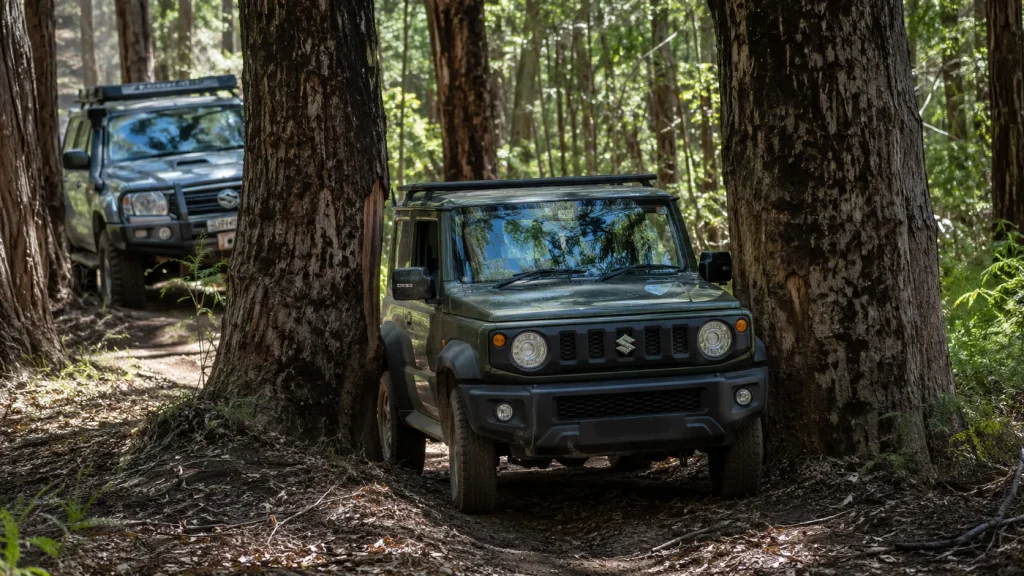
Off-road ability isn’t one number — it’s geometry, weight, traction and momentum. On geometry, the Jimny punches absurdly above its price. Autocar’s instrumented Jimny-vs-Land-Cruiser comparison recorded the Suzuki’s approach, breakover and departure angles at 37°, 28° and 49° — and noted that even a Jeep Wrangler, with a superior 44° approach, can’t match the Jimny’s breakover or its towering departure angle. At roughly 1,135 kg against the Land Cruiser’s 2,055 kg in that test, the Jimny floats where heavy vehicles dig, and it fits between trees and down narrow tracks the big machines physically cannot enter.
Where the big 4x4s answer back is depth, torque and endurance. That same comparison measured the Land Cruiser’s 700 mm wading depth at roughly double the Jimny’s, and the difference in effortless progress is real: a modern large 4×4 rides a wave of low-rev torque (a Land Cruiser 300’s diesel V6 makes 227 kW and 700 Nm against the Jimny’s 75 kW and 130 Nm, per CarsGuide’s comparison), while the Jimny works its low-range gearing and momentum. Both get through astonishing terrain; the big truck does it with less drama, the Jimny with more agility and a far smaller footprint of consequence when things go wrong.
The numbers that actually decide it
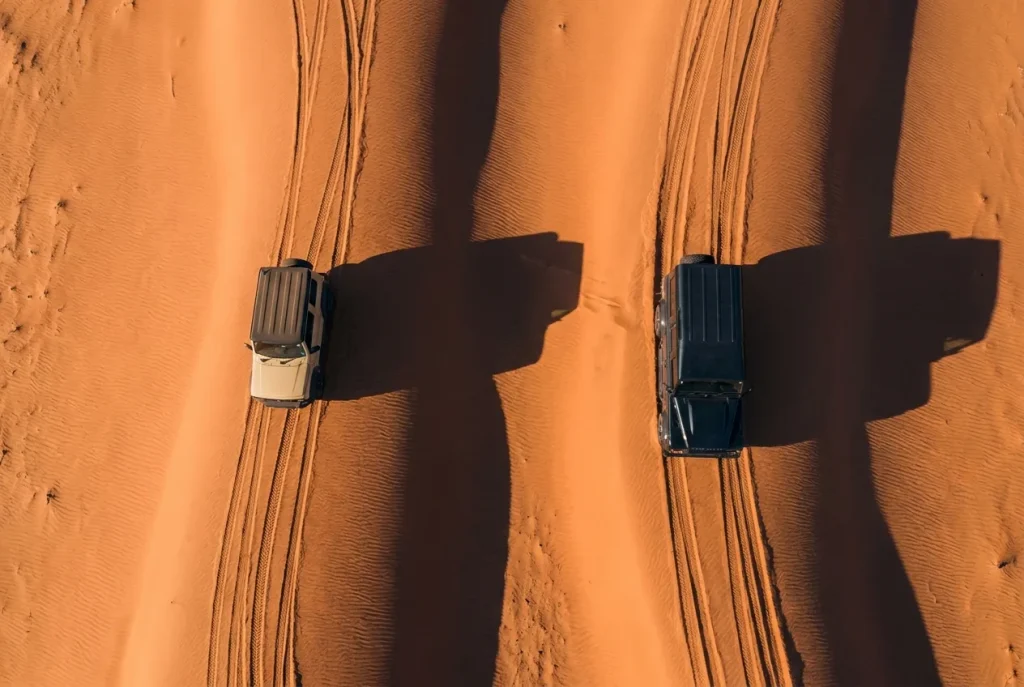
| Factor (typical figures) | Suzuki Jimny (JB74 3-/5-door) | Large ladder-frame 4×4 (LC300/Prado/Wrangler/Defender class) |
|---|---|---|
| Purchase price (new) | R440k–R490k / A$32k–39k | 2.5–4× the Jimny, commonly more |
| Kerb weight | ~1,090–1,200 kg | ~2,000–2,700 kg |
| Power / torque | 75 kW / 130 Nm | 150–250+ kW / 450–700 Nm |
| Off-road geometry | 37° / 28° / 49° — class-leading breakover & departure | Strong, but longer bodies cost breakover; deeper wading |
| Seats + touring payload | 2 comfortably (4 in 5-door), ~350 kg payload | 5–7 people, 600–800 kg payload, 2,500–3,500 kg towing |
| Touring range | 350–450 km (40L tank) | 700–1,300 km (80–140L tanks) |
| Fuel & running costs | Small-car servicing, tyres, insurance | Every consumable costs 2–3× more |
| Highway comfort & safety kit | Adequate; noisy at speed; 3-star (2018, expired) rating | Excellent refinement; current 5-star ratings common |
| Resale strength | Best-in-market retained value (AADA/AutoGrab data) | Land Cruiser/Hilux also excellent; most others ordinary |
Where the Jimny is the right adventure vehicle
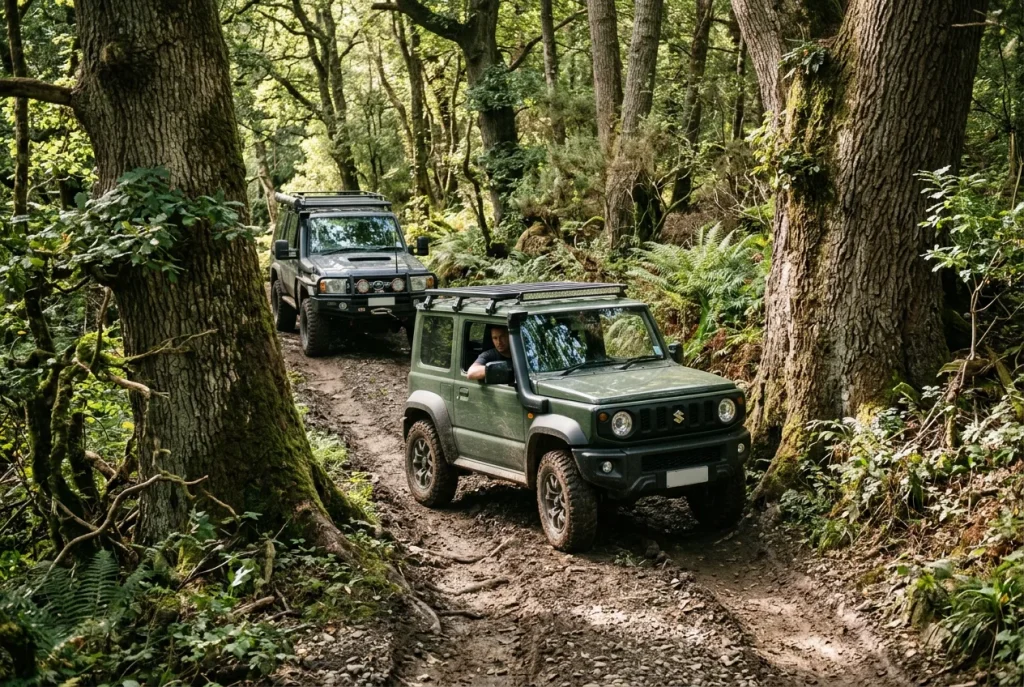
- One or two travellers, light gear. Everything the big truck offers that you’d actually use, at a third of the cost — and change left over for the trips themselves.
- Technical, tight or soft terrain. Narrow forest tracks, dune fields, rocky kloofs: low mass and short overhangs beat torque here. It’s why experienced hands describe the Jimny picking through terrain that forces bigger vehicles to bludgeon.
- Dual-purpose life. If the same vehicle must park in the city Monday to Friday, nothing else combines daily ease with weekend capability like this.
- Budget honesty. Purchase, fuel, tyres, insurance and the class-leading resale we unpack in our depreciation analysis make total ownership cost a fraction of any large 4×4’s.
Where the larger 4×4 is the right call
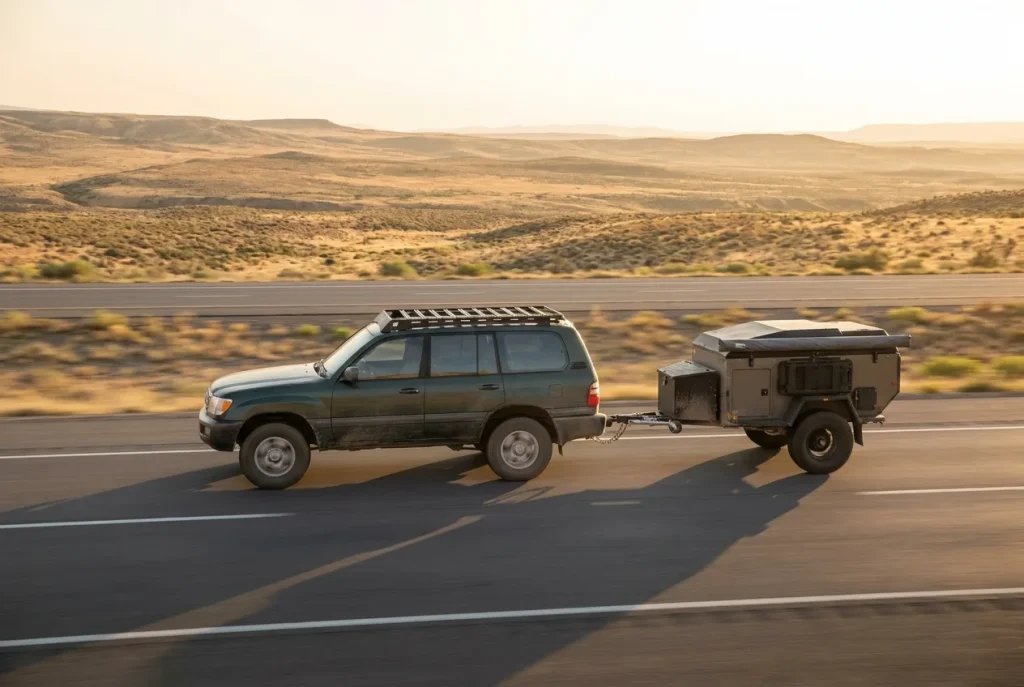
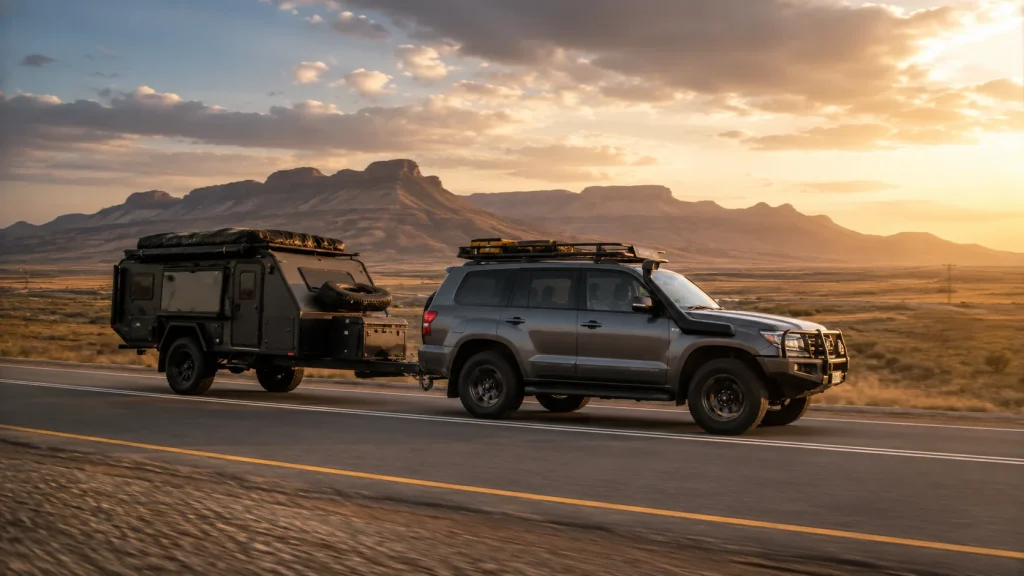
- Family expedition touring. Four-plus people, fridges, rooftop tents, trailers: payload and towing capacity aren’t negotiable, and the Jimny’s ~350 kg limit rules it out. A Land Cruiser, Prado, Everest or well-built double-cab is the honest answer.
- Huge highway distances at pace. Effortless 120 km/h cruising, long-range tanks and modern refinement matter over 1,000 km days in a way no Jimny setup replicates.
- Deep-water, high-load remote work. Greater wading depth, underbody mass tolerance and 600 kg+ of legal payload make big trucks the tool for expedition logistics.
- Occupant protection priorities. Current large 4x4s carry modern five-star ratings and far more crash structure — a legitimate deciding factor for family buyers, as we discussed frankly in the Jimny’s downsides.
Buy the big 4×4 for what you carry. Buy the Jimny for where you go. Confusing the two is how people end up with the wrong truck.
Compact Conqueror
The rivals, briefly ranked against the Jimny
Toyota Land Cruiser / Prado: the expedition benchmark — unmatched load-hauling endurance and support network; the Jimny counters with agility, cost and charm. Toyota’s incoming Land Cruiser FJ (due from mid-2026) is aimed squarely at the space between the two — the first credible attempt to challenge the Jimny’s compact-ladder-frame monopoly, and one to watch before you sign anything. Jeep Wrangler: the closest philosophical rival; more power, more width, more money — full comparison here. Land Rover Defender: brilliant and luxurious, now a monocoque tech showcase at several times the price. Double-cab bakkies (Hilux/Ranger class): the practical all-rounders — superior load and towing, but longer, heavier and less agile on tight trails, with breakover angles the short Jimny simply laughs at.
The two-vehicle truth nobody markets
Here’s the pattern we see constantly in the community: households that can justify it end up with both — a large 4×4 or bakkie for family expeditions and towing, and a Jimny for daily duty and the technical fun the big truck is too precious or too wide for. The Jimny’s low running costs and barely-there depreciation make it an unusually cheap second vehicle to keep. If it must be one vehicle, answer three questions honestly: How many people and how much gear on your typical trip (not your fantasy trip)? What share of your driving is open highway? And does anything you tow exceed 1,300 kg braked? Your answers decide this comparison in about thirty seconds.
Verdict: which is right for your adventure?
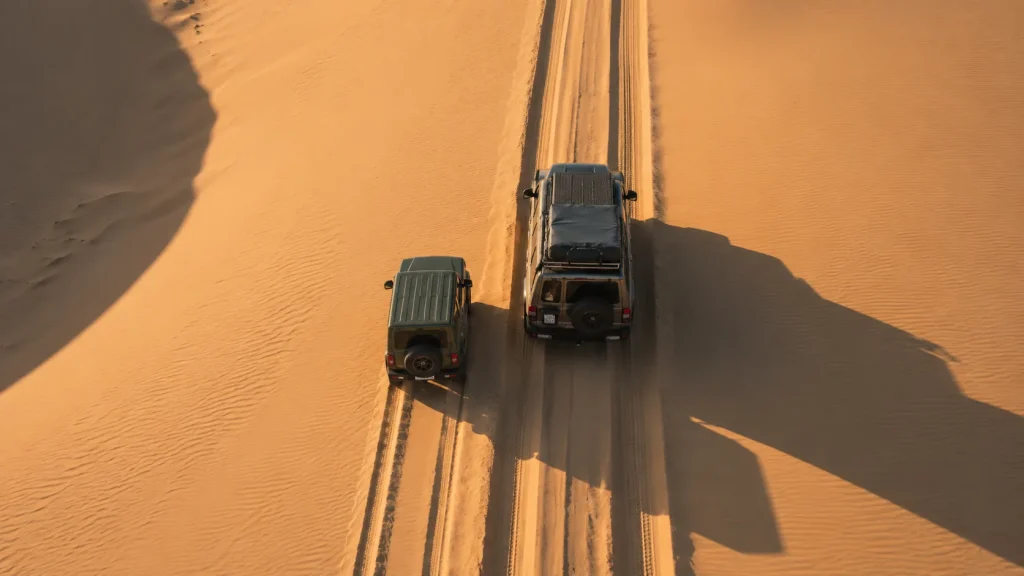
Choose the Jimny if your adventures are one-to-two-up, terrain-focused and budget-aware — it delivers 90% of a big 4×4’s real-world capability for 30% of the cost, and it’s the better daily by miles. Choose the larger 4×4 if people, payload, towing or vast high-speed distances define your travel — that’s what all that metal and money buy. Whichever way you land, walk in prepared: our pre-purchase checklist, 3-door vs 5-door guide and road-trip suitability deep-dive cover the Jimny side of the decision from every angle.
Frequently asked questions
Is the Suzuki Jimny as capable off-road as a big 4×4?
In geometry and agility, often more so: 37° approach, 28° breakover and 49° departure angles beat even a Jeep Wrangler on two of three measures, and its ~1,100 kg weight floats over soft ground. Large 4x4s counter with torque, wading depth (a Land Cruiser wades roughly twice as deep) and load-carrying endurance. Different strengths, both genuinely capable.
Should I buy a Jimny or a Land Cruiser?
Buy the Land Cruiser (or Prado/Everest-class) if your trips involve four-plus people, heavy gear, towing over 1,300 kg, or huge high-speed distances. Buy the Jimny if you travel one- or two-up, value technical-terrain agility and daily-driver ease, and want total ownership costs at a fraction of the big truck’s.
Can a Suzuki Jimny keep up with larger 4x4s on trails?
On technical, tight or soft terrain it frequently leads the convoy — short overhangs, light weight and low range let it pick lines big vehicles can’t take. On high-speed dirt roads and deep water it works harder than a torquey diesel. Convoy etiquette: the Jimny sets the line, the Cruiser carries the fridge.
What can’t a Suzuki Jimny do that a larger 4×4 can?
Carry serious loads (payload is ~350 kg vs 600–800 kg), tow more than about 1,300 kg braked, cruise effortlessly at 120 km/h+ for 1,000 km days, wade really deep water in standard form, or seat five-plus in comfort. If your adventures depend on any of those, size wins.
Is there a middle option between a Jimny and a full-size 4×4?
The space between is thin, which is exactly why Toyota’s compact Land Cruiser FJ — due from mid-2026 — is significant: it’s the first credible new ladder-frame rival to the Jimny’s niche. Until it proves itself, the practical middle path many households choose is a used Prado/Fortuner-class vehicle, or running a Jimny alongside a double-cab.
Keep reading
Join 4,000+ Jimny owners
Get one useful Jimny guide in your inbox each week — no spam, no fluff, unsubscribe anytime.
Free Jimny Tool
Not sure which Jimny to buy?
Compare the Samurai, JB23, JB43 and JB74 side by side — engines, dimensions, kit and what changed between generations.