
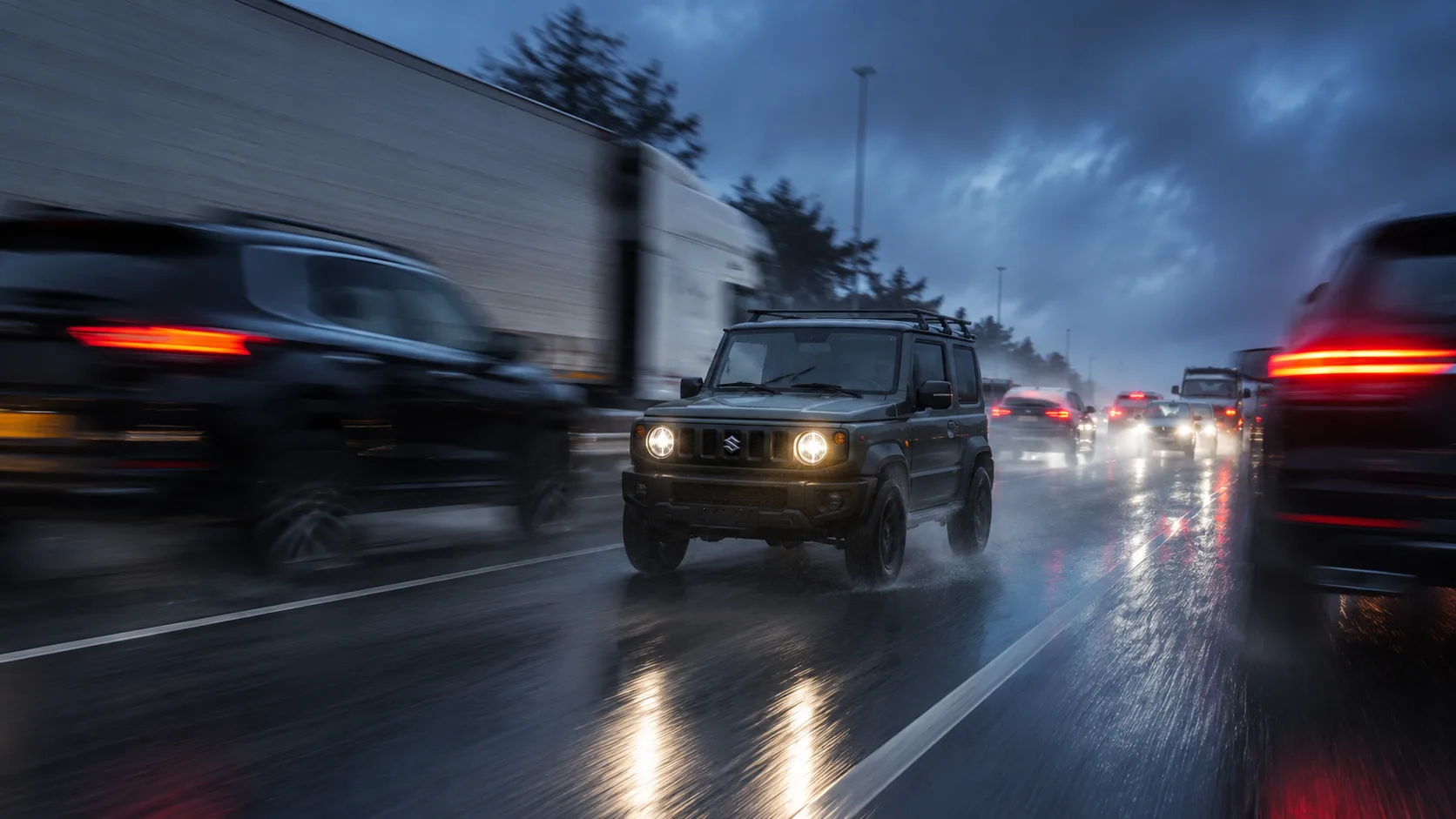
Buying & Ownership
We run a site called Compact Conqueror, so you know where our hearts sit. But the fastest way to end up with a Jimny gathering dust — or worse, resenting it — is to buy one without understanding its compromises. Here’s the honest list, from people who live with them.
Most would-be owners arrive at the same question: “I love the look of the Jimny — should I buy one?” The honest answer: it depends entirely on what you expect it to be. The Jimny is a specialist tool wearing an adorable costume. Judged as a small off-roader, it’s close to perfect. Judged as an ordinary small SUV, it has real, measurable weaknesses that no amount of charm papers over. This guide covers every significant downside, with data where it exists, so you can decide with clear eyes. (For the other side of the ledger, read why people love the Jimny so much.)
1. It’s slow — properly slow
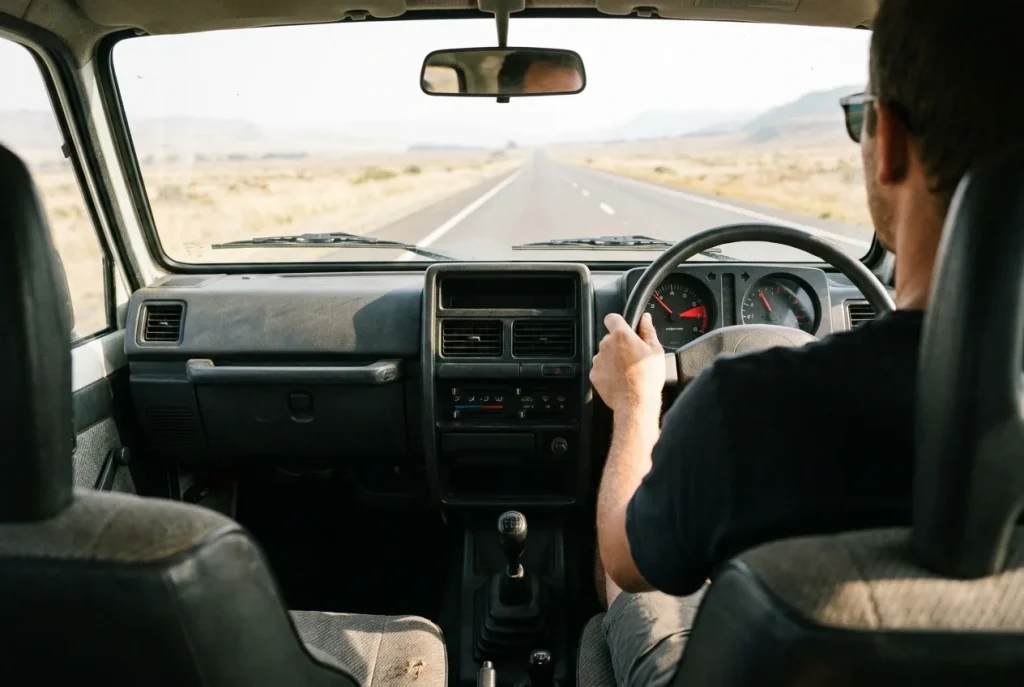
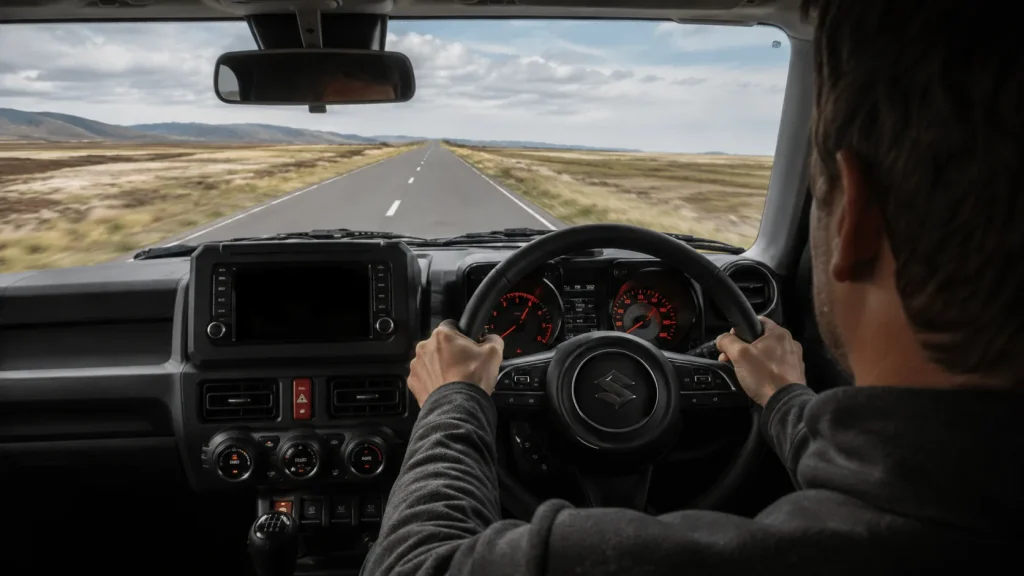
The naturally aspirated 1.5-litre K15B produces 75 kW and 130 Nm in most markets. In a vehicle shaped like a fridge with the aerodynamics to match, that means 0–100 km/h takes around 12–13 seconds, overtaking requires planning, and steep highway climbs with passengers and luggage will have you dropping two gears. The four-speed automatic makes it feel slower still, spinning the engine at high revs to hold cruising speed. If your daily driving involves long fast roads, drive one first at those speeds — not just around the block.
2. The on-road ride and handling are agricultural
The very things that make the Jimny brilliant off-road — the ladder frame, live axles and recirculating-ball steering — work against it on tarmac. The ride is busy and choppy on anything but smooth surfaces, there’s noticeable body roll in corners, and the steering has a vague on-centre zone that demands small constant corrections, especially in crosswinds. Autocar’s road testers, who otherwise adored the car, were blunt that its choppy ride, cumbersome handling and limited grip made it a compromised vehicle for on-road use. Owners adapt — many come to enjoy the engagement — but passengers who value refinement often don’t.
3. The safety rating is the elephant in the room
This is the downside that deserves the most sober consideration. When Euro NCAP crash-tested the fourth-generation Jimny in 2018, it scored three stars out of five: 73% for adult occupant protection, 84% for child occupants, 52% for pedestrian protection and 50% for safety assist. The report noted the driver’s airbag bottoming out in the frontal offset test and deformation of the passenger compartment. Top Gear’s summary was characteristically direct: the Jimny simply doesn’t crash gracefully.
Context matters in both directions. The original ANCAP/Euro NCAP rating has now expired under the six-year validity rule, and the 2026 update brought meaningful improvements in several markets — six airbags, upgraded dual-camera autonomous emergency braking and adaptive cruise control were added to South African and Australian models this year. But the fundamental structure is unchanged, and physics doesn’t negotiate: a 1.1-tonne ladder-frame vehicle is not a modern monocoque crossover in a collision. If your primary mission is ferrying a family on fast roads every day, weigh this honestly.
4. Fuel economy is mediocre for the size
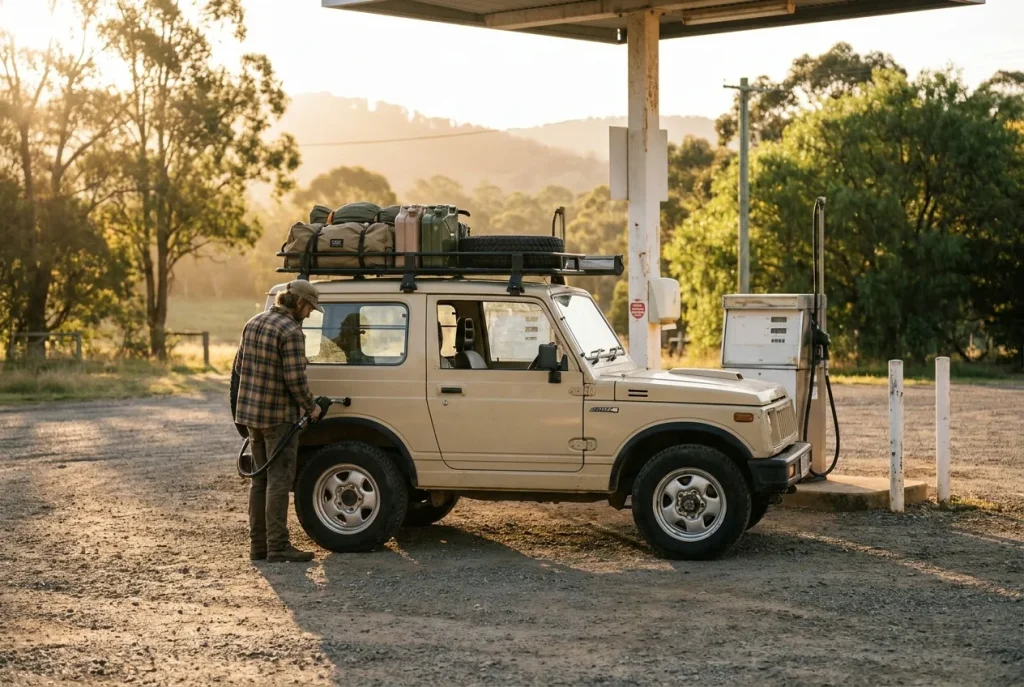
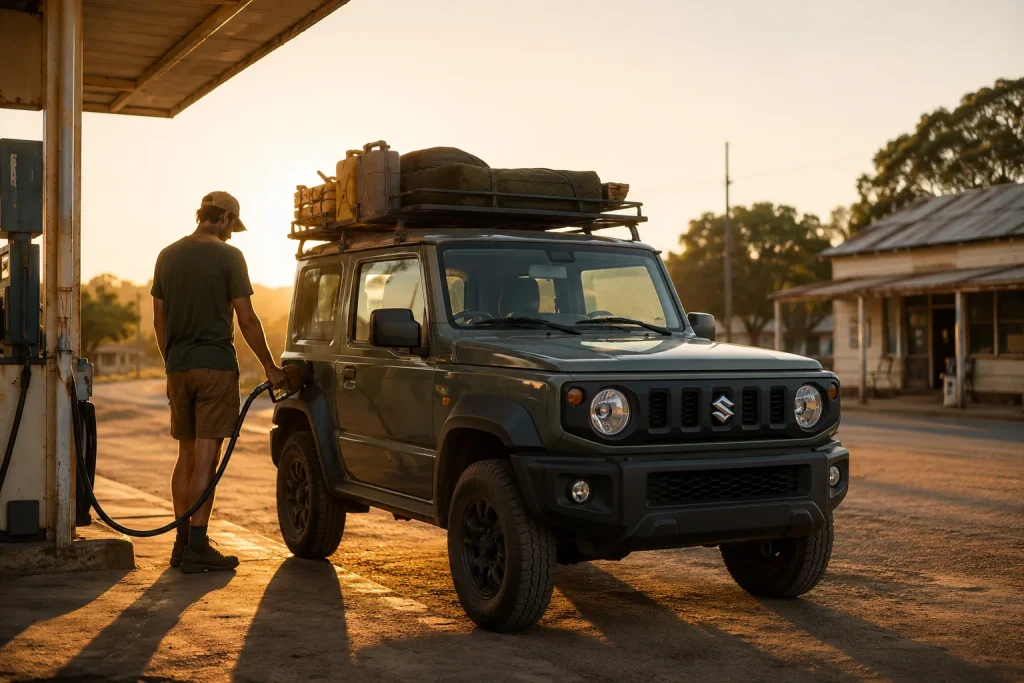
A tiny car should sip fuel. The Jimny doesn’t, because it’s shaped like a brick and geared like a tractor. Official WLTP figures for the three-door span roughly 32–36 mpg (about 7.9–8.8 L/100km), and Auto Express noted CO2 emissions of 154–170 g/km — figures a diesel double-cab twice the size can better on the open road. Real-world owners typically report 8–10 L/100km mixed, worse with a roof rack or larger tyres. The 40-litre tank compounds it: realistic touring range is 350–450 km, which shapes route planning on remote trips. Full numbers live in our running-costs breakdown.
5. Practicality is a genuine constraint
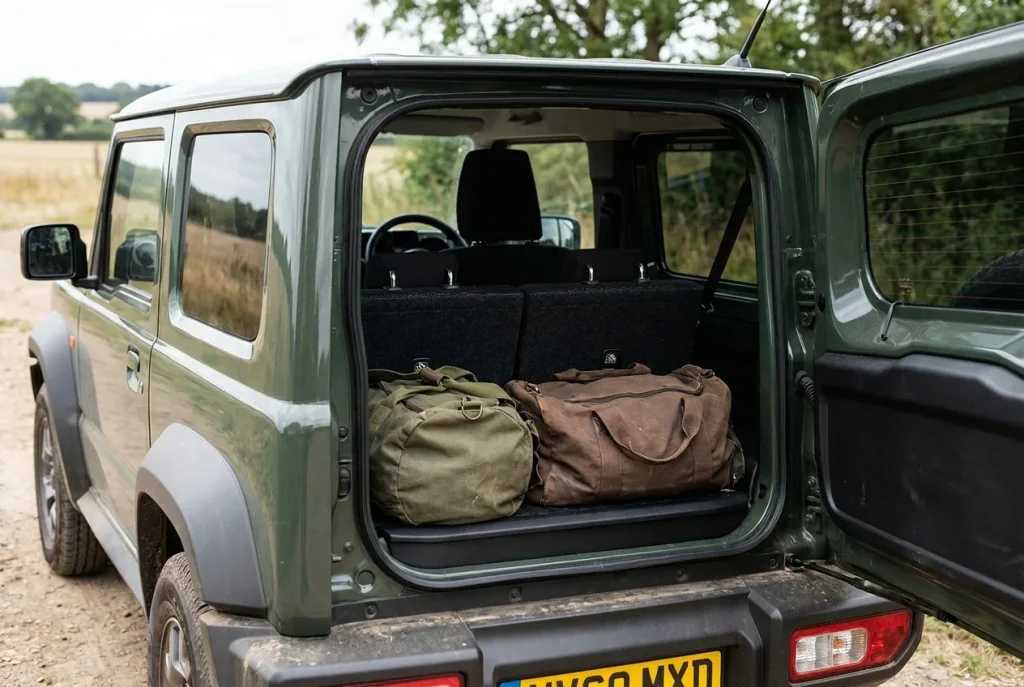
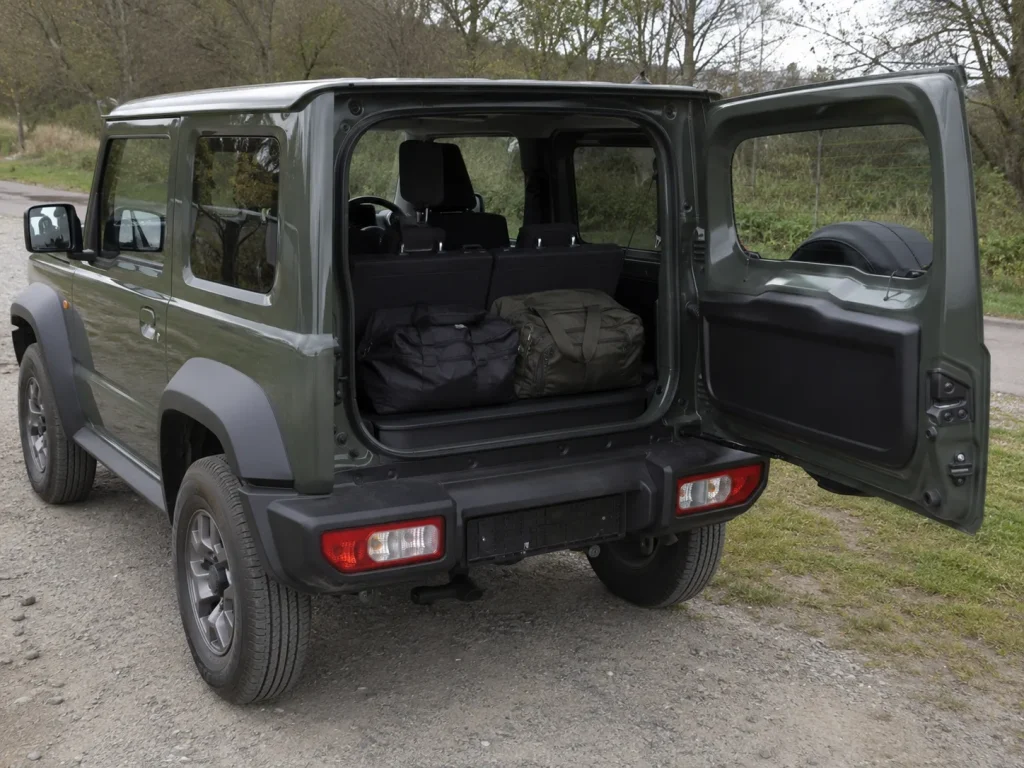
The three-door’s boot holds just 85 litres with the rear seats up — a couple of soft bags, and that’s it. The back seats fit two children or short-trip adults, and the side-hinged tailgate needs clearance to swing. The five-door XL transforms daily usability with a 211-litre boot and proper rear doors, but even it is a small car by family standards. Payload deserves attention too: with a gross vehicle mass only ~350 kg above kerb weight on most variants, four adults plus camping gear puts you at or over the legal limit before you’ve fitted a single accessory. Compare the body styles properly in our 3-door vs 5-door guide.
| Downside | How much it matters | Can you mitigate it? |
|---|---|---|
| Slow acceleration & overtaking | High on highways, low in town | Partly — manual gearbox, throttle controller; no cure |
| Choppy ride & vague steering | Medium — most owners adapt | Partly — quality tyres, steering damper |
| 3-star (2018) crash rating | High for family-first buyers | No — structure is fixed; 2026 update improves tech only |
| Thirsty for its size, 40L tank | Medium — stings on long trips | Partly — gentle driving, long-range tank (aftermarket) |
| 85L boot (3-door), low payload | High for families | Yes — choose the 5-door; pack light |
| Motorway noise & fatigue | Medium–high for commuters | Partly — sound deadening, cruise control |
| Waiting lists / price premiums | Varies by market | Yes — order early, shop used carefully |
6. Motorway journeys are loud and tiring
Wind noise off the upright screen, road roar from all-terrain-friendly tyres and an engine turning high revs at 120 km/h combine into a soundtrack you’ll either find charming or exhausting. Long-distance comfort is workable — thousands of owners tour huge distances, as we cover in our road-trip suitability guide — but it demands the right expectations and usually a few well-chosen upgrades.
7. Buying one is harder than it should be
Demand still outruns supply in most markets. That means waiting lists for new cars and a used market where prices sit unusually close to — sometimes above — new list price, a phenomenon we analyse in our depreciation deep-dive. Great news when you sell; frustrating when you buy. It also attracts opportunistic sellers, so a disciplined pre-purchase inspection matters more here than with most used cars.
The smaller irritations owners mention
- No reach adjustment on the steering wheel — taller drivers may struggle to get truly comfortable.
- Basic infotainment — functional with CarPlay/Android Auto, but graphics and response lag rivals (the 2026 9-inch unit improves this).
- Hard cabin plastics — deliberate and durable, but there’s little sound insulation behind them.
- 4H is not for dry tarmac — the part-time system has no centre differential, so misusing it causes driveline wind-up; new owners must learn this.
- Wading and underbody limits in standard form — capable, but factory clearance and intakes reward respect until you modify.
So — who should walk away, and who shouldn’t?
Walk away if: you cover big highway kilometres daily, you need to carry four people plus luggage regularly, crash-test performance is your top priority, or you expect crossover refinement. There are better tools for those jobs, and we compare them honestly in Jimny vs larger 4x4s.
Buy with confidence if: you want a genuinely capable, characterful, affordable 4×4 for town duty, weekend trails and light touring — and you can smile at the compromises because you understand what they buy you. Reliability is a strength, not a weakness: Suzuki’s record here is excellent and the mechanicals are simple and proven, as our service schedule guide shows. The Jimny doesn’t fail its owners; mismatched expectations do. Know the downsides above, accept them willingly, and this remains one of the most satisfying vehicles money can buy.
Frequently asked questions
What are the main disadvantages of the Suzuki Jimny?
The big seven: slow acceleration (75 kW / 130 Nm), a choppy ride with vague steering on-road, a three-star Euro NCAP rating from its 2018 test, mediocre fuel economy for its size with a 40-litre tank, very limited boot space and payload, motorway noise, and waiting lists or price premiums when buying.
Is the Suzuki Jimny safe?
It scored three Euro NCAP stars in 2018 (73% adult, 84% child occupant protection); that rating has since expired under the six-year validity rule. The 2026 update added six airbags, upgraded AEB and adaptive cruise in several markets, but the ladder-frame structure is unchanged. It is safer than the rating’s reputation suggests in low-speed use, and less protective than modern monocoque rivals in a serious collision.
Is the Suzuki Jimny good on fuel?
Not for its size. Official figures span roughly 7.9–8.8 L/100km (32–36 mpg) and most owners see 8–10 L/100km in mixed driving — boxy aerodynamics and short gearing offset the low weight. The 40-litre tank gives a realistic 350–450 km touring range.
Is the Suzuki Jimny good for families?
The three-door is a poor family car: two child-friendly rear seats and an 85-litre boot. The five-door XL is workable for a small family with light packing (211-litre boot, proper rear doors), but payload of roughly 350 kg and the crash-rating history mean families should weigh it carefully against conventional SUVs.
Is the Suzuki Jimny reliable?
Yes — reliability is one of its genuine strengths, not a downside. The naturally aspirated 1.5 K15B engine and simple driveline have an excellent record, and Autocar’s used-buying guidance notes Suzuki’s strong reliability reputation. Stay current on servicing and driveline oils (especially after water crossings) and problems are rare.
Keep reading
Join 4,000+ Jimny owners
Get one useful Jimny guide in your inbox each week — no spam, no fluff, unsubscribe anytime.
Free Jimny Tool
Not sure which Jimny to buy?
Compare the Samurai, JB23, JB43 and JB74 side by side — engines, dimensions, kit and what changed between generations.