

The original SJ and Samurai are 30 to 45 years old now. At that age, condition is everything and originality is rare. The mechanical simplicity that makes these classics so appealing also makes them easy to keep running — but the bodywork and chassis are another story. Here is what actually goes wrong on the original Jimny, and what to do about it.
Age Changes Everything
Unlike the JB23 or JB74, the SJ and Samurai cannot be assessed on a list of model-specific faults alone. A 40-year-old vehicle’s condition is dominated by how it has been stored, used, and maintained over four decades. Two identical SJ413s can be worlds apart — one a rust-free, cherished survivor, the other a rolling restoration project. That said, the original Jimny has clear, predictable weak points.
A reminder on what these are: the SJ series uses leaf-spring suspension (not the coil springs of later Jimnys) and carburetted engines, which shapes both their charm and their problems. See our SJ & Samurai buyer’s guide for the full background.
You don’t fix a 40-year-old SJ’s problems once. You manage them, forever. That’s classic ownership — and for the right person, it’s a joy.
Compact Conqueror
1. Rust — The Defining Issue

On any SJ or Samurai, rust is overwhelmingly the most important consideration. After decades of service, corrosion can affect virtually any panel and — critically — the ladder-frame chassis itself. This is the single factor that determines whether an SJ is a sound buy or a money pit.
| Rust Area | Severity | Notes |
|---|---|---|
| Chassis rails & crossmembers | Critical | Structural — perforation is a dealbreaker or major repair |
| Footwells & floor pans | High | Lift the mats and inspect thoroughly |
| Rear body mounts / load bed | High | Common on pickup and soft-top variants |
| Bulkhead & inner wings | High | Hidden rust, expensive to repair properly |
| Door bottoms & tailgate | Medium | Cosmetic but indicates overall condition |
| Suspension mounts & spring hangers | High | Leaf-spring mounting points — safety-critical |
Treatment: a thorough cavity wax and underbody treatment is essential for any SJ you intend to keep. Address surface rust before it penetrates. Many surviving SJs have had chassis repairs or replacements — confirm the quality of any such work.
2. Carburettor & Fuel System

The carburetted F10A and G13A engines suffer age-related fuelling issues, especially on examples that have stood unused. Symptoms include hard starting, rough idle, hesitation, and poor running.
- Gummed-up carburettor jets from old, evaporated fuel — a clean and rebuild usually resolves it
- Worn needle valves and float issues causing flooding or fuel starvation
- Perished rubber fuel lines — a fire risk; replace as a matter of course on a fresh purchase
- A carburettor rebuild kit is inexpensive and the work is within reach of a classic-car DIYer
These issues are cheap and straightforward to address for anyone comfortable with classic-car maintenance — and part of the SJ’s appeal is exactly this kind of accessible, mechanical simplicity.
3. Brakes & Suspension (Age-Related)
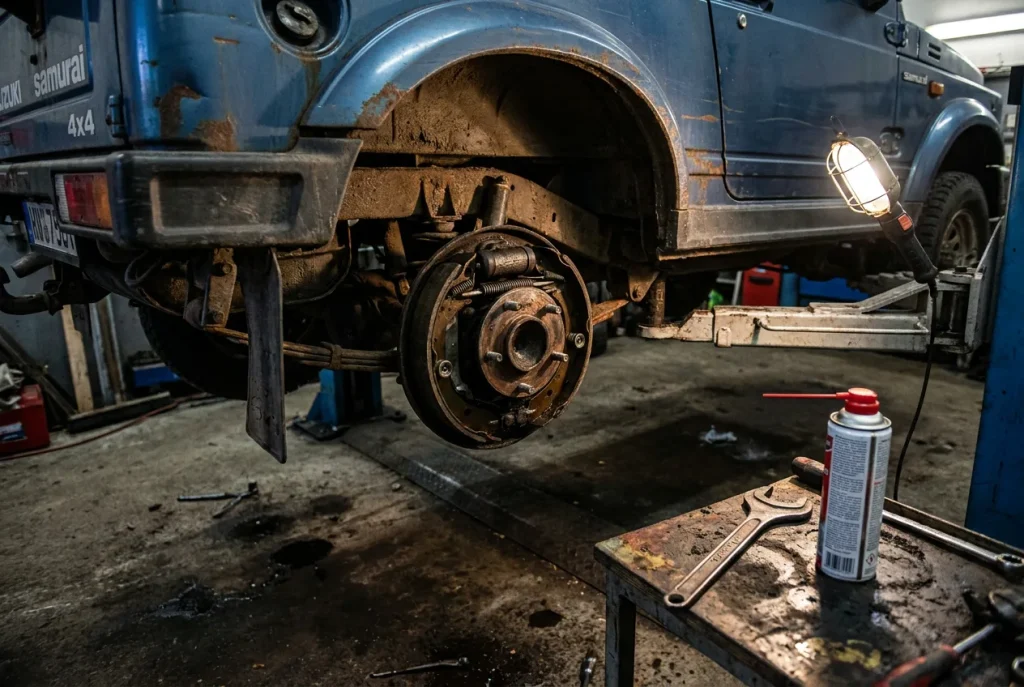
After decades — and especially after standing — the braking and suspension systems need attention:
- Seized or contaminated brake components (wheel cylinders, calipers) after standing
- Perished brake hoses — replace for safety
- Tired, sagging or cracked leaf springs and worn spring bushes
- Worn steering components causing excessive play in the recirculating-ball steering
- Perished suspension and steering rubber throughout
⚠ Brakes are safety-critical
On a vehicle this age, do not assume the brakes are sound. Have the entire braking system inspected and recommissioned by a competent mechanic before relying on the vehicle. Seized or contaminated brakes after years of standing are common and dangerous.
4. Electrical & General Wear
Age-related electrical gremlins — earthing issues, corroded connectors, tired switches, and aged wiring — are common but generally inexpensive to chase down. Other wear items include the clutch, exhaust (rusts through), and interior trim (often sun-damaged and hard to source in good condition). None are individually serious; collectively they form the “recommissioning” work that a neglected SJ needs.
The Honest Reality of SJ Ownership
The SJ and Samurai reward a particular kind of owner: someone who enjoys the mechanical involvement, accepts that a 40-year-old vehicle needs ongoing attention, and values character over convenience. The mechanical simplicity means most jobs are DIY-friendly and parts (mechanical especially) are well supported by a strong global community. The bodywork and chassis are where the real money and effort go.
Buy the best, most rust-free example you can afford. A sound SJ is a delight; a rusty one is a bottomless project. For pricing and what to look for, see our SJ & Samurai buyer’s guide.
Frequently Asked Questions
What is the biggest problem with the Suzuki SJ and Samurai?
Rust — specifically structural rust in the ladder-frame chassis, plus the footwells, floor pans, body mounts and bulkhead. On a 30–45-year-old vehicle, corrosion determines whether the car is a sound buy or a money pit. A rusted-through chassis is a dealbreaker or major repair. Always inspect the chassis exhaustively and prioritise a rust-free example.
Are SJ and Samurai engines reliable?
The carburetted F10A and G13A engines are simple and durable, but age-related fuelling issues are common — gummed jets, worn needle valves and perished fuel lines, especially on cars that have stood. These are inexpensive and straightforward to address for anyone comfortable with classic-car maintenance. The mechanical simplicity is a core part of the SJ’s appeal.
Is it safe to drive a 40-year-old Samurai?
It can be, once properly recommissioned — but do not assume an old SJ’s brakes and suspension are sound. Seized or contaminated brakes after standing are common and dangerous. Have the entire braking system, steering and suspension inspected and recommissioned by a competent mechanic before relying on the vehicle, and address any perished hoses and worn components.
How hard is it to maintain an SJ or Samurai?
Mechanically, it is one of the most DIY-friendly vehicles ever made — simple carburetted engine, basic electrics, no computers. Most mechanical jobs are within reach of a competent home mechanic, and the global community and parts supply are excellent. The challenge is the bodywork and chassis: rust repair requires skill, and good body panels can be hard to find.
Are parts available for the SJ and Samurai?
Yes — mechanical parts (engine, drivetrain, brakes, suspension) are well supported through a strong global community, new-old-stock, and reproduction suppliers. Some body panels and interior trim are harder to source in good condition, which is part of why rust-free original examples command a premium. The community is the best resource for sourcing.
Should I buy a cheap, rusty SJ to restore?
Only with eyes open. A cheap rusty SJ can cost far more to restore than a sound example costs to buy outright — chassis and body rust repair is skilled, expensive work. Unless you specifically want a restoration project and have the skills or budget, buy the best, most rust-free example you can afford. Condition beats price decisively on these classics.
Service intervals, fluid grades and capacities vary by engine variant, model year and market. Always confirm the correct specification for your specific vehicle against the owner’s manual or a factory/Haynes service manual before carrying out any work.
Related Reading
SJ & Samurai Buyer’s Guide
How to buy the original Jimny — model lineage, pricing and inspection.
Free Newsletter
The Compact Conqueror Newsletter
Maintenance reminders, DIY guides, mod picks and Jimny news — free, every week.
Free Jimny Tool
What will your Jimny really cost to own?
Fuel, insurance, tyres and servicing — get a realistic monthly and annual running-cost estimate in under a minute.
Related: the Suzuki Samurai (SJ) buyer’s guide →