
Affiliate Disclosure: Compact Conqueror earns a small commission on qualifying purchases made through links on this page — at no extra cost to you. We only recommend products we’ve tested or researched thoroughly. See our full affiliate disclosure.
The Suzuki Jimny is mechanically capable of terrain that shames vehicles twice its price. The limiting factor — almost always — is not the car. It’s technique. Understand the hardware, apply the right inputs, and your Jimny will cross terrain that defeats larger, heavier competitors. Here is what you need to know.
Understanding the AllGrip Pro 4WD System
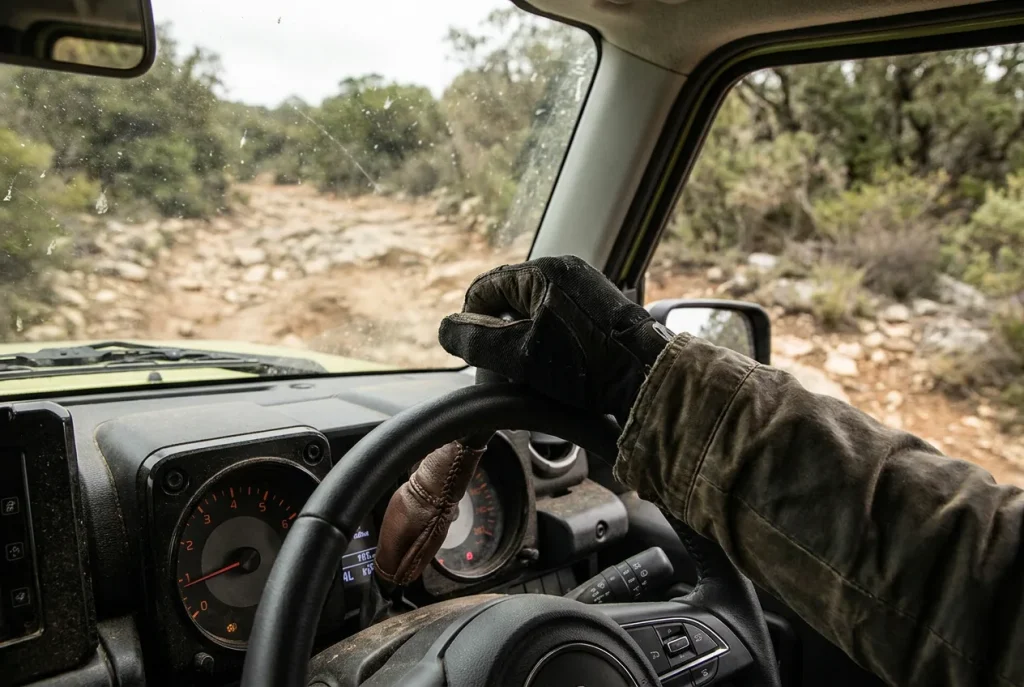
Before you leave the tar, understand the system you’re operating. The JB74’s AllGrip Pro is a part-time, manually-selected 4WD setup. It is not an all-wheel-drive system — it is a traditional 4×4 with a low-range transfer case and a centre lock that splits torque 50/50 front and rear.
| Mode | Use Case | When to Select | When NOT to Use |
|---|---|---|---|
| 2H (2WD rear) | Normal road driving | All sealed surfaces | Never on slippery surfaces |
| 4H (4 High) | Loose, slippery, or uneven surfaces | Gravel, sand, wet grass, light mud | Dry sealed roads at any time |
| 4L (4 Low) | Maximum traction, low-speed terrain | Rock crawling, steep climbs, deep mud, recovery | Speeds above 40 km/h, dry tar |
The JB74 allows shifting between 2H and 4H while moving at low speed (below 100 km/h). Shifting into 4L requires a momentary stop. Engage 4L before you need it — attempting to shift in the middle of a difficult situation is poor technique.
The Jimny’s hardware is not the limitation. Technique, tyre pressure, and momentum management separate confident drivers from stuck ones.
Compact Conqueror
Tyre Pressure — The Most Important Variable
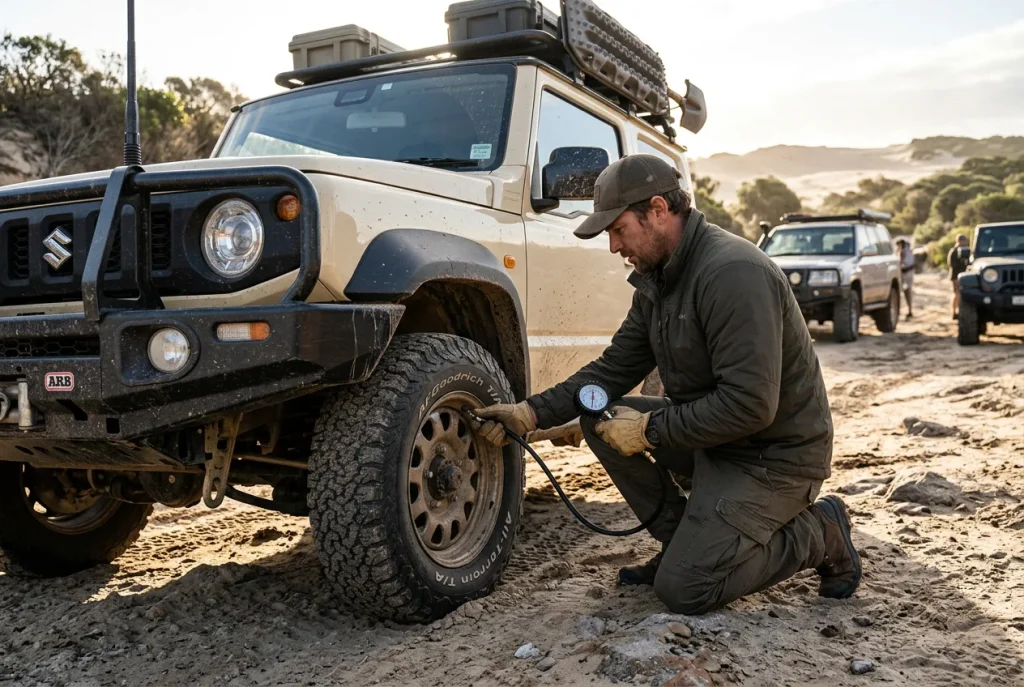
Correct tyre pressure for the surface is the highest-impact technique adjustment available to any off-road driver. Reducing pressure increases the tyre’s contact patch, improving traction on soft surfaces and reducing the risk of puncture on rocky terrain.
| Surface | Recommended Pressure | Notes |
|---|---|---|
| Sealed road (normal) | 2.0–2.2 bar (factory) | Never drive on tar at off-road pressures |
| Gravel / compacted dirt | 1.8 bar | Marginal reduction for comfort and grip |
| Rocky terrain | 1.4–1.6 bar | Reduces puncture risk; improves tyre conformation to rocks |
| Sand (firm) | 1.2 bar | Increases contact patch significantly |
| Deep / soft sand | 0.9–1.1 bar | Maximum float — re-inflate immediately after soft section |
| Mud (firm base) | 1.6 bar | Keep pressure moderate; self-cleaning tread more important |
Always carry a quality 12V compressor capable of inflating from 0.9 bar to 2.2 bar in reasonable time. The ARB Twin, Bushranger 4×4, and Ironman Explorer compressors are proven choices in the South African market. A deflation tool (Staun or Bushranger type) speeds up the airing-down process significantly.
Sand Driving
Sand is the terrain the Jimny handles most intuitively — its light weight (1,135 kg GVM) is a major advantage over heavier vehicles that sink more deeply into soft sand. Apply these principles:
Before You Enter the Sand
- Air down to 1.0–1.1 bar (coastal dune sand) or 1.2 bar (inland sandy tracks)
- Engage 4H before reaching soft sand — engage early, not when you’re stuck
- Increase speed gradually to find the minimum speed needed to maintain momentum
- Scout the exit before you enter — do not drive into a sand bowl without a known way out
While Driving on Sand
- Maintain momentum — unnecessary stops in soft sand require effort to restart
- Use the highest gear that maintains movement — lower revs reduce wheel spin
- Steer with gentle inputs — sharp steering changes dig the front wheels in
- Follow previous tracks where they exist — compacted sand is firmer than virgin surface
- If you feel the car slow, build speed before you lose all momentum — do not wait until you stop
If You Get Stuck in Sand
- Stop before you bury the vehicle further with spinning wheels
- Reverse slowly out on your own track if possible
- If unable to reverse, deflate tyres further (to 0.8–0.9 bar) to increase float
- Clear sand from in front of all four tyres before attempting to move
- A kinetic recovery rope to another vehicle or an anchor is your next option
Rocky Terrain and Rock Crawling
Rocky terrain rewards patience and precision over speed. The Jimny’s short wheelbase (2,590 mm) is a major asset here — it clears rocky obstacles that longer vehicles high-centre on.
Speed and Throttle Control
Rock crawling is done at walking pace in 4L. The goal is to place each wheel deliberately on a stable surface. Rushing causes mistakes — a misplaced wheel leads to body contact with the rock, tyre damage, or an axle strike.
Line Selection
Walk the obstacle before you drive it. Identify the high point (where a wheel might go over a rock crest rather than around it), the side tilt angle at any point, and your recovery route if you need to reverse. The best line is rarely the most obvious one.
Approach, Departure, and Break-Over Angles
The JB74’s factory clearance angles are:
- Approach angle: 37° (stock) — improved to approximately 42° with a 40 mm lift
- Departure angle: 49° (stock) — the rear bumper is the limiting factor
- Break-over angle: 28° (stock) — the lowest chassis point is the transfer case; a bash plate protects this
If an obstacle exceeds these angles, you will make contact. Bash plates protect the drivetrain when this happens — this is why they’re in the Tier 2 modification list. Do not attempt steep rocks without underbody protection fitted.
Mud Driving
Mud is the terrain where the Jimny’s light weight matters less and tyre selection matters most. A deep self-cleaning tread pattern cuts through to a firm base; a shallow, closely spaced pattern becomes a boat hull.
Key Mud Techniques
- Engage 4L for deep mud — you need torque control, not speed
- Select an aggressive AT tyre with a wide void ratio (gap between tread blocks) for self-cleaning
- Keep your line straight where possible — steering in deep mud loads the front tyres sideways and causes digging
- Where the mud is firm underneath, maintain steady momentum — the Jimny’s weight advantage helps here
- Cross-axle situations (different traction on each side) are where a rear diff lock transforms the car — note this for your modification planning
After the Mud
Mud packed into wheel arches affects steering and cooling. Hose the underside down after any significant mud section and inspect the brake components. Re-check all fluid levels after any session involving water crossings.
Water Crossings
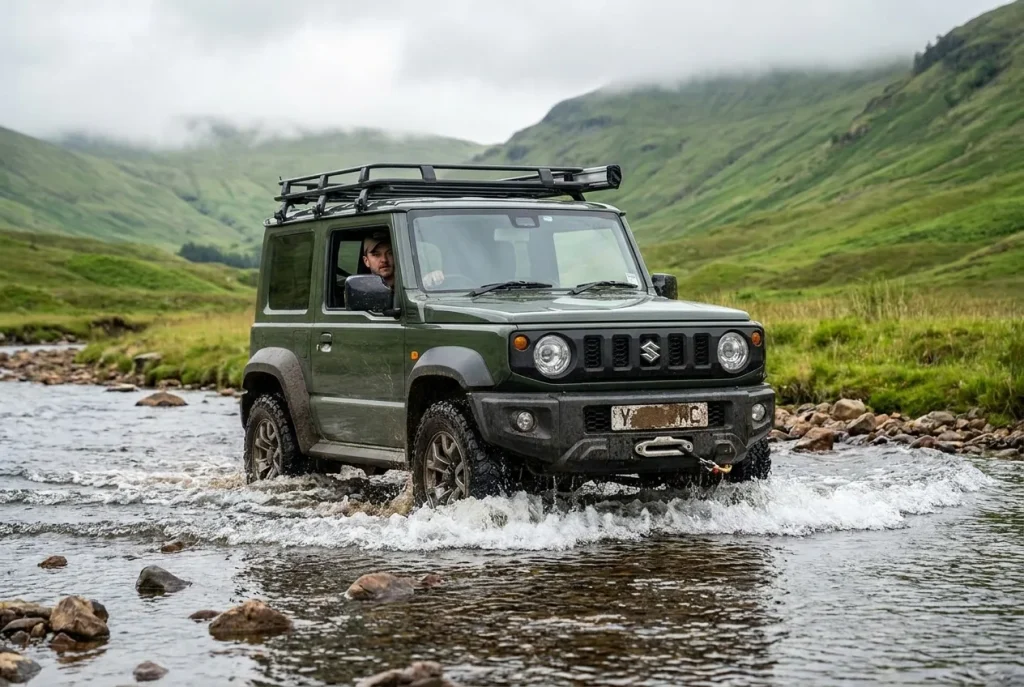
The JB74’s factory water wading depth is 300 mm at the standard air intake height. Fitting a snorkel raises this significantly, but the wading depth is not only limited by the air intake — the gearbox, transfer case, and diff vents also factor in.
Before You Cross
- Walk the crossing if depth is uncertain — prod with a stick to check the bottom hardness and depth
- Identify the entry and exit points — a slow entry is safer than a steep-sided bank approach
- Check current speed — a flowing crossing above knee height is more challenging than a still pool
- Engage 4L before the water, not in it
During the Crossing
- Maintain a slow, steady speed — 5–8 km/h creates a bow wave ahead of the vehicle that depresses water level at the engine bay
- Do not stop in the middle of the crossing
- Keep revs steady — do not let the engine note drop
After the Crossing
- Dry the brakes gently by applying light brake pressure while moving on dry ground
- Check all drivetrain fluids for water ingress (milky fluid = water contamination — address immediately)
- Inspect the air filter for moisture if the crossing was close to the intake height
Frequently Asked Questions
Do I need a diff lock on the Jimny for off-road driving?
Not for most South African trail conditions. The Jimny’s light weight, short wheelbase, and AllGrip Pro system handle the majority of gravel, sand, and moderate rocky terrain without a locker. A rear diff lock is genuinely transformative for serious cross-axle rocky terrain or deep mud where open diff slip is the limiting factor. Add it to your Tier 3 build list, not Tier 1.
What is the Jimny’s maximum water wading depth?
The factory specification is 300 mm (approximately 30 cm / knee height) with the standard air intake. A properly fitted snorkel raises the intake height to approximately 1,500 mm, but remember that gearbox and differential vent heights also set practical limits. Do not assume a snorkel means unlimited wading depth.
Should I use 4H or 4L for beach driving?
4H is appropriate for most beach and dune driving at normal speeds. Switch to 4L if you encounter very steep dune faces, soft bowl situations where you need maximum torque at low speed, or recovery scenarios. 4L is not needed for flat beach runs or firm-packed sand.
How do I recover a stuck Jimny?
First: stop spinning the wheels — further spinning buries the vehicle deeper. Assess your situation calmly. Try reversing on your own tracks. If that fails: deflate tyres further, clear material from around and in front of wheels, then try again. If still stuck, use a kinetic rope attached to a second vehicle at rated recovery points. Never use the tow ball as a recovery point.
Is the Jimny suitable for novice off-road drivers?
Yes — with guidance. The Jimny is forgiving, compact, and the AllGrip Pro system is intuitive. Join a 4×4 club or attend an introductory off-road course before attempting challenging terrain alone. Local Jimny clubs regularly run mentored trail days specifically for new owners.
What tyres are best for Drakensberg or mountain trails?
For mixed terrain including rocky Drakensberg trails, wet mountain tracks, and gravel passes, a moderate all-terrain tyre (BF Goodrich KO2, Falken Wildpeak AT3W, or Cooper Discoverer AT3) in 215/75R15 is the most versatile choice. Prioritise a tyre with good wet grip ratings alongside trail capability.
Related Reading
Off-Road & Adventure Hub
Full off-road hub: trail guides, technique articles, gear reviews, and destination features.
First Jimny Mods: The Priority List
The mods that make your Jimny trail-ready — in priority order with SA market pricing.
Jimny Service Schedule & Maintenance Guide
After the trails, keep your Jimny healthy with the right service intervals and fluid specs.
Free Newsletter
The Compact Conqueror Newsletter
Mod guides, trail reports, maintenance reminders and Jimny news — free, every week.
Free Jimny Tool
Working out your Jimny’s tyre size?
Check fitment, overall diameter, speedo error and clearance for any tyre size — before you buy or lift.