
Affiliate Disclosure: Compact Conqueror earns a small commission on qualifying purchases through links on this page — at no extra cost to you. We only recommend gear we have tested or our community has verified. See our affiliate disclosure.
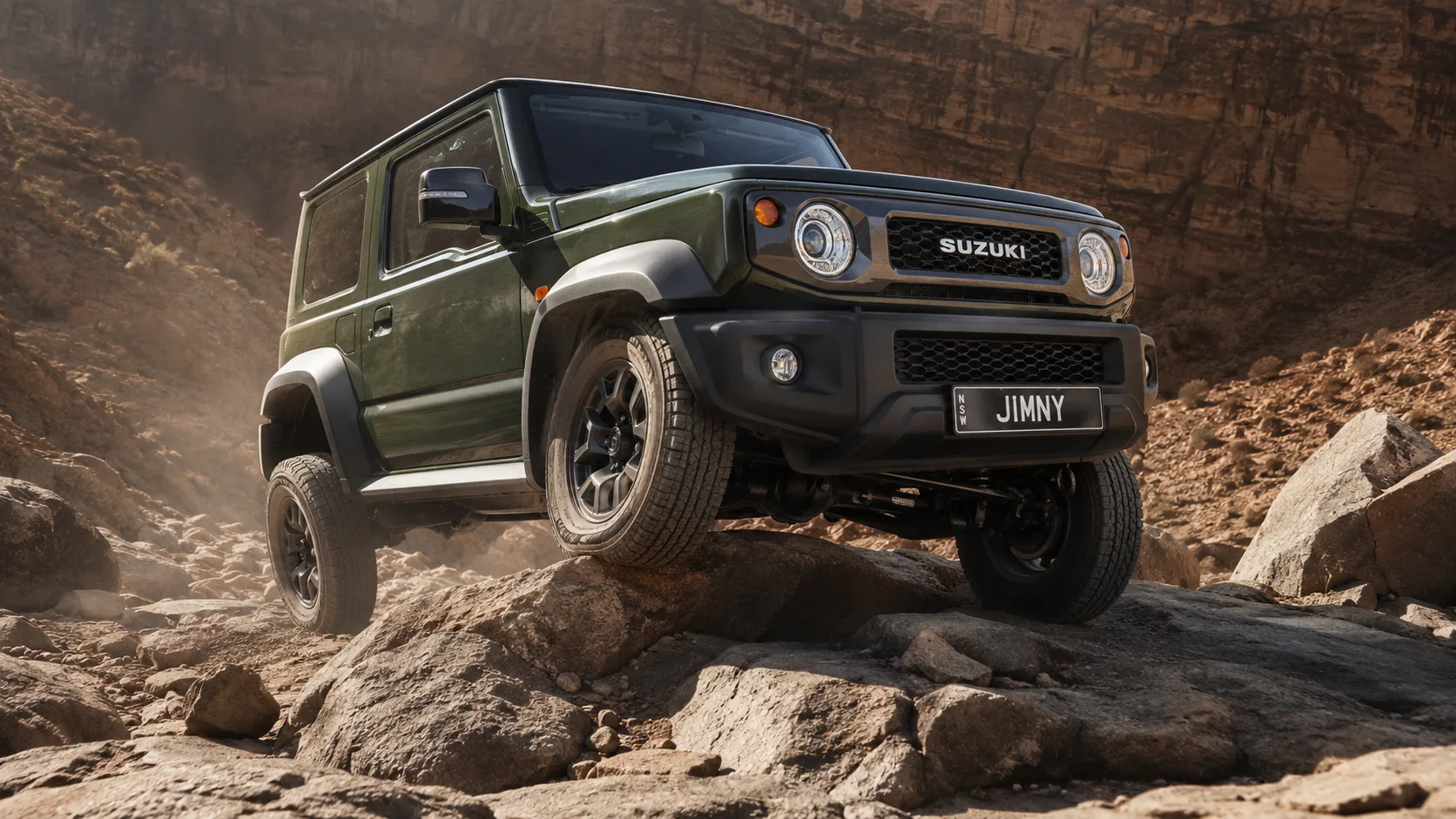
Rock is where the Jimny’s short wheelbase and superb articulation come into their own. Patience, precise wheel placement, and the discipline to pick a line are everything here — rock crawling rewards finesse, not throttle. This guide covers the technique, the protection you need, and how to keep all four tyres working on the rocks.
Why the Jimny is a Natural Rock Crawler
The Jimny’s short wheelbase gives it an excellent break-over angle — it crests ridges and rock steps that catch the belly of longer vehicles. Its rigid axles (front and rear) deliver genuine articulation, keeping tyres in contact with the ground over uneven rock. Add low range’s deep gearing for crawling control, and the Jimny is one of the most naturally capable rock vehicles in its size class.
Its limitation is the open differentials — without a diff lock, the Jimny can spin a lifted wheel and stall progress in cross-axle situations. Technique (and, for the committed, a rear diff lock) addresses this.
Rock crawling is a chess game, not a drag race. The driver who looks three moves ahead and places each tyre deliberately always wins.
Marcus Roux, Compact Conqueror
Essential Protection First
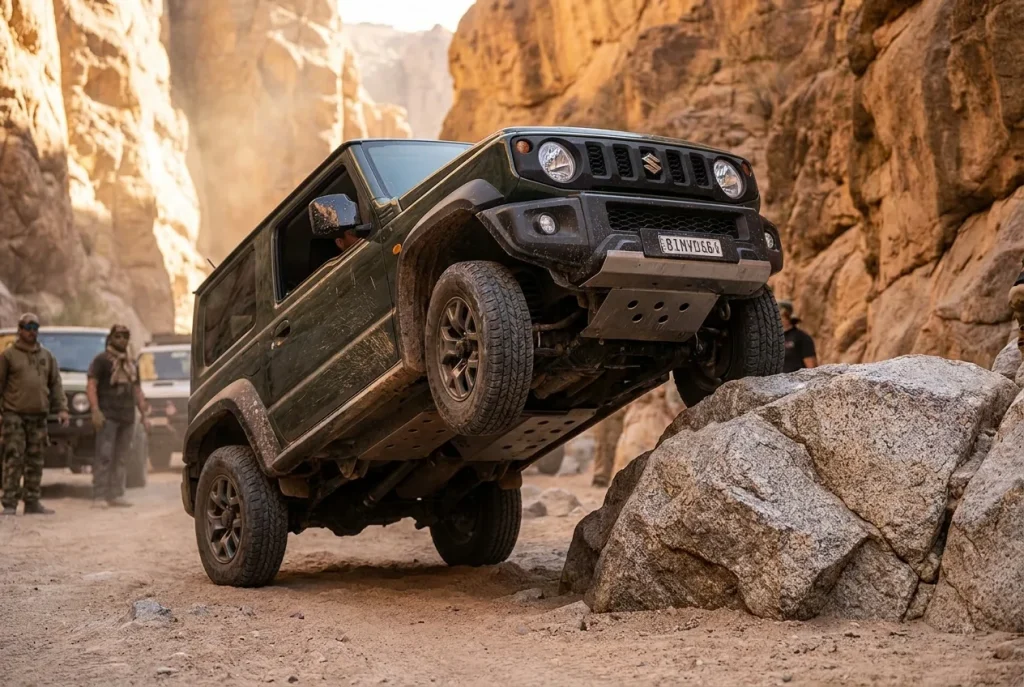
Rock is unforgiving. Before tackling serious rock, fit underbody protection — the rocks will find your sump, transfer case and sills. Skid plates and rock sliders are not optional on rocky trails:
- Skid plates protect the sump, gearbox and transfer case from rock strikes
- Rock sliders protect the sills from side contact and give you a recovery jacking point
- Quality all-terrain or mud-terrain tyres with strong sidewalls resist cuts on sharp rock
See our guides to skid plates and sliders and tyres before your first rocky trail.
Rock Crawling Technique
- Air down to roughly 1.4–1.6 bar. Lower pressure lets the tyre conform around rocks for grip and cushions impacts, protecting the sidewalls and wheels
- Select low range (4L), 1st or 2nd gear. You want maximum control and the ability to crawl at walking pace
- Get out and look. On a difficult section, stop and walk it. Pick your line — which rocks each tyre will climb, where the belly will clear, where the danger is
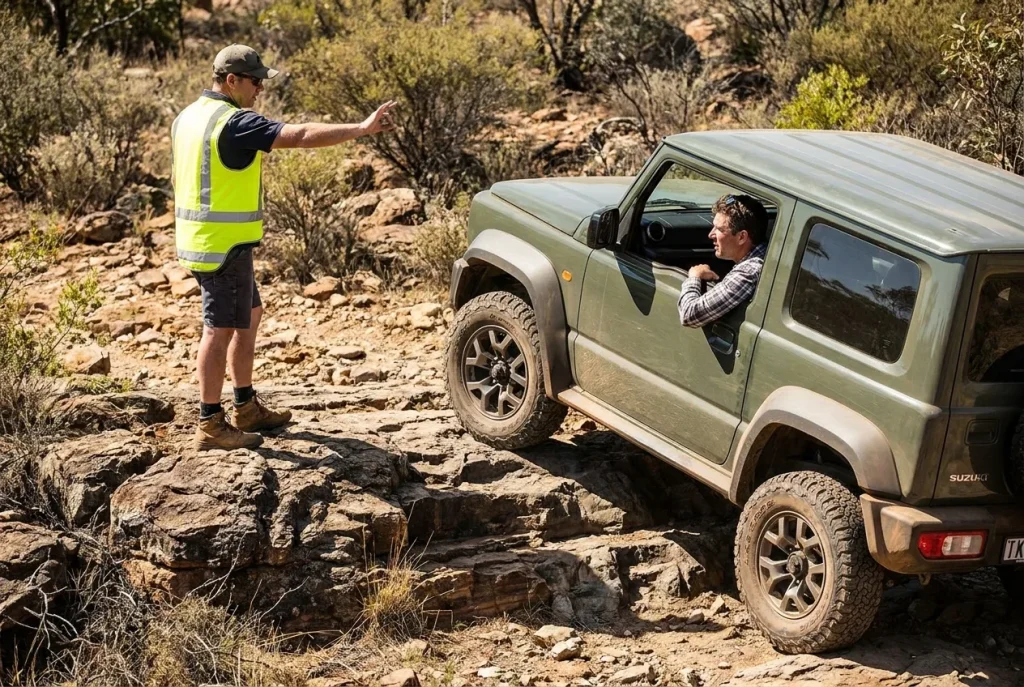
- Use a spotter. A person outside the vehicle guiding wheel placement is invaluable on technical rock. Agree clear hand signals beforehand
- Place your tyres deliberately. Drive the tyres over obstacles, not the diff or belly between them. Putting a tyre up onto a rock lifts the chassis over it
- Crawl, don’t charge. Let the engine idle the vehicle forward in low range. Throttle is for measured progress, not momentum. Charging rocks breaks things
- Manage cross-axle situations. If a wheel lifts and spins (open diff), a gentle dab of brake (left-foot braking) can transfer some torque to the grounded wheels. A rear diff lock solves this completely
- Maintain momentum only where needed — a small, controlled amount to crest a step, then back to a crawl
Descending Rock
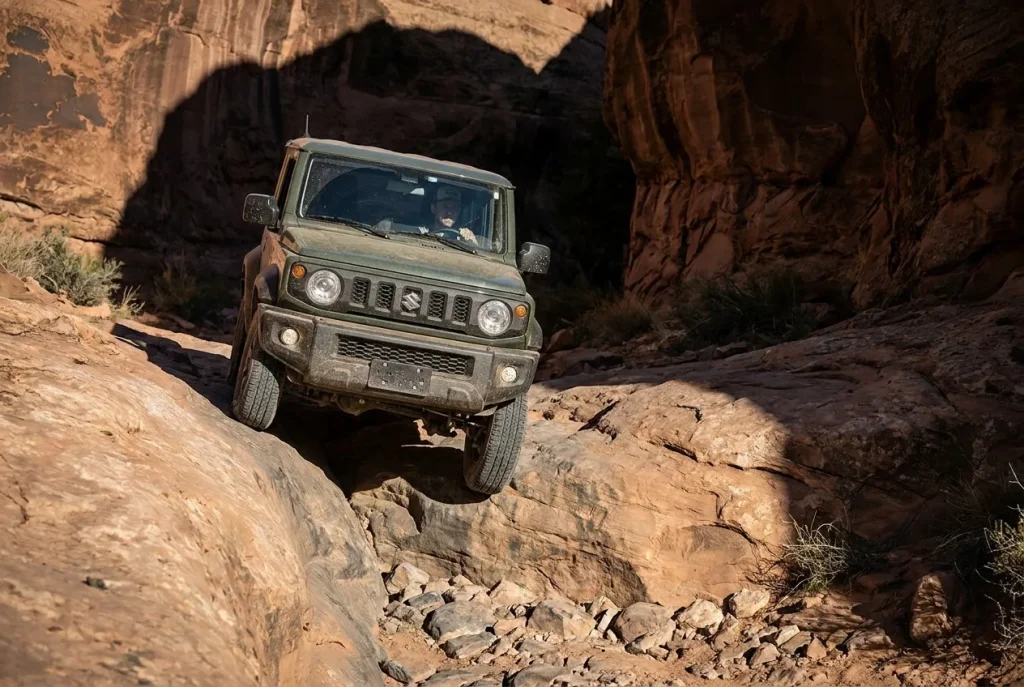
Going down is often more nerve-wracking than going up. Use engine braking in low range 1st gear — let the gearing hold the vehicle back rather than riding the brakes, which can lock the wheels and cause a slide. The Jimny’s hill descent control (on equipped models) manages this electronically. Keep the front wheels straight and pointed downhill; turning across a steep rock face risks a roll.
⚠ Know your limits and the roll risk
Side slopes and off-camber rock are where rollovers happen. The Jimny’s narrow track and high-ish centre of gravity (especially when lifted) make it sensitive to side angles. If a section feels beyond you, turn back. There is no shame in choosing not to attempt an obstacle — broken vehicles and injuries are far worse.
Protecting the Drivetrain
Rock crawling loads the drivetrain hard. Avoid sudden shock loads (charging obstacles), don’t spin then suddenly grip (which shock-loads CV joints and the transfer case), and inspect the underbody and skid plates after a rocky trail for impact damage. A bent skid plate has done its job — check what’s behind it is intact.
Frequently Asked Questions
Is the Suzuki Jimny good at rock crawling?
Yes — it is one of the most naturally capable rock crawlers in its size class. Its short wheelbase gives an excellent break-over angle, its rigid axles articulate well to keep tyres on the ground, and low range provides crawling control. The main limitation is the open differentials, which can spin a lifted wheel in cross-axle situations — addressed by technique or a rear diff lock.
Do I need skid plates for rock crawling in a Jimny?
Yes. Rock will find your sump, transfer case and sills. Skid plates protect the critical underbody components from rock strikes, and rock sliders protect the sills and give you a jacking point. Tackling serious rock without underbody protection risks expensive drivetrain damage. Fit protection before your first rocky trail.
What tyre pressure for rock crawling on a Jimny?
Around 1.4–1.6 bar. Lower pressure lets the tyre conform around rocks for grip, cushions impacts to protect the sidewalls and wheels, and increases the contact patch. Re-inflate to road pressure before returning to tar. Strong-sidewall all-terrain or mud-terrain tyres resist cuts on sharp rock.
Do I need a diff lock for rock crawling?
Not essential, but transformative on technical rock. The Jimny’s open differentials send power to the wheel with least resistance, so a lifted wheel spins and progress stalls in cross-axle situations. A rear diff lock (such as an ARB Air Locker) locks both rear wheels to turn together, dramatically improving cross-axle traction. Technique like gentle left-foot braking helps without a locker.
Should I use a spotter when rock crawling?
Whenever the terrain is technical, yes. A spotter outside the vehicle can see exactly where your tyres are and guide placement over obstacles you cannot see from the driver’s seat. Agree clear hand signals beforehand, position the spotter safely (never where the vehicle could slide or roll onto them), and trust their guidance.
How do I descend steep rock safely in a Jimny?
Use engine braking in low range 1st gear — let the gearing hold the vehicle back rather than riding the brakes, which can lock the wheels and cause a slide. Use hill descent control if your model has it. Keep the front wheels straight and pointed downhill; turning across a steep face risks a roll. If a descent looks beyond your ability, find another way.
Trail conditions, access rules, permit requirements and seasonal closures change frequently and without notice. This guide is general information, not a substitute for current local advice. Always check conditions with local authorities or guides, travel prepared and within your abilities, and never drive a trail alone if you can avoid it.
Related Reading
Free Newsletter
The Compact Conqueror Newsletter
Trail reports, technique guides, mod picks and Jimny news — free, every week.
Free Jimny Tool
Working out your Jimny’s tyre size?
Check fitment, overall diameter, speedo error and clearance for any tyre size — before you buy or lift.