
Affiliate Disclosure: Compact Conqueror earns a small commission on qualifying purchases through links on this page — at no extra cost to you. We only recommend gear we have tested or our community has verified. See our affiliate disclosure.
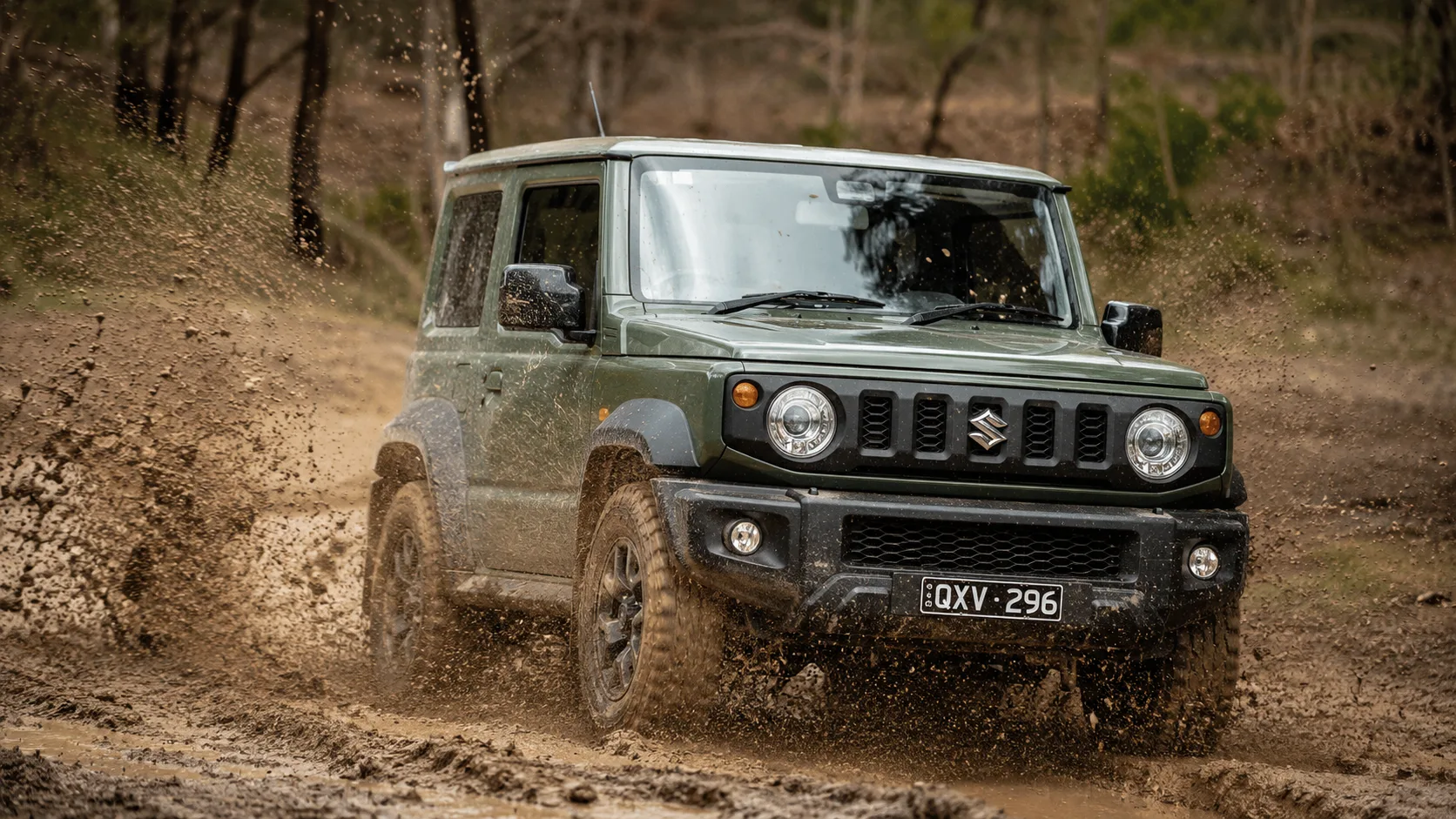
Mud is where the Jimny’s light weight becomes a superpower. Where heavier 4x4s sink and bog, the featherweight Jimny floats — if you drive it right. Mud is also where overconfidence ends trips. This guide covers reading mud, the technique to get through it, and the recovery plan for when you don’t.
Why the Jimny Excels in Mud
The single biggest factor in mud performance is weight, and the Jimny weighs around 1,100 kg — roughly half what a full-size 4×4 weighs. Less weight means less tendency to sink through the surface crust into the bog beneath. Combined with short overhangs, a tight wheelbase, and genuine low-range 4WD, the Jimny gets through mud that swallows much larger, more powerful vehicles.
The catch: light weight also means less momentum to carry you through, and the Jimny’s modest power can be overwhelmed by clinging mud if you bog the wheels. Technique matters more than power.
In mud, the Jimny’s lightness is the whole game. Stay light on the controls, keep it moving, and let the tyres do the work.
Marcus Roux, Compact Conqueror
Before You Enter: Read the Mud

The most important skill is judging mud before committing to it. Walk it if you can:
- Depth: Probe with a stick. Unknown-depth mud or water is the classic trap — there may be a hidden hole or rock
- Base: Is there a firm bottom under the mud, or is it bottomless bog? A firm base is drivable; bottomless bog is not
- Length: Can you see the firm ground at the far side, and is it within the distance your momentum can carry you?
- Ruts: Existing ruts show the established line — but deep ruts can high-centre a short vehicle. Judge whether your clearance suits them
- Exit: Always identify your exit before you enter. Never commit to mud you can’t see the end of
Mud Driving Technique
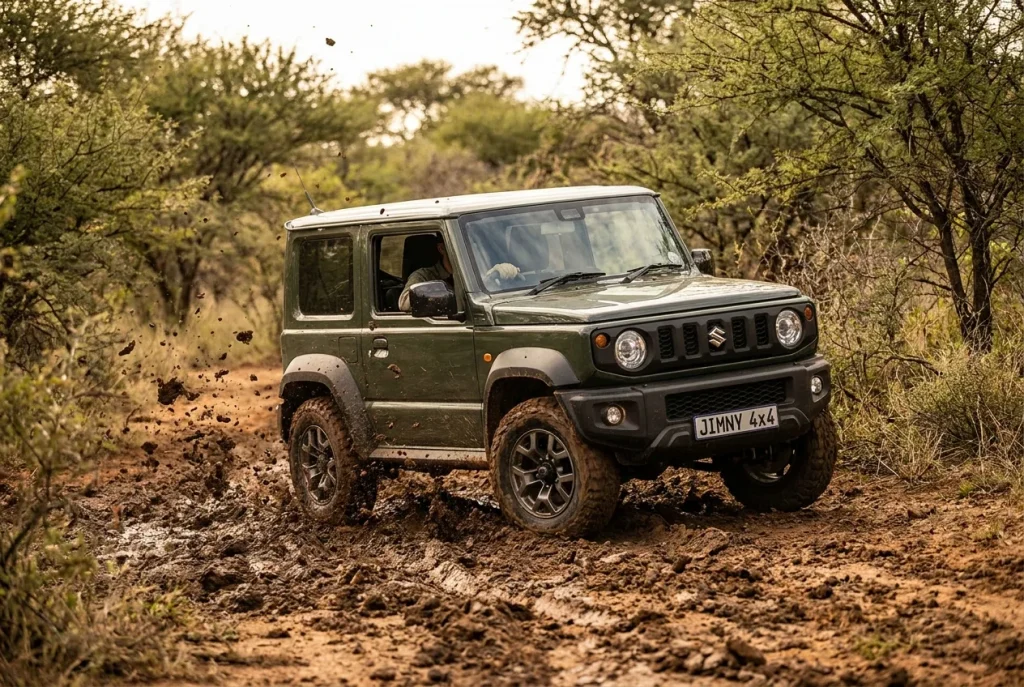
- Tyres first. Air down to roughly 1.4–1.6 bar for a larger contact patch and better grip. Mud-terrain tyres clear mud from their tread far better than all-terrains in deep, sticky mud — but quality ATs handle most situations
- Select low range (4L) for control and torque, typically 2nd or 3rd gear to keep momentum without bogging
- Maintain steady momentum. Enough speed to keep moving, not so much that you lose control or slam a hidden obstacle. Smooth and consistent beats fast and jerky
- Keep the wheels turning at a constant speed. Spinning wheels dig you in; bogged wheels stop you. Find the rhythm where the tyres are clearing mud and finding grip
- Steer gently and use the ruts. Let the established ruts guide you. If you lose traction, a gentle “wiggle” of the steering can help the tyre shoulders find fresh grip
- If you start to bog, don’t bury it. Ease off before the wheels spin uselessly. Reversing back along your entry tracks is often the best escape
- Don’t stop in the bad section unless you have to — getting moving again from a standstill in deep mud is far harder than maintaining momentum
Recovery in Mud
Even with perfect technique, mud bogs vehicles. Be ready:
- Recovery boards under the driven wheels are the first resort for a bogged Jimny — clear mud from in front of the tyres, wedge the boards in, and drive out gently
- A kinetic recovery rope and a second vehicle handle deeper bogs — but never attach to anything but rated recovery points
- A winch is the remote-area answer when no second vehicle is available
- A shovel to clear mud from around the chassis and tyres is often what actually frees the vehicle
See our recovery gear essentials guide for the full kit and how to use it safely.
⚠ Protect your diff oil after deep mud and water
Deep mud and water crossings can force water past the differential and transfer case breathers, contaminating the gear oil. After deep mud or water, inspect these fluids — milky oil must be changed immediately. See our transfer case oil change guide.
After the Mud

Mud is corrosive and abrasive. After a muddy trail: rinse the underbody thoroughly (mud holds moisture against metal and accelerates rust), clean mud from the radiator and intercooler area to prevent overheating, check the brakes (mud-contaminated brakes are less effective until cleaned), and re-inflate your tyres to road pressure before returning to tar.
Frequently Asked Questions
Is the Suzuki Jimny good in mud?
Yes — surprisingly so. The Jimny’s light weight (around 1,100 kg) means it tends to float over mud that bogs heavier 4x4s, and its short wheelbase, low range and genuine 4WD make it very capable. The trade-off is less momentum and modest power, so technique matters more than in a heavy, powerful vehicle. Read the mud, keep steady momentum, and don’t bury the wheels.
What tyre pressure should I use in mud on a Jimny?
Around 1.4–1.6 bar is a good starting point for mud, increasing the contact patch for better grip and flotation. Re-inflate to road pressure before returning to tar — driving on lowered pressures at highway speed builds heat and risks tyre failure. Carry a 12V compressor to air back up.
Do I need mud-terrain tyres for the Jimny?
Only if you drive deep, sticky mud regularly. Mud-terrain tyres clear clinging mud from their tread far better than all-terrains, but they are noisier, wear faster and grip less well on wet tar. For occasional mud, quality all-terrains handle most situations. Reserve mud-terrains for genuinely mud-focused use. See our best tyres guide for options.
What do I do if my Jimny gets bogged in mud?
Stop spinning the wheels immediately — spinning digs you in deeper. Try reversing gently back along your entry tracks. If that fails, clear mud from around the tyres with a shovel and use recovery boards under the driven wheels to regain traction. For deeper bogs, use a kinetic recovery rope with a second vehicle or a winch, attached only to rated recovery points.
How do I protect my Jimny after driving in mud?
Rinse the underbody thoroughly to remove mud that holds moisture against metal and accelerates rust. Clean mud from around the radiator to prevent overheating, check that mud-contaminated brakes work properly, and inspect the differential and transfer case oils for milky water contamination after deep mud or water — changing them immediately if contaminated. Re-inflate tyres to road pressure.
Can I drive through mud alone in a Jimny?
It is far safer not to. If you bog in deep mud alone, self-recovery with boards and a shovel may work, but a winch or a second vehicle is often needed. Whenever possible, drive challenging mud in convoy, carry a full recovery kit, tell someone your route and expected return, and never commit to mud you cannot see the end of.
Trail conditions, access rules, permit requirements and seasonal closures change frequently and without notice. This guide is general information, not a substitute for current local advice. Always check conditions with local authorities or guides, travel prepared and within your abilities, and never drive a trail alone if you can avoid it.
Related Reading
Free Newsletter
The Compact Conqueror Newsletter
Trail reports, technique guides, mod picks and Jimny news — free, every week.
Free Jimny Tool
Working out your Jimny’s tyre size?
Check fitment, overall diameter, speedo error and clearance for any tyre size — before you buy or lift.