
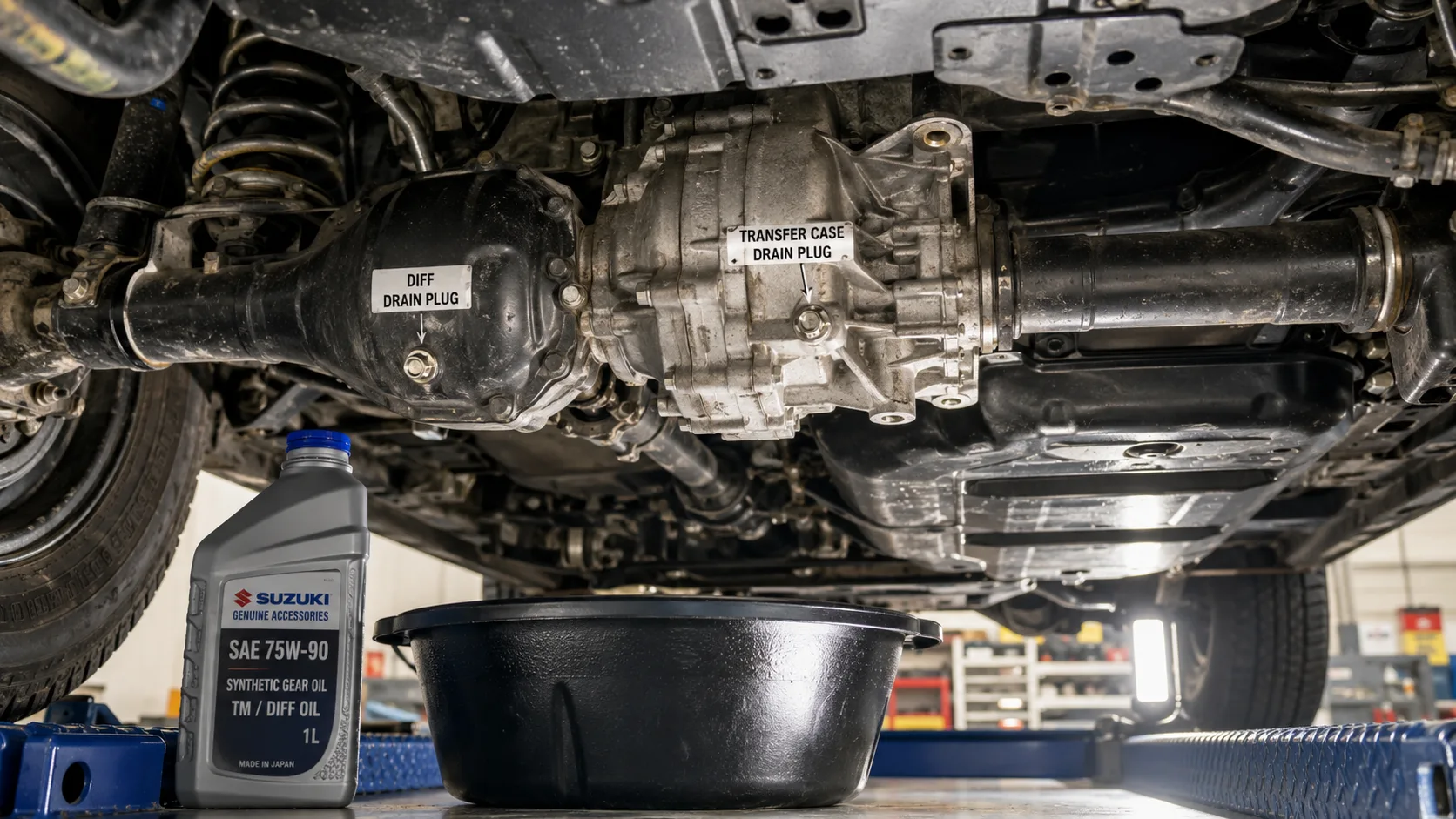
The transfer case and differential oils are the most neglected fluids on the Suzuki Jimny — and neglecting them is the most common cause of expensive 4WD drivetrain repairs. The job is straightforward, the fluids are cheap, and doing it on schedule can add a hundred thousand kilometres to your drivetrain’s life. Here is how.
Safety First — Read Before You Start
- Never work under a vehicle supported only by a jack. Always use rated axle stands on firm, level ground, and chock the wheels remaining on the ground.
- Work on a cold engine and cold components where the job involves hot fluids or brakes — fresh-run oil and brake parts can cause serious burns.
- Wear eye protection and gloves. Used oil, brake dust and brake fluid are hazardous.
- Use the correct torque settings — under- or over-tightening fasteners on a 4×4 is dangerous, especially on wheels and brakes.
- If you are not fully confident — especially with brakes — have the work done by a qualified mechanic. There is no shame in it, and safety-critical systems are not the place to learn under pressure.
Why the Drivetrain Fluids Matter So Much
The Jimny’s genuine off-road ability comes from its transfer case (which splits drive between front and rear and provides low range) and its front and rear differentials. These components run in gear oil that degrades over time, gets contaminated by moisture — especially after water crossings — and eventually fails to protect the gears. The result of neglect is accelerated wear, whining, and ultimately expensive transfer case or differential failure.
Unlike engine oil, these fluids are out of sight and easy to forget. But on a vehicle used as Suzuki intended — off-road, in mud, through water — they need changing every 40,000 km, and inspecting after every significant water crossing.
Engine oil gets all the attention. The transfer case and diffs get none — until they whine, and then the bill arrives. Change them on schedule.
Sarah Okafor, Compact Conqueror
The Four Drivetrain Fluids
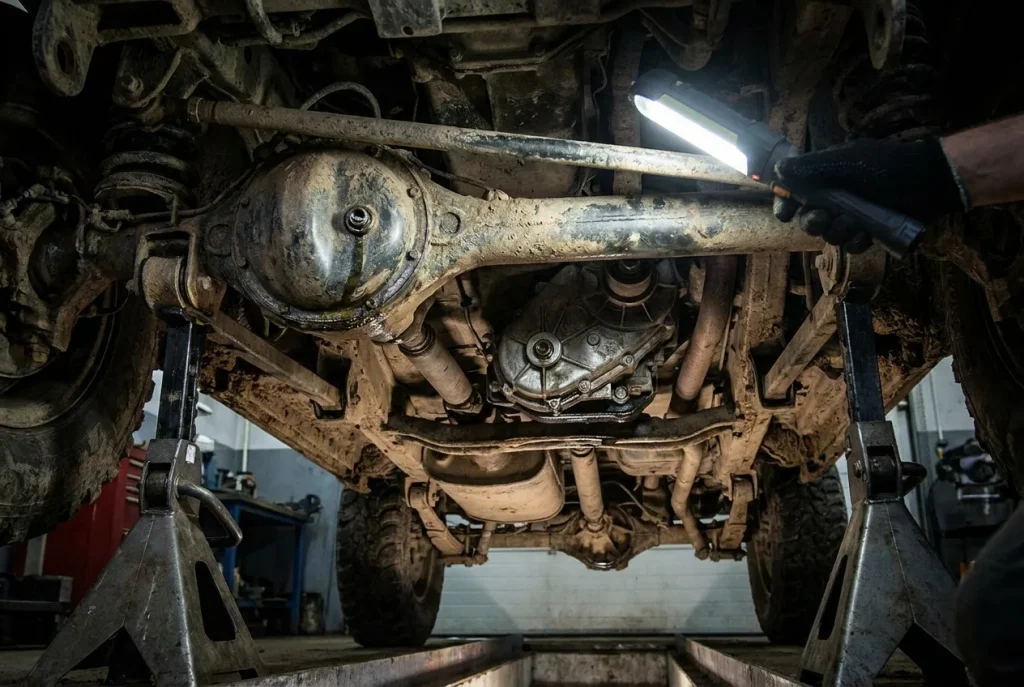
| Component | Typical Fluid | Approx. Capacity | Interval |
|---|---|---|---|
| Transfer case | GL-4 75W-85 gear oil | ~0.9–1.3 litres | 40,000 km |
| Front differential | GL-5 75W-90 gear oil | ~1.2 litres | 40,000 km |
| Rear differential | GL-5 75W-90 gear oil | ~1.4 litres | 40,000 km |
| Manual gearbox (related) | GL-4 75W-85 / 75W-90 | ~1.5 litres | 40,000–60,000 km |
⚠ GL-4 vs GL-5 — get it right
The transfer case (and manual gearbox) often specify GL-4, while the differentials specify GL-5. Some GL-5 oils contain extra-pressure additives that can attack brass synchroniser and bush components in units designed for GL-4. Always match the GL rating to each component — confirm against your manual.
What You’ll Need
- Correct gear oil for each component (GL-4 and GL-5 as specified)
- A gear oil pump or syringe (the fill holes are awkward to reach by pouring)
- Sockets / spanners for the fill and drain plugs (often a square drive or hex)
- New sealing washers for the drain and fill plugs
- Drain pan, funnel, rags, brake cleaner
- Torque wrench (plugs must be correctly torqued)
- Rated axle stands and wheel chocks — and ideally level ground so fill levels are accurate
⚠ Open the fill plug first
Before draining any unit, always loosen the fill plug first. If the fill plug is seized and you have already drained the oil, you are left with an empty, undriveable component. Confirm you can open the fill plug before you drain.
Step-by-Step: Changing a Differential / Transfer Case Oil
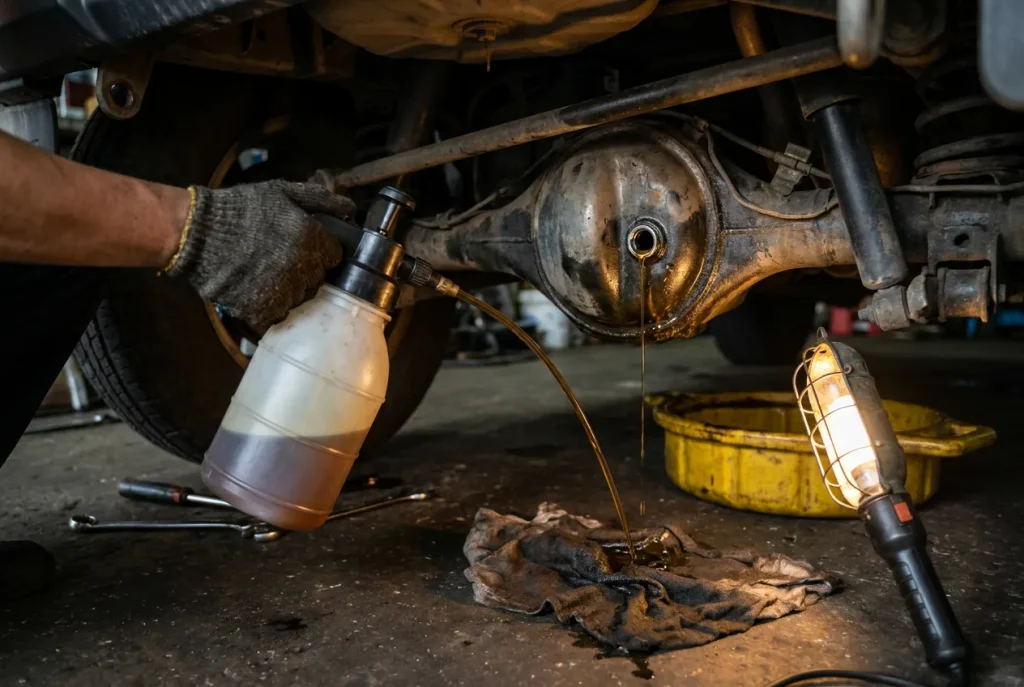
The process is the same for each unit (transfer case, front diff, rear diff). Work on level ground for accurate fill levels.
- Secure the vehicle on rated axle stands on firm, level ground, with the wheels chocked. The vehicle must be level for the fill level to be correct.
- Loosen the fill plug first. Confirm it will open before you drain anything. Clean around it first to keep dirt out.
- Position the drain pan under the drain plug (the lower plug).
- Remove the drain plug and let the old oil drain fully. Inspect it: milky oil indicates water ingress; metallic particles indicate wear. A magnetic drain plug will collect fine swarf — clean it.
- Clean and refit the drain plug with a new sealing washer, torqued to specification.
- Fill through the fill hole using a pump or syringe until oil just begins to seep out of the fill hole — this is the correct level for these units (filled to the bottom of the fill hole).
- Refit the fill plug with a new washer, torqued to specification.
- Wipe down and check for leaks. Repeat for each component.
- Dispose of the old oil responsibly at a recycling point.
⚠ Fill level = bottom of the fill hole
Differentials and transfer cases are filled to the bottom of the fill hole, not to a stated capacity. When clean oil just begins to weep from the fill hole with the vehicle level, it is full. The capacity figures are for buying oil, not for measuring the fill.
After Water Crossings — Inspect, Don’t Assume

Water crossings are the single biggest threat to these fluids. Water can enter past the breathers and seals, emulsifying the gear oil into a milky paste that no longer protects the gears. After any significant water crossing:
- Inspect each unit’s oil — crack the fill plug and check for milky, creamy contamination
- If contaminated, change the affected fluid immediately before further driving
- Consider fitting extended diff breathers (a popular mod) to reduce water ingress for regular water crossings
- Don’t wait for the 40,000 km interval if you’ve been through deep water
For the full maintenance picture, see our JB74 service schedule and JB23 service schedule.
Frequently Asked Questions
How often should I change the Jimny transfer case and diff oil?
Every 40,000 km under normal use — and immediately after any significant water crossing if the oil shows milky contamination. These are the most neglected fluids on the Jimny, and neglecting them is the most common cause of expensive 4WD drivetrain repairs. On a vehicle used off-road as intended, treat the 40,000 km interval as a firm milestone.
What oil goes in the Jimny transfer case and differentials?
Typically GL-4 75W-85 gear oil in the transfer case (and manual gearbox), and GL-5 75W-90 gear oil in the front and rear differentials. Capacities are roughly 0.9–1.3 litres for the transfer case, 1.2 litres front diff and 1.4 litres rear diff. Always confirm the grade, GL rating and capacity against your owner’s manual for your specific vehicle.
Why does GL-4 vs GL-5 matter for the Jimny drivetrain?
Some GL-5 gear oils contain extra-pressure additives that can corrode brass components in units designed for GL-4 — such as the synchronisers in a manual gearbox or bushes in the transfer case. The transfer case and gearbox often specify GL-4, while the differentials specify GL-5. Always match the correct GL rating to each component to avoid damage.
How do I know if water got into my diffs after a crossing?
Crack open the fill plug of each unit and check the oil. Milky, creamy, or coffee-coloured oil indicates water has emulsified with the gear oil — it no longer protects the gears and must be changed immediately. Clean gear oil is dark amber to brown. Always inspect after any deep or sustained water crossing rather than assuming the seals kept water out.
Can I change the drivetrain oils myself?
Yes — it is a straightforward DIY job, easier than many engine jobs, requiring basic tools plus a gear oil pump (the fill holes are awkward to pour into). The key rules are: open the fill plug before draining, use the correct GL rating for each unit, fill to the bottom of the fill hole, and torque the plugs to specification. Work on level ground for accurate fill levels.
What are extended diff breathers and do I need them?
Extended diff breathers reroute the differential and transfer case air breathers higher up the vehicle (away from water), reducing the chance of water being drawn in past the breather during a crossing as the hot components cool and contract. They are a worthwhile, inexpensive modification for anyone who regularly crosses water, and they help protect exactly the fluids this guide covers.
Fluid grades, capacities and torque settings vary by engine variant, model year and market. The figures here are an indicative guide — always confirm the correct specification for your specific vehicle against the owner’s manual or a factory/Haynes service manual, and torque all fasteners to the manufacturer’s specification.
Related Reading
Free Newsletter
The Compact Conqueror Newsletter
DIY guides, maintenance reminders, mod picks and Jimny news — free, every week.
Free Jimny Tool
What will your Jimny really cost to own?
Fuel, insurance, tyres and servicing — get a realistic monthly and annual running-cost estimate in under a minute.