
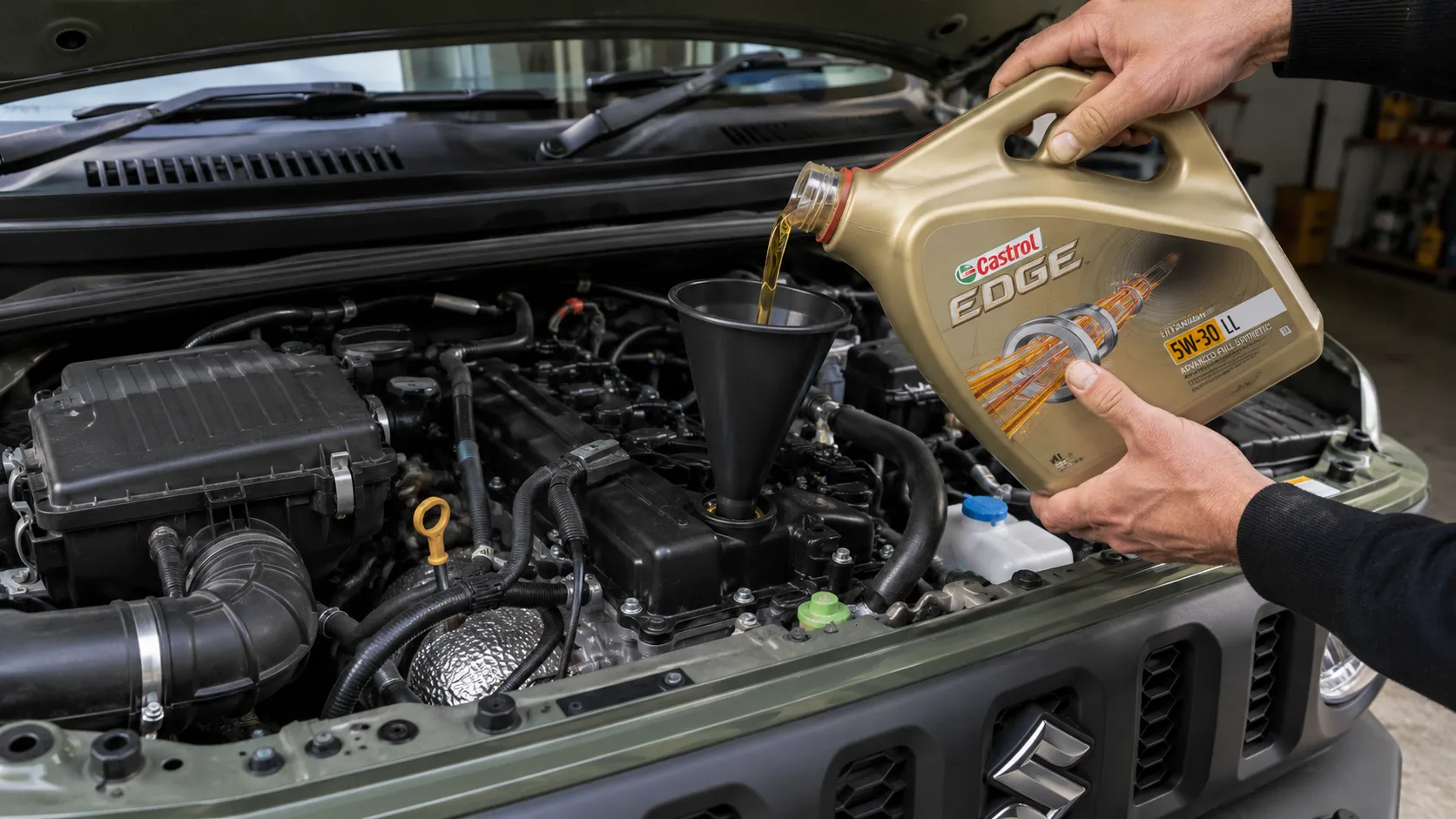
Changing your Jimny’s engine oil is the single most valuable thing you can do for its longevity — and it’s a genuinely beginner-friendly DIY job that takes about 30 minutes. This step-by-step guide covers the process for the JB74 (K15B) and the third-generation 1.3L (M13A), what you need, and the mistakes to avoid.
Safety First — Read Before You Start
- Never work under a vehicle supported only by a jack. Always use rated axle stands on firm, level ground, and chock the wheels remaining on the ground.
- Work on a cold engine and cold components where the job involves hot fluids or brakes — fresh-run oil and brake parts can cause serious burns.
- Wear eye protection and gloves. Used oil, brake dust and brake fluid are hazardous.
- Use the correct torque settings — under- or over-tightening fasteners on a 4×4 is dangerous, especially on wheels and brakes.
- If you are not fully confident — especially with brakes — have the work done by a qualified mechanic. There is no shame in it, and safety-critical systems are not the place to learn under pressure.
Why Change Your Own Oil?
Beyond the cost saving, doing your own oil changes means you can use the exact oil you want, do it on your own schedule (important for off-road and dusty use where 5,000 km intervals beat the factory 10,000–15,000 km), and — crucially — inspect the underside of the vehicle and the old oil for warning signs every time. It’s the cheapest insurance against expensive engine problems.
An oil change is the cheapest job you’ll ever do and the one that matters most. Skip it and the engine pays — eventually with interest.
Sarah Okafor, Compact Conqueror
What You’ll Need
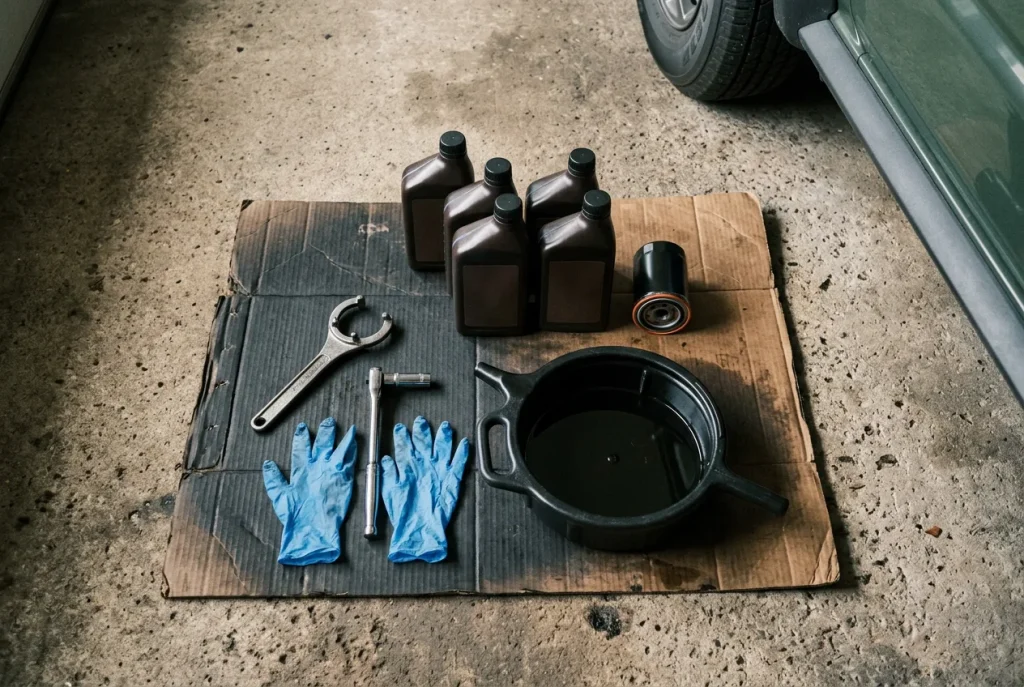
| Item | Specification | Notes |
|---|---|---|
| Engine oil | See table below for your engine | Buy slightly more than the stated capacity |
| Oil filter | Correct part for your engine | Genuine Suzuki or quality equivalent (e.g. Mann, Bosch) |
| Drain plug washer | Crush washer (correct size) | Replace each time — prevents leaks |
| Socket / spanner | For the drain plug (commonly 14–17 mm) | Confirm size for your vehicle |
| Oil filter wrench | Cup or strap type | For removing the spin-on filter |
| Drain pan | Minimum 5-litre capacity | To catch the old oil |
| Funnel | Clean | For mess-free refilling |
| Axle stands / ramps | Rated for the vehicle | Plus wheel chocks — never a jack alone |
| Gloves, rags, eye protection | — | Used oil is hazardous |
| Engine | Typical Oil Grade | Approx. Capacity (with filter) |
|---|---|---|
| JB74 — K15B 1.5L | 5W-30 fully synthetic | ~3.3 litres |
| Third-gen — M13A 1.3L | 10W-40 / 5W-40 (semi/full synthetic) | ~4.6 litres |
| Third-gen — G13BB 1.3L (earlier) | 10W-40 | ~5.0 litres |
| JB23 — K6A 658cc turbo | 5W-30 / 5W-40 full synthetic | ~2.7–3.0 litres |
⚠ Buy oil to the dipstick, not the spec sheet
Stated capacities are for buying the right quantity. The dipstick is the authority on how much to actually put in. Fill to just below the upper mark, run the engine, let it settle, then top up precisely. Overfilling damages seals and can cause oil to foam.
Step-by-Step: Oil Change
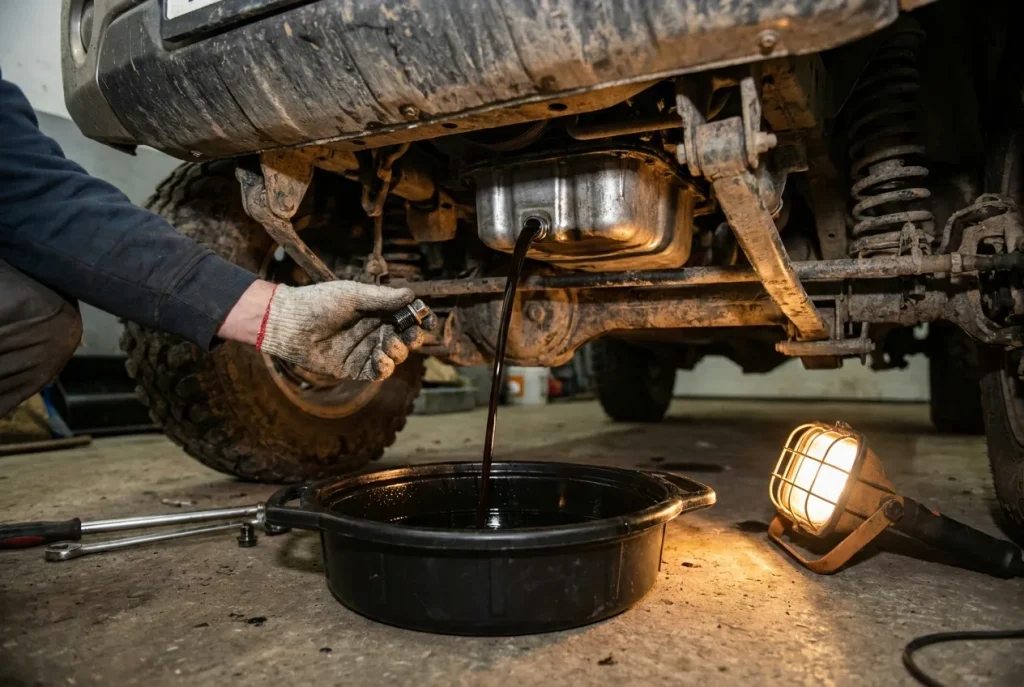
- Warm the engine slightly. Run it for 2–3 minutes so the oil flows freely and carries contaminants out — but not so long that the oil and exhaust are dangerously hot. Then switch off.
- Raise and secure the vehicle. On firm, level ground, raise the front, place rated axle stands, chock the rear wheels. Confirm it is stable before going underneath.
- Position the drain pan. Place it under the sump drain plug, allowing for the initial flow to arc outward.
- Remove the drain plug. Loosen with the correct socket, then unscrew by hand for the last turns (expect warm oil). Let it drain fully — several minutes.
- Remove the old oil filter. Position the drain pan beneath it (filters hold oil). Use the filter wrench to loosen, then unscrew by hand. Wipe the mounting face clean.
- Fit the new filter. Smear a film of fresh oil on the new filter’s rubber seal. Screw on by hand until the seal contacts, then tighten the additional amount specified on the filter (typically three-quarters to one full turn) — by hand, not with the wrench.
- Refit the drain plug. Fit a new crush washer, thread the plug in by hand to avoid cross-threading, then torque to the manufacturer’s specification (commonly around 35 Nm — verify).
- Refill with new oil. Lower the vehicle. Add oil through the filler, stopping short of the full capacity. Wait, then check the dipstick.
- Check the level. With the vehicle level, the dipstick should read between the marks. Add small amounts and re-check — do not overfill.
- Run and re-check. Start the engine; the oil light should go out within seconds. Check for leaks at the plug and filter. Switch off, wait a few minutes, and re-check the dipstick. Top up if needed.
- Dispose of the old oil responsibly. Take used oil and the old filter to a recycling point or service centre — never pour it away.
Reading the Old Oil — Free Diagnostics
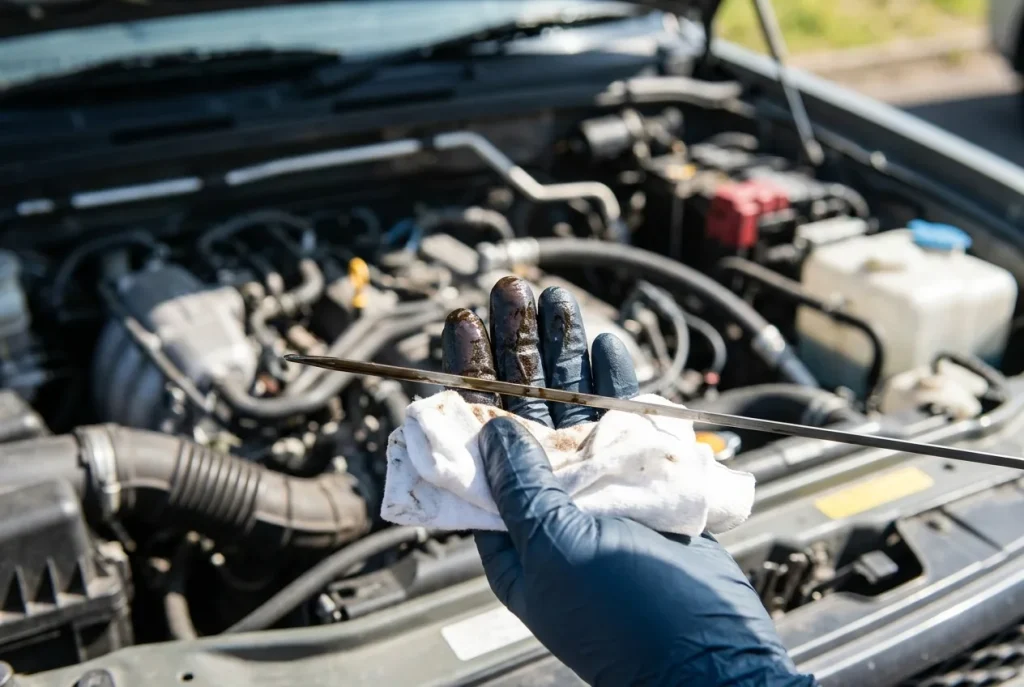
Before you discard it, the old oil tells you about the engine’s health:
- Milky / creamy: Coolant contamination — possible head gasket issue. Investigate before driving further.
- Metallic glitter: Internal wear — have it investigated.
- Very black and thick (gritty): Overdue change or hard use — shorten your interval.
- Fuel smell / thin: Possible fuelling issue diluting the oil.
- Normal: Dark amber to black, smooth, no particles — exactly what you want.
How Often?
For normal road use, follow your manual’s interval (10,000 km for the third-gen, 15,000 km for the JB74, or 12 months). For off-road, dusty, towing, or short-trip use, shorten the oil change interval to 5,000 km. See our JB74 service schedule and JB23 service schedule for full plans.
Frequently Asked Questions
How much oil does a Suzuki Jimny take?
It depends on the engine. The JB74’s K15B 1.5L takes approximately 3.3 litres with a filter change. The third-gen 1.3L M13A takes around 4.6 litres, the earlier G13BB around 5.0 litres, and the 658cc K6A turbo around 2.7–3.0 litres. Always confirm against your owner’s manual and fill to the dipstick mark rather than relying on a stated capacity.
What oil should I use in my Jimny?
The JB74 K15B uses fully synthetic 5W-30. The third-gen 1.3L M13A typically uses 10W-40 or 5W-40 (semi- or fully synthetic); the K6A turbo benefits from a quality 5W-30/5W-40 full synthetic. Always confirm the grade against your owner’s manual for your specific engine, year and market — and use a quality oil meeting the required specification.
How long does an oil change take on a Jimny?
For a confident DIYer, about 30 minutes once you have the tools and oil ready. First-timers should allow an hour and not rush — particularly the steps of securing the vehicle safely, fitting the filter correctly, and checking the level properly. The job is genuinely beginner-friendly thanks to the Jimny’s accessible engine bay and sump.
How often should I change my Jimny’s oil?
For normal road use, follow your manual: typically 10,000 km for the third-gen and 15,000 km for the JB74, or every 12 months. For off-road, dusty, towing, or frequent short-trip use, shorten the interval to 5,000 km — these conditions contaminate oil faster. Regular oil changes are the single biggest factor in Jimny engine longevity.
Can I overfill the oil on a Jimny?
Yes, and it is harmful. Overfilling can cause the oil to foam (reducing lubrication), stress seals, and lead to leaks. Always fill to just below the upper dipstick mark, run the engine, let it settle, then top up precisely to the upper mark. Use the dipstick as the authority — never just pour in the full stated capacity blindly.
What do I do with the old oil?
Used engine oil and oil filters are hazardous waste and must be recycled, never poured down a drain or onto the ground. Collect the old oil in a sealable container and take it, along with the old filter, to a recycling point, service centre, or auto-parts retailer that accepts used oil. Many do so free of charge.
Fluid grades, capacities and torque settings vary by engine variant, model year and market. The figures here are an indicative guide — always confirm the correct specification for your specific vehicle against the owner’s manual or a factory/Haynes service manual, and torque all fasteners to the manufacturer’s specification.
Related Reading
Transfer Case & Diff Oil Change
The drivetrain fluids most owners forget — and how to change them.
Free Newsletter
The Compact Conqueror Newsletter
DIY guides, maintenance reminders, mod picks and Jimny news — free, every week.
Free Jimny Tool
What will your Jimny really cost to own?
Fuel, insurance, tyres and servicing — get a realistic monthly and annual running-cost estimate in under a minute.