

Affiliate Disclosure: Compact Conqueror earns a small commission on qualifying purchases through links on this page — at no extra cost to you. We only recommend products tested or verified by our community. See our affiliate disclosure.
The daily driver build is the most rational Jimny specification: a car you can take to the office every weekday and to a trail every second weekend without compromise in either direction. It does not require a huge budget, a trailer to transport it, or a dedicated wash bay. This build costs R8,000–R18,000 in total modifications and transforms the experience in both environments.
The Daily Driver Philosophy
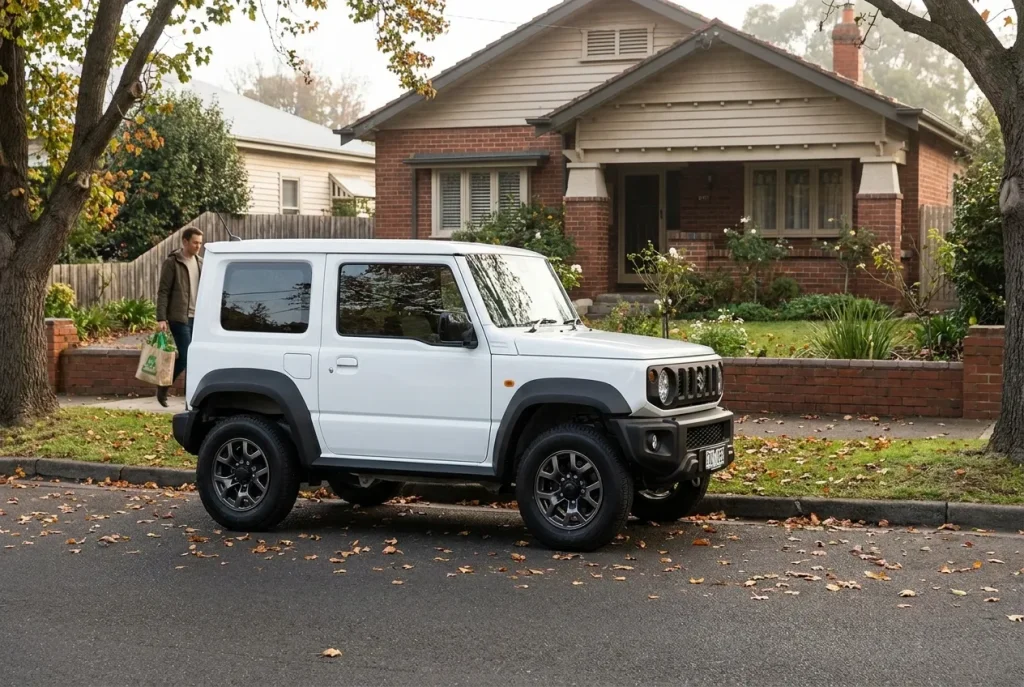
Most Jimny owners drive more kilometres on tar than on dirt. A daily driver build acknowledges this reality while still making meaningful capability improvements for the gravel roads, farm gates, and light trails that define the South African weekend use case.
The daily driver spec avoids: aggressive mud-terrain tyres that roar on tar, suspension lifts so high they upset on-road handling, and modifications that require the car to leave the road to be useful. Every upgrade in this specification improves the driving experience on both surfaces.
The best Jimny build for most owners is the one they actually use every day without compromising either environment.
James Crawford, Compact Conqueror
Daily Driver Build Specification
| Component | Brand / Option | Approx. Cost (ZAR) | Notes |
|---|---|---|---|
| All-terrain tyres (4 + spare) | Falken Wildpeak AT3W 215/75R15 | R9,500–R12,000 | Best daily-use AT tyre: low noise, excellent wet grip |
| Wheel alignment (post-tyre fit) | 4×4-specialist workshop | R650–R900 | Mandatory with any new tyre size |
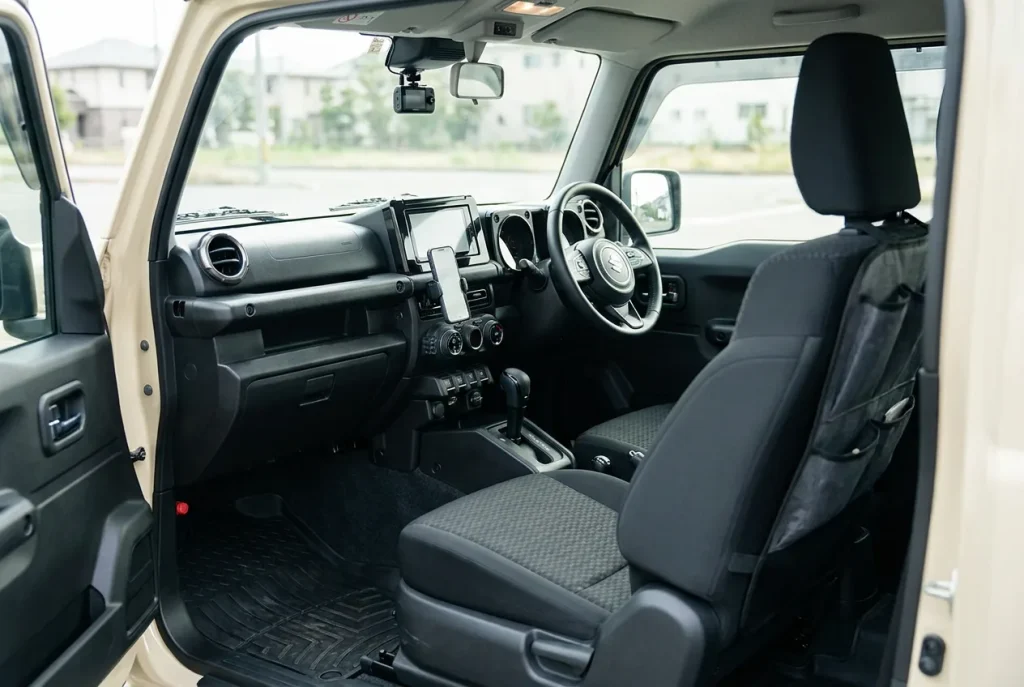
| Heavy-duty rubber floor mats | Sakura / Hase / custom moulded | R650–R1,100 | Waterproof, hose-cleanable, prevents carpet damage |
| Cargo liner (boot) | Custom-moulded rubber | R550–R850 | Protects boot from trail mud and equipment |
| Tyre pressure gauge (quality) | Micrometer or Longacre digital | R200–R450 | Accurate pressure reading for airing down |
| Basic kinetic recovery rope + 2x shackles | 8,000 kg rope, 4.75 t shackles | R900–R1,400 | Minimum safe recovery setup |
| Recovery boards (x2) | Bush Mech or MaxTrax | R1,800–R4,500 | Self-recovery without a second vehicle |
| 12V compressor (medium) | Bushranger Explorer / Ironman | R1,400–R2,200 | Re-inflate after airing down — essential |
| Dash camera | Thinkware Q800 Pro or Garmin 67W | R2,500–R4,500 | Incident protection — valuable in SA traffic |
| LED interior upgrade (optional) | 5050 SMD strip — warm white | R300–R600 | Improved cabin visibility at night |
Free Jimny Tool
What will your Jimny really cost to own?
Fuel, insurance, tyres and servicing — get a realistic monthly and annual running-cost estimate in under a minute.
Total Budget Estimate
| Category | Budget Range |
|---|---|
| All-terrain tyres (5 with spare) | R9,500–R12,000 |
| Tyre fitting, balancing, alignment | R1,200–R1,700 |
| Interior protection (mats + liner) | R1,200–R1,950 |
| Pressure management (gauge + compressor) | R1,600–R2,650 |
| Basic recovery kit | R2,700–R5,900 |
| Dash camera | R2,500–R4,500 |
| Total | R18,700–R28,700 |
The majority of this budget is the tyre upgrade and recovery kit — both of which directly improve capability and safety. The compressor and dash camera are investments that pay for themselves at first use.
What This Build Does and Does Not Change

What Improves
- Off-road capability: AT tyres transform grip on loose surfaces, mud, and gravel. The difference versus stock road tyres is immediately noticeable
- On-road confidence in wet weather: Quality AT tyres (particularly the Falken AT3W) perform better in wet tar conditions than many road tyres in this segment
- Practical utility: Rubber mats and cargo liner mean trail days stop being a cleaning nightmare
- Safety: Recovery gear and compressor mean a stuck situation stays manageable
What Does Not Change
- Road noise: AT tyres are slightly louder than road tyres — negligible on quality brands like the Falken AT3W
- Fuel economy: Approximately 0.4–0.7 L/100 km increase from the AT tyre change — acceptable
- Ground clearance: No lift means stock clearance — this is appropriate for the daily driver use case
- Ride height: The Jimny looks essentially stock — intentional for daily parking environments
Optional Additions for the Daily Driver
These additions move toward the Weekend Warrior spec but are compatible with daily use:
- Nudge bar or combo bar: Adds front recovery points and light mounting for R5,000–R9,000
- LED spot lights (small pods): Meaningful night driving improvement on gravel for R1,500–R3,000 including wiring
- 40mm lift kit: Improves approach and departure angles and gives the AT tyres more articulation room — but shifts the build toward Weekend Warrior territory
Maintenance Schedule for a Modified Daily Driver
AT tyres require more frequent rotation than road tyres — every 12,000 km rather than 15,000 km. Include the spare in a 5-tyre rotation pattern every 30,000 km. Compressors should be drained of moisture after every use to prevent internal corrosion. The recovery rope should be air-dried after trail use before packing away.
Frequently Asked Questions
Is the daily driver build suitable for first-time Jimny owners?
Yes — this is the ideal first-year build. It addresses the highest-impact areas (tyres, safety, practical utility) without locking you into decisions before you understand your actual use pattern. Run this spec for 6–12 months, then upgrade to Weekend Warrior if the trails are calling.
Can I do the daily driver build in stages?
Absolutely. Priority order: tyres first (biggest impact), floor mats and cargo liner (immediate quality-of-life), pressure gauge and compressor (safety for airing down), then recovery kit. The dash camera can go in any time.
Will AT tyres affect my Jimny warranty?
Fitting approved tyre sizes (215/75R15 on the factory rim) should not invalidate the powertrain warranty. No structural modifications are made to the vehicle. Keep receipts for all fitment work. The tyre size change does not require notification to Suzuki under normal circumstances, but inform your insurer.
Is the Falken Wildpeak AT3W the right choice for all SA conditions?
For most SA daily drivers: yes. It performs excellently in wet Cape winters, handles Gauteng summer storms, and copes with the gravel and farm roads of the interior without the road noise penalty of an aggressive tyre. The BF Goodrich KO2 is marginally better on rocky trails but louder on tar and R600–R1,000 more expensive per tyre.
Does this build work if I drive long distances between towns (N1, N3 etc.)?
Yes. Quality AT tyres are highway-capable at standard road speeds. Fuel consumption increases are modest (0.4–0.7 L/100 km). The compressor and recovery gear add minimal weight and have no impact on highway dynamics. This build is fully highway-suitable.
Related Reading
Jimny Weekend Warrior Build
The next level — what happens when the trails start calling more often.
Best Tyres for Suzuki Jimny
Full tyre comparison guide for the JB74 with all size and brand options.
Free Newsletter
The Compact Conqueror Newsletter
Mod guides, trail reports, build diaries and Jimny news — free, every week.