Affiliate Disclosure: Compact Conqueror earns a small commission on qualifying purchases made through links on this page — at no extra cost to you. We only recommend products we’ve tested or our community has verified. See our full affiliate disclosure.
The Suzuki Jimny’s body-on-frame construction gives it inherent structural rigidity, but the critical mechanical components below the chassis — engine sump, gearbox, transfer case, fuel tank — are exposed to whatever the terrain throws at them. Underbody protection is not glamorous, not visible from the road, and not optional if you’re taking your Jimny anywhere beyond smooth gravel.
What Needs Protection — and Why
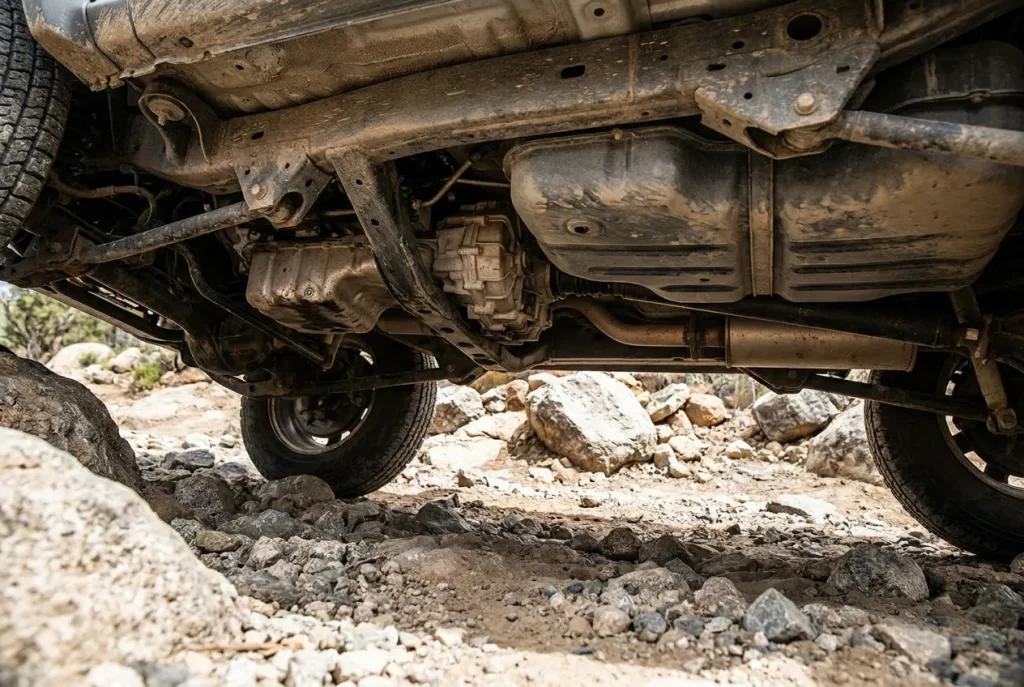
Walking under a Jimny at stock height reveals exactly what sits closest to the ground:
| Component | Vulnerability | Consequence of Damage | Protection Priority |
|---|---|---|---|
| Engine sump (oil pan) | Low-hanging, directly behind front wheels | Rock strike = oil loss = engine seizure | ⭐⭐⭐⭐⭐ Critical |
| Gearbox / transmission | Behind sump, slightly recessed | Strike risk on steep rocky approach angles | ⭐⭐⭐⭐⭐ Critical |
| Transfer case | Mid-vehicle, protrudes below chassis rail | The most commonly struck component on rocky trails | ⭐⭐⭐⭐⭐ Critical |
| Fuel tank | Rear underbody, partially protected by chassis | Puncture risk on sharp rocks | ⭐⭐⭐⭐ High |
| Rear differential | Low-hanging at rear axle | Strike = diff oil loss = rear axle failure | ⭐⭐⭐⭐ High |
| Rock sliders (sill rails) | Side of vehicle between axles | Side-entry rocks can stave in thin body sills | ⭐⭐⭐ Medium-High |
Skid Plate Materials: Steel vs Aluminium Alloy
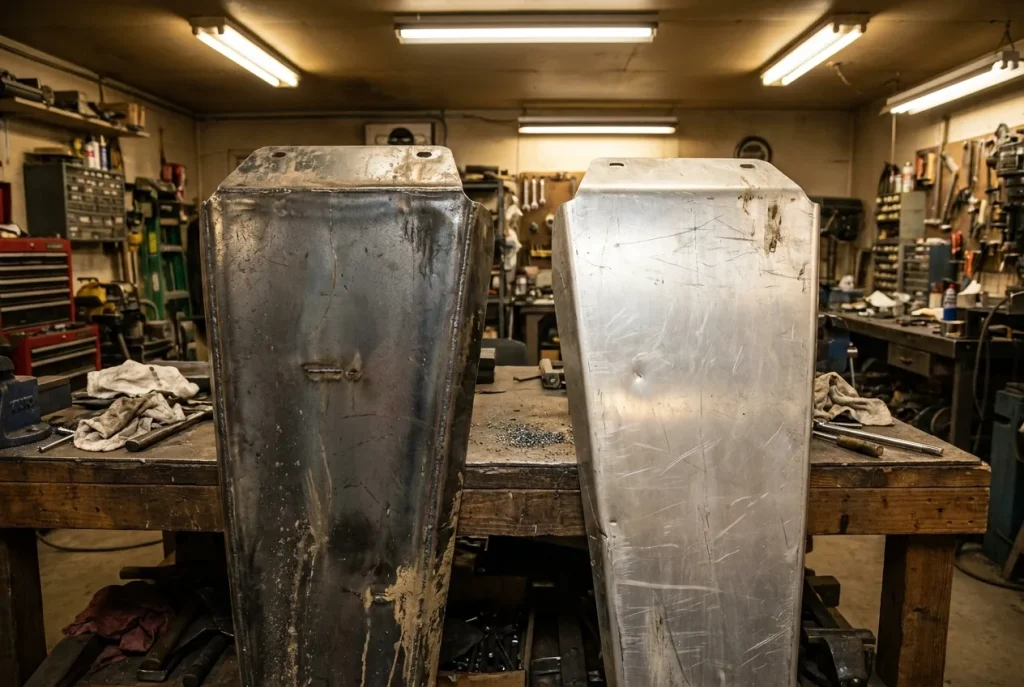
Two material choices dominate the JB74 skid plate market. Each has genuine trade-offs:
| Property | Mild Steel (3–4 mm) | High-Strength Steel (4–6 mm) | Aluminium Alloy (6–8 mm) |
|---|---|---|---|
| Weight | 4–6 kg per plate | 6–9 kg per plate | 2.5–4 kg per plate |
| Impact resistance | Bends, deforms | High — resists deformation | Cracks under severe point impact |
| Sliding over rocks | High friction — can hang up | High friction | Low friction — slides smoothly |
| Corrosion resistance | Requires coating/painting | Requires coating/painting | Excellent — anodised |
| Repairability | Weld or replace | Weld or replace | Replace (welding aluminium is complex) |
| Price (per plate) | R800–R1,800 | R1,200–R2,500 | R1,500–R3,200 |
For most South African owners: 4 mm mild steel with a quality powder coat is the sensible choice. It’s affordable, locally repairable if bent, and absorbs rock impacts without cracking. High-strength steel (HARDOX) is justified for serious rock crawlers who encounter sharp, high-force impacts regularly. Aluminium alloy is favoured for its weight savings and rock-sliding properties on sandy or rocky terrain where getting “stuck” on a plate is a concern.
Underbody armour is the most under-rated modification category. It saves your drivetrain so the glamorous mods can keep running.
Sarah Okafor, Compact Conqueror
Complete Skid Plate Coverage — JB74
Front Skid Plate (Engine + Gearbox)
The most important piece of armour on the vehicle. A quality front plate covers the engine sump and gearbox housing in a single unit, bolts to the front chassis rails, and is designed to deflect rocks forward and downward rather than absorbing the full impact force into the chassis.
Look for plates with a raised leading edge (to redirect rocks) and drain holes or access points for the sump drain plug. Plates that require removing the entire plate to change the oil are an ongoing maintenance annoyance.
Transfer Case Skid Plate
The transfer case is the most commonly struck component on technical rocky trails in South Africa. It sits at the lowest point of the driveline, exposed between the front and rear chassis rails. A quality transfer case plate is a separate item from the front skid — it mounts to the central chassis section and protects the AllGrip Pro transfer case housing.
Fuel Tank Skid Plate
The JB74’s fuel tank sits at the rear of the underbody, partially shielded by the rear chassis. A dedicated fuel tank plate adds the final layer of protection for trails involving loose rocks thrown back from the front tyres.
Rear Differential Skid Plate
The rear diff housing is exposed at the rear axle. A bolt-on rear diff guard protects the housing from direct rock strikes. This is a lower priority than the three plates above, but an essential addition for any owner who regularly runs rocky trails.
Rock Sliders (Side Sills)
Rock sliders are not technically “under” the vehicle, but they protect the sill area between the wheels — the section most vulnerable to rocks encountered during side slopes, cross-axle situations, and tight trail passages. A steel slider (also called a sill rail or rock rail) takes the impact that would otherwise stave in the thin pressed-steel sill panel.
Quality rock sliders also serve as a jacking point and step — a useful secondary function for Hi-Lift jack use in recovery situations.
Recommended Skid Plate Sets — SA Market
| Brand | Coverage | Material | Approx. Price (full set) | Notes |
|---|---|---|---|---|
| ARB (through Opposite Lock SA) | Front + TC + fuel | 3 mm steel | R4,500–R6,500 | Clean fitment, good deflection geometry |
| Ironman 4×4 | Front + TC | 3 mm steel | R3,200–R4,800 | Budget-accessible, wide SA distribution |
| TJM | Front + TC + rear diff | 4 mm steel | R5,000–R7,000 | Comprehensive coverage, quality finish |
| Rival 4×4 (import) | Front + TC + fuel + diff | 4 mm steel | R6,000–R9,000 | Premium quality, often community group buy import |
| Local fabrication (SA) | Custom to spec | 4–6 mm steel | R3,000–R6,000 | Regional 4×4 workshops — get references first |
Rock Sliders — Options
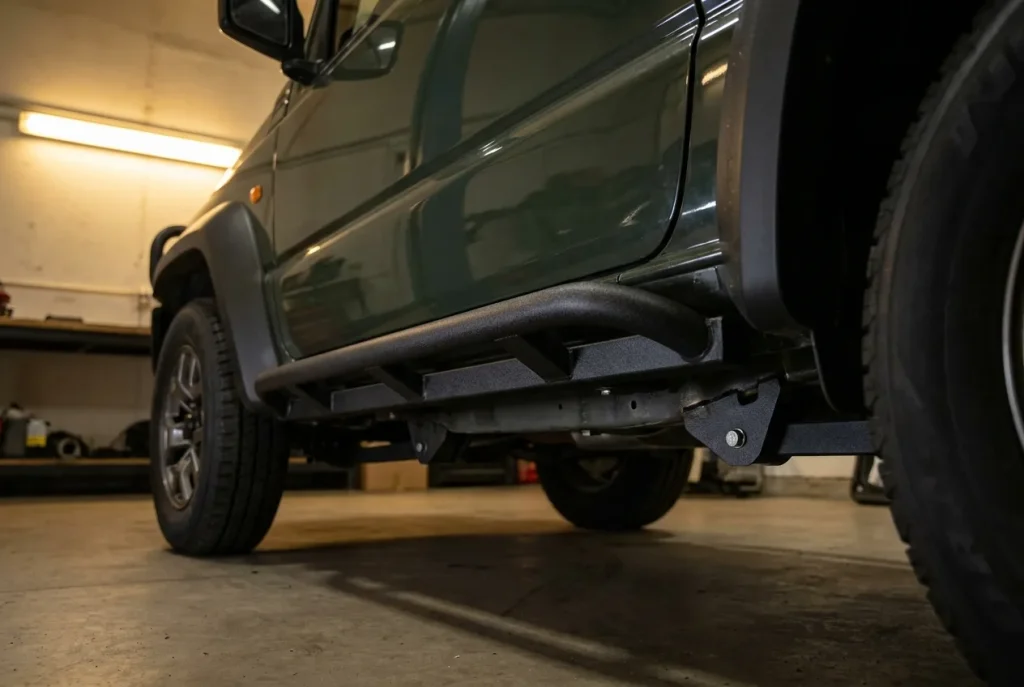
| Brand/Type | Material | Step Function | Approx. Price (pair fitted) | Notes |
|---|---|---|---|---|
| ARB Rock Sliders | 3 mm steel powder coat | No | R3,500–R5,000 | Clean look, strong mounting |
| Bush Baby 4×4 Rails | 4 mm steel | Yes (integrated step) | R4,000–R5,500 | SA made — popular choice |
| 4×4 Mega World (SA) | 3–4 mm steel | Optional | R3,200–R4,500 | Good value, local backup |
| Custom fabricated (local) | 4–6 mm steel | Specifiable | R2,500–R4,500 | Best for custom build requirements |
Installation Notes
Skid plates bolt to the factory chassis mounting points. No welding is required for standard plate installation. Installation time: 1–2 hours per plate at a qualified workshop. Key points:
- Use the correct-grade bolts (grade 8.8 minimum) — do not substitute hardware-store equivalents
- Apply a small amount of anti-seize compound to threads in the chassis captive nuts — trail mud causes corrosion
- Inspect and re-torque bolts at the 5,000 km service after installation — vibration can loosen them
- Check clearance between the plate and the sump drain plug before finalising — some plates require a drain plug access hole cut or existing hole alignment
- Rock sliders: ensure the welds at the chassis mounting brackets are fully penetrated — the rock slider takes side-load forces that a poorly welded mount will not handle
Frequently Asked Questions
Do I need skid plates if I only drive gravel roads?
For smooth graded gravel, skid plates are not essential. The risk begins when gravel roads incorporate embedded rocks, stream crossings with rocky beds, and rough ungraded tracks — which describes most of the interesting gravel roads in South Africa. The cost of a three-piece skid plate set (R4,000–R7,000) is trivially small compared to a sump replacement (R8,000–R15,000) or transfer case repair (R12,000–R25,000).
Should I get steel or aluminium skid plates?
For most SA conditions, mild steel is the pragmatic choice — it’s cheaper, locally weldable if bent, and absorbs impact energy without cracking. Aluminium alloy makes sense for owners who regularly slide over rocks on sandy terrain where the lower friction of aluminium prevents the plate hanging up on rock edges.
Are rock sliders the same as side steps?
No. Side steps (running boards) are designed for entry assistance — they are not rated for vehicle recovery or rock contact loads. Rock sliders are structural components welded or bolted to the chassis with the primary purpose of taking the impact of side terrain contact. Do not use a side step as a jacking point or in a Hi-Lift recovery setup.
Will skid plates affect my ground clearance?
A quality skid plate adds 8–15 mm of plate thickness below the sump or transfer case. On the JB74 at stock height, the ground clearance remains well above the plate’s lower face — the plate sits recessed within the chassis envelope. A 40 mm lift makes this even less of a concern. You are not sacrificing meaningful clearance for this protection.
Can I fit skid plates myself?
Yes — bolt-on skid plates are a DIY job for any owner comfortable with basic tools. Lift the vehicle safely on axle stands, identify the mounting points from the installation instructions, and torque the bolts to specification. Rock sliders that require welding to chassis mounting plates should be done by a qualified welder.
Related Reading
Jimny Lift Kit Guide
More clearance means less contact — but protection is still necessary.
Jimny Recovery Gear Essentials
Protected underbody + recovery kit = the complete trail safety package.
First Mods Priority List
See where underbody protection fits in the full modification sequence.
Free Newsletter
The Compact Conqueror Newsletter
Mod guides, trail reports, maintenance tips and Jimny news — free, every week.
Free Jimny Tool
Working out your Jimny’s tyre size?
Check fitment, overall diameter, speedo error and clearance for any tyre size — before you buy or lift.