
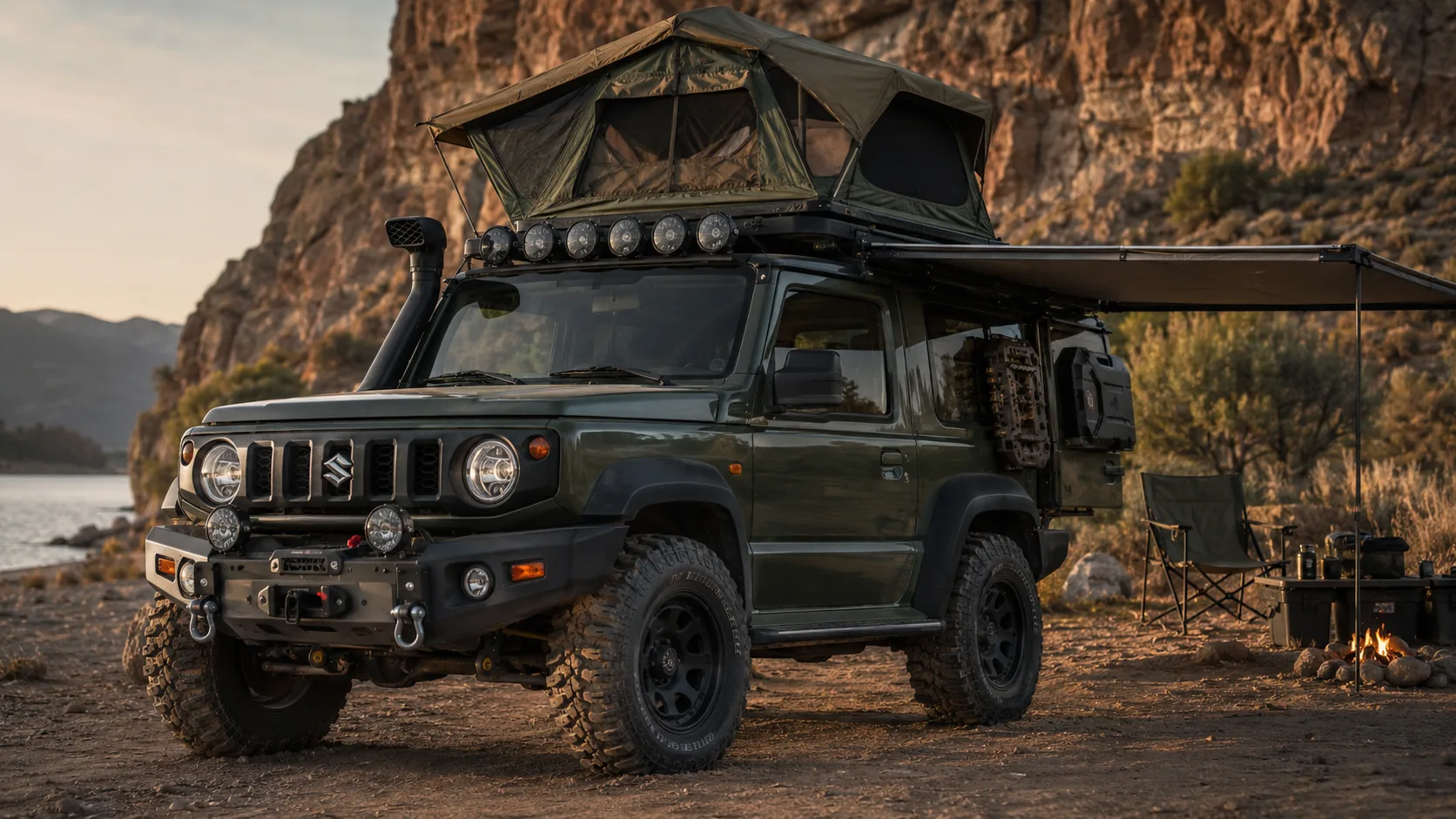
Affiliate Disclosure: Compact Conqueror earns a small commission on qualifying purchases through links on this page — at no extra cost to you. We only recommend products tested or verified by our community. See our affiliate disclosure.
The full overland build is the Jimny taken to its logical extreme — a self-sufficient, self-recovering, sleep-from-the-vehicle expedition machine capable of weeks in remote terrain without external support. It is not the right build for everyone, and it is not cheap. But for the owner who genuinely needs it, a properly built overland Jimny is one of the most capable and distinctive adventure vehicles available at any price point.
What an Overland Build Requires
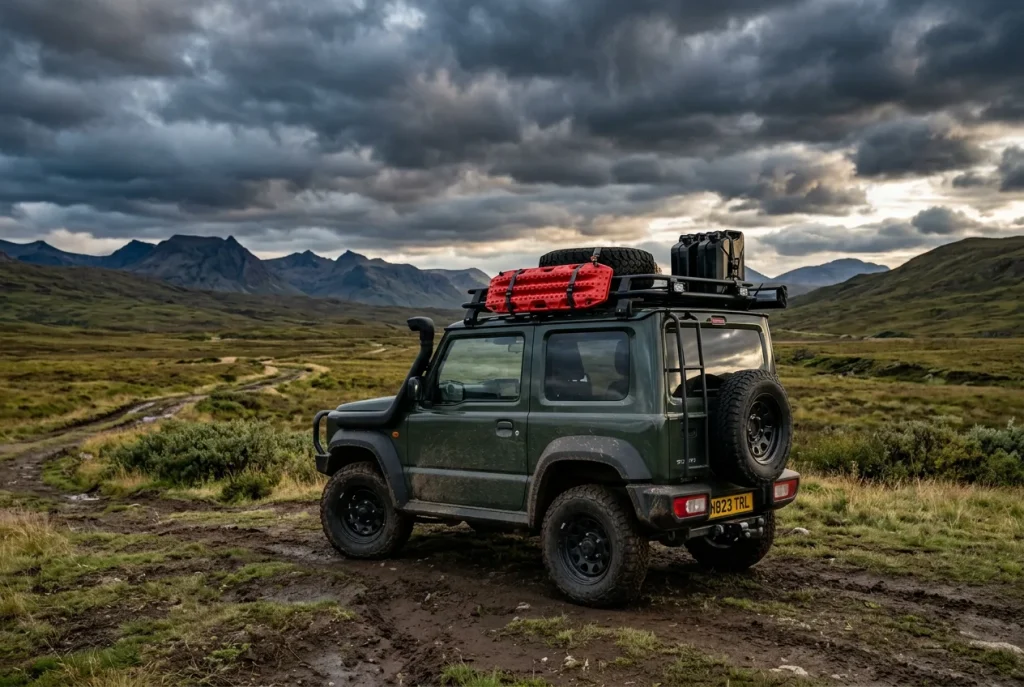
Overlanding is defined by self-sufficiency over extended time periods in remote locations. An overland-spec Jimny needs to address five core capabilities:
- Extended range: Fuel capacity beyond the standard 40L tank — long-range tank or jerry cans
- Independent power: A second battery and management system for fridges, lighting, and communications equipment
- Self-recovery: Winch, complete recovery kit, rear diff lock — capable of extraction without a second vehicle
- Sleeping accommodation: Rooftop tent or sleeping setup that does not require tenting infrastructure
- Habitat: Camp kitchen, water, shelter — the ability to operate independently for multiple days
An overland Jimny is a small expedition vehicle. It should be capable of handling everything the terrain and weather throw at it, without external assistance.
Marcus Roux, Compact Conqueror
Full Overland Build Specification
This specification assumes the Weekend Warrior base (suspension, skid plates, bull bar, recovery, lighting) is already in place. These are the additional overland-specific modifications:
| Component | Brand / Option | Approx. Cost (ZAR) | Notes |
|---|---|---|---|
| Winch (8,000–9,500 lb electric) | Warn VR EVO 8 or Runva 9.5XP | R8,000–R14,000 (winch only) | Requires winch-compatible bull bar cradle |
| Synthetic winch rope | Warn Epic Synthetic 9.5 mm x 28 m | R2,000–R3,500 | Safer than steel cable if it snaps |
| Winch accessories (dampener, extension, block) | Warn or ARB | R1,200–R2,000 | Complete winch recovery kit |
| Dual battery system | Redarc BCDC1225D + 100Ah AGM or LiFePO4 | R5,500–R10,000 fitted | DC-DC charger + auxiliary battery management |
| Fridge / cooler | Engel MT35 or ARB Elements 47L | R8,000–R16,000 | 12V compressor fridge — superior to ice for multi-day |
| Long-range fuel tank OR jerry cans | Long Ranger tank: R8,000–R14,000 fitted / Jerry cans: R800–R1,500 | R800–R14,000 | Long-range tank preferred; jerry cans as fallback |
| Rooftop tent | Eezi-Awn Blade or ARB Flinders | R14,000–R28,000 fitted | Quality tent significantly affects sleep quality in the field |
| Awning | ARB 2500mm x 2500mm or Eezi-Awn Manta | R4,000–R7,500 | Shade and rain shelter beside the vehicle |
| Rear diff lock | ARB Air Locker + onboard compressor | R18,000–R26,000 fitted | Transforms technical terrain capability |
| Snorkel | Safari Snorkel (if not fitted) | R2,800–R4,500 fitted | Essential for water crossings on remote routes |
| Water storage (10–20L) | Rigid water tank or MSR Dromedary bags | R500–R2,500 | Independent water supply for remote camps |
| Camp kitchen | Camp Champ 2-burner or MSR WhisperLite | R1,500–R5,000 | Cooking independent of campsite infrastructure |
| Communications (satellite) | Garmin inReach Mini 2 | R5,500–R8,500 (+ subscription) | Two-way satellite messaging for remote area safety |
| Navigation | Garmin Overlander or tablet + Tracks4Africa | R6,000–R12,000 | SA-specific mapping for remote tracks |
Total Build Cost Estimate
| Phase | Specification | Cumulative Cost Estimate |
|---|---|---|
| Stock JB74 GLX | Factory vehicle | R380,000–R415,000 |
| Daily Driver | AT tyres, mats, recovery basics, compressor, dash cam | + R18,000–R28,000 |
| Weekend Warrior | Lift, skids, sliders, bull bar, lights, recovery kit | + R32,000–R52,000 |
| Full Overland | Winch, dual battery, fridge, long-range fuel, RTT, awning, ARB locker, comms, nav | + R80,000–R135,000 |
| Full overland total (from new JB74) | All phases | R510,000–R630,000 |
Building from a used JB23 reduces the vehicle cost dramatically. Many overland-focused owners choose a sound JB23 as the base platform (R80,000–R150,000) and spend the modification budget more freely as a result — total build cost from a JB23: approximately R200,000–R320,000.
The Dual Battery System — How it Works
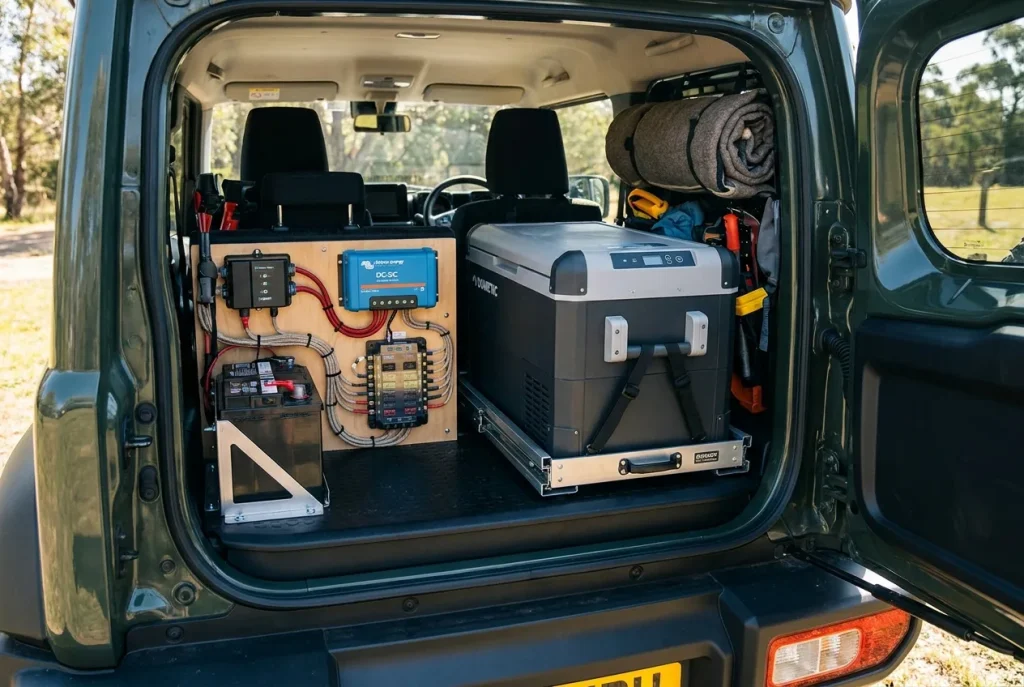
The overland Jimny’s 12V electrical system needs to handle the factory alternator, the starter battery, and the auxiliary load (fridge, lighting, communications) simultaneously — without the auxiliary load being able to discharge the starter battery flat in camp.
A DC-DC charger (also called a BCDC charger — Redarc is the SA standard) manages this: it intelligently charges the auxiliary battery from the alternator while driving, prevents the auxiliary battery from back-drawing the starter battery when the engine is off, and provides a regulated charge to both batteries. The Redarc BCDC1225D (25A) is the appropriate unit for a single auxiliary battery setup in a Jimny.
Battery choice: 100 Ah AGM (R2,500–R4,500) is the accessible entry point. Lithium Iron Phosphate (LiFePO4) at 100 Ah (R8,000–R14,000) provides 30–40% more usable capacity in a significantly lighter package — the weight saving matters on the Jimny’s limited payload. LiFePO4 is the upgrade choice for extended overland use.
Winch Installation Notes
A winch installation on the Jimny requires:
- A bull bar with a suitable winch cradle (confirm compatibility before purchasing either item)
- Heavy-gauge wiring directly from the battery (0 B&S or 25 mm2 cable — do not use standard automotive wire)
- Quality circuit breaker (300A) in the winch feed line
- A dash-mounted winch isolator switch (required for battery protection when vehicle is parked)
- Synthetic rope preferred over steel cable — lighter, does not store dangerous energy if it snaps, floats (useful in water crossings)
A winch installation with quality wiring and a synthetic rope runs R3,500–R6,000 in labour and ancillary components beyond the winch purchase price. Have it done by a qualified auto-electrician familiar with high-current 12V systems.
Rear Diff Lock — The Game Changer
The ARB Air Locker system for the JB74 replaces the factory rear diff carrier with a locker unit that, when pressurised by the onboard compressor, locks both rear half-shafts to rotate together. This eliminates the open differential’s tendency to send power to the wheel with least resistance — transforming cross-axle traction on rocky terrain.
The onboard compressor that operates the ARB Air Locker also inflates tyres, which partially offsets the requirement for a standalone compressor. A quality auto-electrician should run the compressor plumbing and the diff lock switch wiring simultaneously with the locker installation.
Managing Payload
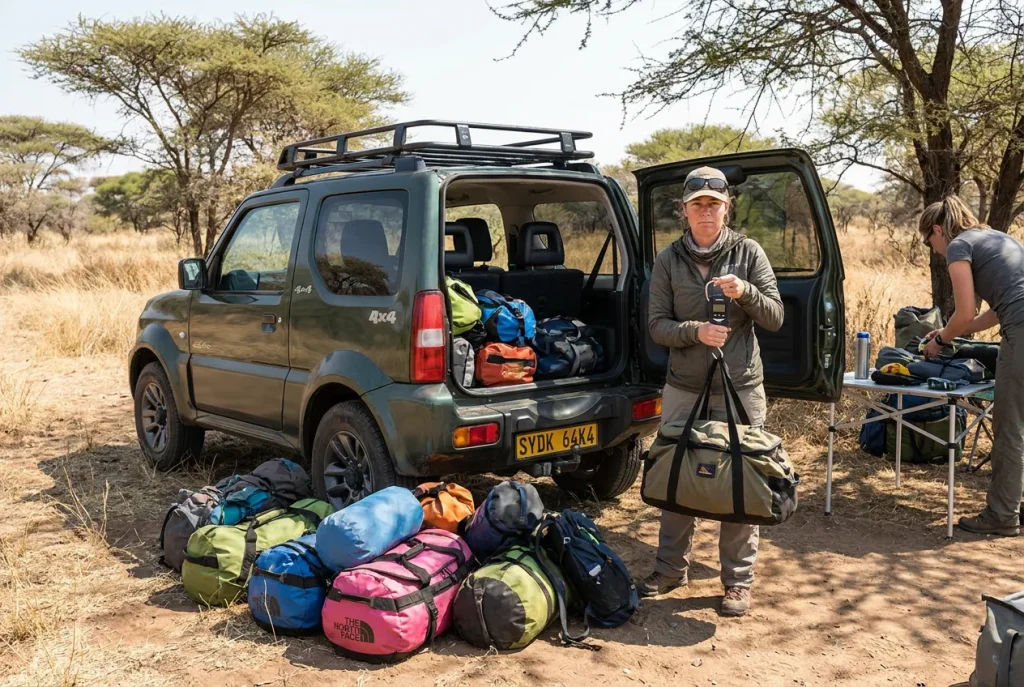
The JB74’s rated payload is approximately 400 kg (GVM minus kerb weight). A fully equipped overland build — with rooftop tent (25–40 kg), fridge (18–22 kg), second battery (20–30 kg), recovery gear (15–20 kg), water (10L = 10 kg), food (10–15 kg), fuel (jerry cans: 20L = 16 kg), personal kit (20–30 kg), and roof rack (12–20 kg) — approaches 160–200 kg of payload. This remains within the 400 kg limit but leaves limited margin. Weight discipline is important on a Jimny overland build.
Frequently Asked Questions
Can the Jimny genuinely handle extended overland routes like Botswana or Namibia?
Yes, when correctly built. The Jimny’s light weight, short wheelbase, and genuine 4WD hardware make it capable on the tracks through the Kalahari, Namibia’s remote river crossings, and Mozambique’s coastal tracks. The limitations are payload capacity, interior space for long-haul kit, and the fact that many Africa-specific spares are stocked for Land Rover and Toyota platforms — carry Jimny-specific spares.
Is a rooftop tent worth the cost for overlanding?
For multi-night remote camping, a rooftop tent transforms the experience. Set-up time is under 3 minutes compared to 15–30 for a ground tent. The sleeping surface is consistently level and off the ground — no rocks, no moisture, no insects. Quality matters: Eezi-Awn and ARB Flinders are the SA community standards. Cheap rooftop tents have thin canvas that leaks and corrodes rapidly in rain and coastal conditions.
What range does the long-range fuel tank provide?
The Long Ranger fuel system for the Jimny (available in varying capacities) typically extends fuel range from the factory 40L to 60–75L. At a real-world 8–9 L/100 km on rough terrain with a loaded overland build, this provides 650–900 km range between fills — adequate for most SA and southern African remote routes. Always carry at minimum 20L in a jerry can as backup regardless of tank size.
How does the ARB Air Locker affect daily driving?
When disengaged (unlocked), the rear diff operates normally as an open differential. There is no daily driving impact. The locker engages only when pressurised from the dashboard switch — typically in 4L terrain. Do not engage the locker on tar.
Is a LiFePO4 battery worth the premium over AGM?
For a vehicle used weekly for trail camping and regularly drawing from the auxiliary battery, yes. LiFePO4 provides 80% of its rated capacity as usable energy (compared to 50% for AGM), charges faster from the DC-DC charger, and has a significantly longer cycle life (2,000+ cycles vs 400–600 for AGM). The premium pays for itself in longevity for a heavily used system.
Can two people sleep in a Jimny overland setup?
Two adults can sleep comfortably in most rooftop tents on the Jimny. The 1.4m x 2.1m sleeping surface of the ARB Flinders is adequate for two adults. In cold conditions, a sleeping bag rated to the minimum expected temperature and a good sleeping mat are required. Interior sleeping (seats folded flat) is possible for one person in a pinch but is not comfortable for regular use.
Related Reading
Free Newsletter
The Compact Conqueror Newsletter
Mod guides, trail reports, build diaries and Jimny news — free, every week.
Free Jimny Tool
Working out your Jimny’s tyre size?
Check fitment, overall diameter, speedo error and clearance for any tyre size — before you buy or lift.