
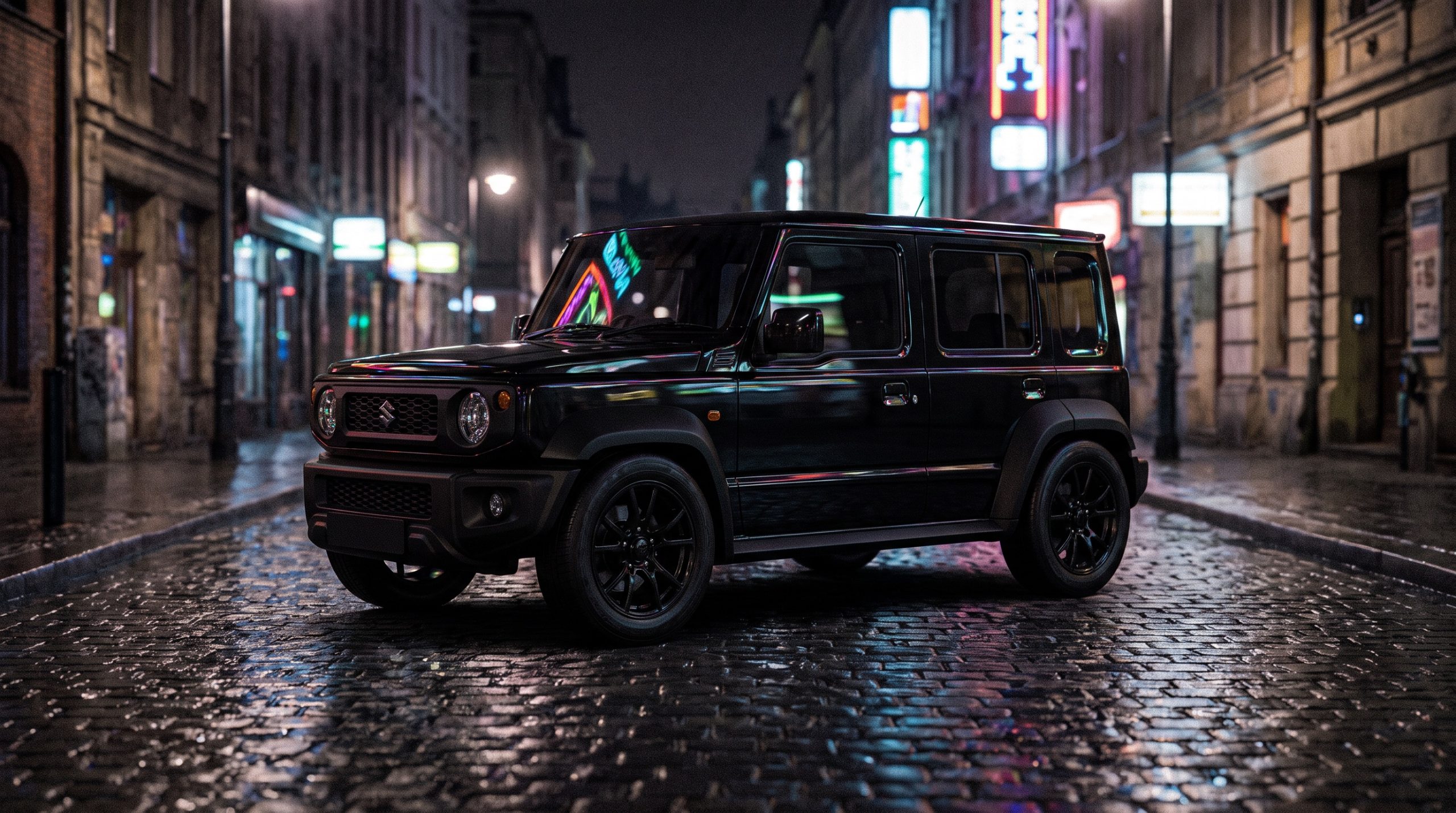
The Jimny has been dressed up as a Defender, a G-Class and a 1980s Land Cruiser. Now a Japanese tuner has gone somewhere much stranger: the GMC Typhoon, the turbocharged early-1990s American SUV that could out-accelerate sports cars. C.L.Link, a Hiroshima-based specialist in Jimny and Land Cruiser parts, revealed the build on 6 October 2026, and it makes its full public debut at Tokyo Auto Salon 2027, which runs from 15 to 17 January.
What C.L.Link changed
The kit was designed with Ryo Ishikawa, founder of the Japanese fashion label #FR2, and it is almost entirely about the face and the stance. The round factory headlights give way to a square-headlight conversion with a dedicated grille and front bumper, and the bodywork picks up flares and blacked-out trim. In place of the GMC lettering there is a red “UMC” badge on the nose and tailgate. At the back, the tailgate-mounted spare wheel is gone, replaced by a body-colour panel, with smoked tail-light lenses and red reflectors.
Underneath, a set of Eibach springs and Bilstein dampers lowers the car by an inch, and C.L.Link’s own UnionRim TX wheels in 16-inch size wear 215/70R16 Toyo Open Country H/T II tyres. A C.L.Link Type 1 rear muffler, Recaro front bucket seats and colour-matched rear seat covers complete it. Nothing is done to the engine: the 1.5-litre K15B keeps its 75 kW and 130 Nm, so this is a Typhoon in costume only.
Why a GMC Typhoon?
Because almost nobody outside the United States remembers it, and the people who do remember it fondly. The Typhoon was a factory special built on the compact GMC Jimmy for only two model years, 1992 and 1993. It used a 4.3-litre turbocharged V6 rated at 280 hp with full-time all-wheel drive and could reach 60 mph in around 5.3 seconds, which in 1992 put a boxy two-door SUV in sports-car company. GMC built just 4,697 of them, and clean examples are now collectable.
There is a neat irony in the choice: the Typhoon’s base vehicle was called the Jimmy, and C.L.Link has turned a Jimny into one. The square-lamp, black-trimmed early-90s look also fits a trend that has been running in Japan for years, where body-kit makers have sold retro conversions for the Jimny modelled on everything from old Land Cruisers to the classic Defender.
What lowering actually does to a Jimny
Lowering is unusual on a Jimny, and it is worth being clear about the trade-off, because it is not quite what most people assume. The Jimny runs solid axles front and rear, so the lowest point under the car, the differential housing, sits a fixed distance from the ground set by the tyre size, not by the springs. A 1-inch spring drop therefore leaves diff clearance where it was. In fact the kit’s 215/70R16 tyres are about 14 mm larger in diameter than the factory 195/80R15s, which raises the diffs by around 7 mm.
What the drop does cost is everything hung on the body: the bumpers, the sills and the middle of the chassis sit about 25 mm closer to the ground, which trims the approach, departure and breakover angles that make the Jimny so good off road, and shorter springs usually mean less suspension travel too. On tar it should sit flatter in corners. On a rocky track it will scrape sooner. That is the opposite philosophy to most Jimny builds, which our Jimny lift kit guide covers in detail, and the street-biased highway-terrain tyre is a deliberate choice; our Jimny tyre guide explains what you give up against an all-terrain.
Could you fit it to a South African Jimny?
Probably, but nobody has confirmed it yet. The Japanese-market Jimny Nomade is built in India, at the same factory that supplies the five-door Jimny sold in South Africa, and both markets drive on the left with right-hand-drive cars. That makes it very likely the panels and lights would fit a local five-door. C.L.Link has said nothing about export, though, and the kit is designed around the five-door; there is no word on a three-door version. If you are unsure which body you have, our 3-door vs 5-door guide sets out the differences, and the Jimny vs Jimny Sierra explainer untangles Japan’s model names, Nomade included.
Two practical points if you are tempted. Replacement headlights have to stay roadworthy, so check with a testing station before you fit aftermarket lamps. And tell your insurer about any body or suspension modification, because an undeclared change is an easy reason to refuse a claim. Our first Jimny mods priority list is a good reality check on where the money is best spent first.
C.L.Link Typhoon Jimny FAQ
Is this an official Suzuki model?
No. It is an aftermarket kit from the Japanese tuner C.L.Link, and Suzuki has had no involvement. The “UMC” badges are C.L.Link’s nod to GMC, not a trademark of either company.
How much does the kit cost?
C.L.Link has not published a price. Orders are due to open when the car is shown at Tokyo Auto Salon 2027 in January.
Does it make the Jimny faster?
No. The engine is untouched, so it keeps the standard 75 kW and 130 Nm. The only mechanical changes are the exhaust muffler and the lowered suspension.
Will it still go off road?
It keeps the Jimny’s low-range four-wheel drive and its diff clearance, but the lower body, sills and bumpers mean it will scrape sooner on rocks and steep ramps. Think of it as a city car first.
Sources: Gear Patrol and HotCars for the build; GMC Typhoon production and specifications from Wikipedia. Tyre-height and clearance figures are our own calculations from the published tyre sizes. Header image: an AI-generated illustration, not a photograph of the C.L.Link car.
Free Jimny Tool
Working out your Jimny’s tyre size?
Check fitment, overall diameter, speedo error and clearance for any tyre size — before you buy or lift.