Affiliate Disclosure: Compact Conqueror earns a small commission on qualifying purchases made through links on this page — at no extra cost to you. We only recommend products we’ve tested or our community has verified. See our full affiliate disclosure.
A lift kit does three things for the Suzuki Jimny: it creates clearance for larger tyres, improves the approach and departure angles over rough terrain, and — let’s be honest — it looks better. But choose the wrong kit, go too high, or skip the supporting modifications and you introduce handling problems, CV wear, and voided warranty claims. This guide keeps you on the right side of all three.
How Much Lift Does the Jimny Actually Need?
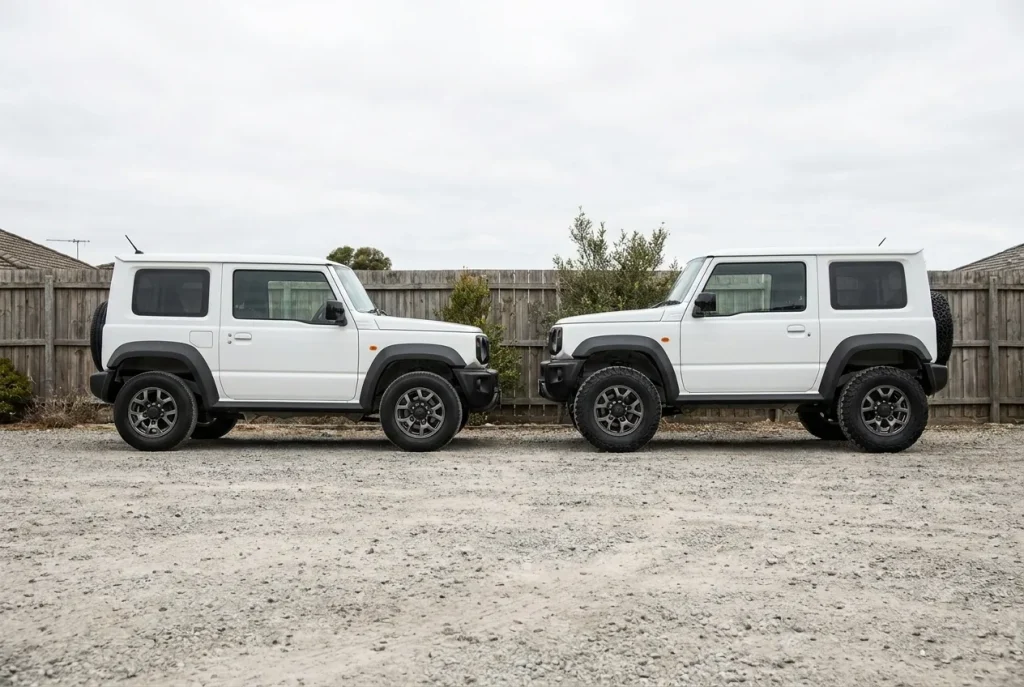
The JB74 at stock height is already a capable off-road vehicle. A lift is not required for moderate trail use. The case for lifting is primarily about tyre clearance — creating enough space for a 215/75R15 tyre to articulate fully without contacting the guard, and building the geometry margin that comes with increased ride height.
| Lift Height | Max Tyre Size | Geometry Impact | Supporting Mods Required | Best For |
|---|---|---|---|---|
| 0 mm (stock) | 215/75R15 | Factory spec | None | Daily use, light gravel |
| 30–40 mm | 215/75R15 / marginal 225 | Acceptable — within factory CV joint angle tolerance | Wheel alignment | The sweet spot — most SA owners |
| 50 mm | 225/75R15 | CV joint angles approach limits — inspect regularly | Alignment + brake line inspection | Moderate trail + larger tyres |
| 60–80 mm | 235/75R15 + | Requires CV joint replacement, radius arm correction, extended brake lines | Full geometry correction package | Serious off-road builds only |
The 40 mm lift is the community consensus sweet spot. It gives meaningful clearance improvement, keeps CV joint angles within safe limits, and works beautifully with 215/75R15 tyres without requiring additional structural modifications.
Don’t lift further than your tyres and geometry warrant. More height is not more capable — it’s more complexity.
James Crawford, Compact Conqueror
What a Lift Kit Contains
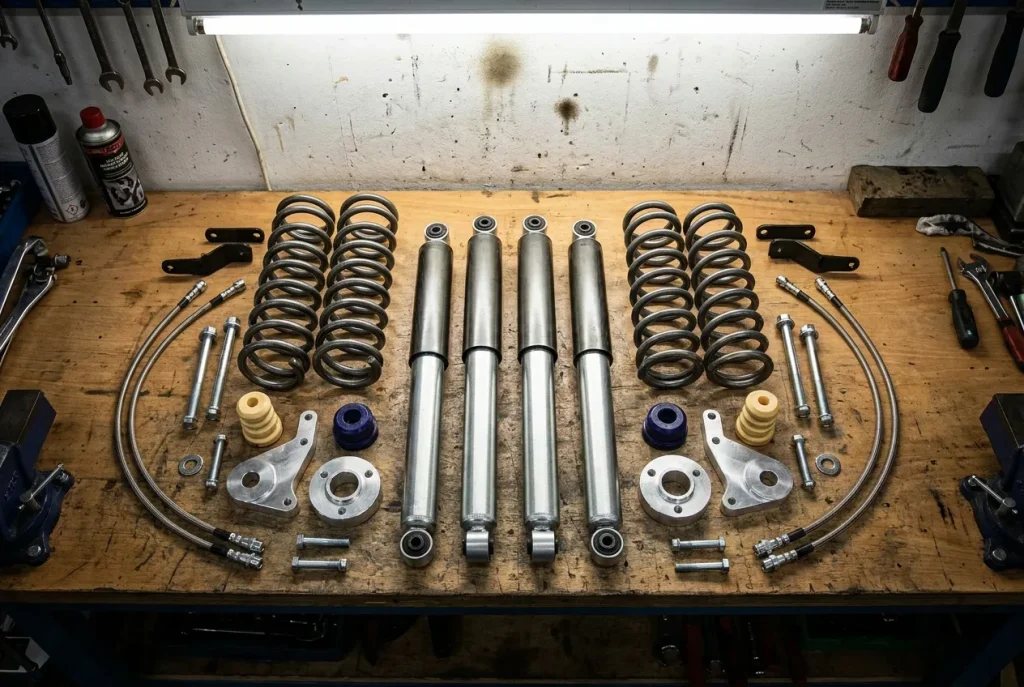
A complete Jimny lift kit typically includes:
- Front coil springs: Increased spring rate to raise the ride height without excessive travel loss
- Rear coil springs: Matched rate to keep the car level
- Shock absorbers (x4): Tuned for the new spring rates and extended travel
- Bump stop spacers: Prevent bottoming out at full droop
- Installation hardware: Bolts, spacers, bushings
Some budget kits contain only coil spacers (also called spacer lifts) — these sit on top of the factory spring and raise ride height without changing the spring or damper. Spacer lifts are cheaper but compromise the suspension working geometry and do not improve travel. Avoid them in favour of a proper spring-and-damper kit.
Free Jimny Tool
Working out your Jimny’s tyre size?
Check fitment, overall diameter, speedo error and clearance for any tyre size — before you buy or lift.
Lift Kit Brand Comparison — SA Market
| Brand | Lift Height | Kit Type | Approx. Cost (fitted) | On-Road Feel | Off-Road Performance | Notes |
|---|---|---|---|---|---|---|
| Old Man Emu (ARB) BP51 Shocks + OME Springs | 40 mm | Coil + shock | R14,000–R18,000 | ⭐⭐⭐⭐⭐ | ⭐⭐⭐⭐⭐ | Dakar-derived — benchmark for performance |
| Old Man Emu (ARB) Nitrocharger + OME Springs | 40 mm | Coil + shock | R9,500–R13,000 | ⭐⭐⭐⭐ | ⭐⭐⭐⭐⭐ | Excellent value for serious trail use |
| Kings (Superior Engineering) | 40–50 mm | Coil + shock | R10,000–R15,000 | ⭐⭐⭐⭐ | ⭐⭐⭐⭐⭐ | Popular in AU community, strong SA distributor |
| Tough Dog | 40 mm | Coil + shock | R8,000–R11,000 | ⭐⭐⭐⭐ | ⭐⭐⭐⭐ | Reliable mid-tier choice |
| Ironman 4×4 | 40 mm | Coil + shock | R6,500–R9,000 | ⭐⭐⭐ | ⭐⭐⭐⭐ | Budget-accessible — decent trail performance |
| Dobinsons | 40–50 mm | Coil + shock | R9,000–R13,000 | ⭐⭐⭐⭐ | ⭐⭐⭐⭐ | Strong off-road, good SA availability |
Our Pick: Old Man Emu Nitrocharger Sport + OME Springs
The OME Nitrocharger Sport kit represents the best balance of on-road ride quality, off-road performance, and price. The Nitrocharger Sport shocks use a twin-tube design with a high-pressure nitrogen charge that maintains consistent damping throughout travel. OME springs are tuned specifically for the Jimny’s weight — they handle a loaded roof rack or recovery kit without sacrificing empty-vehicle comfort.
The BP51 kit (bypass pistons) is a step up in performance for owners who trail aggressively and regularly — the remote-reservoir design maintains damping consistency through extended off-road runs. The price premium is justified only if you actually need that level of performance.
What Changes When You Lift a Jimny
Wheel Alignment
Mandatory after any suspension modification. A lift changes the caster, camber, and toe settings established by the factory geometry. An incorrect wheel alignment causes rapid, uneven tyre wear — the most expensive consequence of skipping this step. Cost: R600–R900 at a 4×4-specialist workshop. Book it on the same day as the lift installation.
CV Joint Angles
The JB74’s front CV joints operate at factory-specified angles at stock height. A 40–50 mm lift increases these angles. At 40 mm with quality springs (not spacers), the angles remain within Suzuki’s engineering tolerances. At 50 mm and above, inspect the CV joints every 20,000 km for wear. At 60 mm+, fit heavy-duty replacement CV joints before the installation.
Brake Lines
The factory brake lines have minimal excess length. At lifts of 50 mm and above, the front brake lines reach the limits of their stretch under full articulation. Extended/braided brake lines are required at these lift heights. At 40 mm, inspect the routing and check for any contact with suspension components — in most cases the factory lines clear cleanly.
Speedo and Terrain Response
If you fit larger tyres at the same time as the lift (the sensible approach), re-calibrate your speedo. The AllGrip Pro system uses wheel speed sensors to manage 4WD engagement — a significant size change affects this calculation. A 215/75R15 at +4% diameter is generally within acceptable tolerance.
Installing a Lift Kit — What to Expect
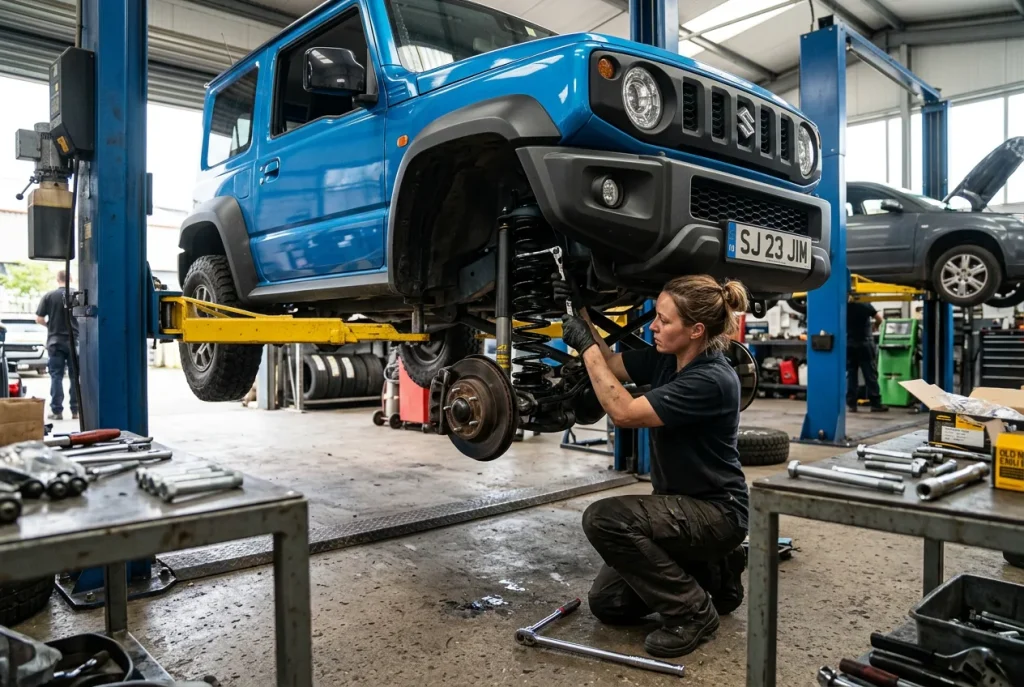
Professional installation at a qualified 4×4 workshop takes 3–5 hours for a complete spring-and-shock kit. The process involves:
- Remove wheels, front and rear
- Compress and remove factory springs and shocks
- Install new springs (note correct rate: driver side vs passenger side if the kit differentiates)
- Install new shock absorbers
- Refit wheels and lower the vehicle
- Road test for handling and settling (springs settle 5–10 mm over the first 500 km)
- Full four-wheel alignment at a 4×4-specialist
Do not DIY the alignment. Home alignment tools do not provide the precision required for the Jimny’s geometry — the cost of four tyres worn unevenly far exceeds the R700–R900 alignment fee.
Frequently Asked Questions
Does lifting a Jimny void the warranty?
SA consumer law (Consumer Protection Act) means a manufacturer cannot void your entire warranty because of an aftermarket modification. However, if a specific modification directly causes a specific failure, the manufacturer may decline that claim. Use reputable brands, have work done by qualified workshops, and keep all receipts. Consult Suzuki Auto SA for their current interpretation of warranty modification policy.
Should I lift before or after fitting new tyres?
Do both at the same time if budget allows. Fitting 215/75R15 tyres at stock height works fine — they clear without contact. Adding the lift later then requires a second alignment. If you can only do one at a time, tyres first (bigger impact per rand), then lift.
Is a 40 mm lift safe for daily tar driving?
Yes. A properly installed 40 mm lift from a reputable brand (OME, Tough Dog, Kings) with a simultaneous four-wheel alignment drives safely and comfortably on tar. The ride height increase raises the centre of gravity marginally — noticeable only in extreme emergency manoeuvres. No change to normal driving behaviour.
What is a “spacer lift” and should I fit one?
A spacer lift (or coil spacer) sits on top of the factory spring to increase ride height without replacing the spring or shock absorber. They are cheap (R1,500–R3,000 installed) and provide a modest height increase. The downside: the factory shocks are now operating outside their design travel range, spring geometry is compromised, and the ride quality typically worsens. For the price difference to a proper kit, fit the real thing.
How long does a lift kit installation take?
A complete spring-and-shock kit takes approximately 3–5 hours at a qualified workshop. Budget for the full day — a wheel alignment appointment after installation is recommended and adds 30–60 minutes. Drop the car in the morning, collect in the afternoon.
Can I install a lift kit myself?
Experienced home mechanics with a spring compressor, a quality jack and axle stands, and the appropriate torque wrench can install a lift kit. The work itself is straightforward. The issue is the wheel alignment — this cannot be done without specialist equipment. If you self-install, book a same-day alignment appointment at a 4×4 workshop.
Related Reading
Best Tyres for Suzuki Jimny
The tyre upgrade that should happen alongside (or before) your lift kit decision.
Jimny Skid Plates & Sliders
Protect the underside you’ve just given more ground clearance.
Free Newsletter
The Compact Conqueror Newsletter
Mod guides, trail reports, maintenance tips and Jimny news — free, every week.