
Affiliate Disclosure: Compact Conqueror earns a small commission on qualifying purchases made through links on this page — at no extra cost to you. We only recommend products we’ve tested or our community has verified. See our full affiliate disclosure.
Getting stuck is not a question of if — it’s a question of when. Every off-road driver gets stuck eventually. The difference between a minor inconvenience and a dangerous situation is the recovery gear you carry, the knowledge to use it correctly, and the discipline to fit rated recovery points before you need them.
The Non-Negotiable Rule: Rated Recovery Points First
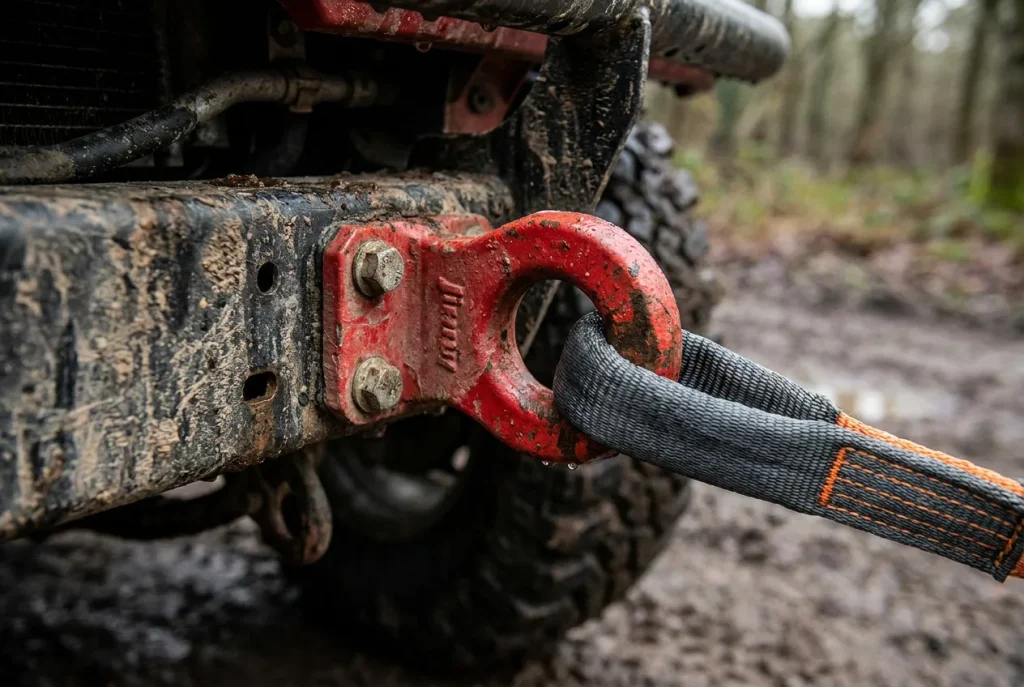
Before any recovery gear discussion, address the single most important foundation: rated recovery attachment points. The JB74’s factory tow hooks are rated — verify they are present and undamaged. If you have fitted an aftermarket bull bar, confirm it has rated recovery rings.
Never use a tow ball as a recovery point. A tow ball is designed for downward pulling loads. A kinetic recovery strap generates a sharp horizontal shock load that can shear the tow ball bolt and turn the ball into a projectile. People have been killed by sheared tow balls during vehicle recovery. This is not a theoretical risk.
Fit rated recovery points before you carry any other recovery gear. Everything else is useless without a safe attachment point.
Marcus Roux, Compact Conqueror
Essential Recovery Kit — The Minimum
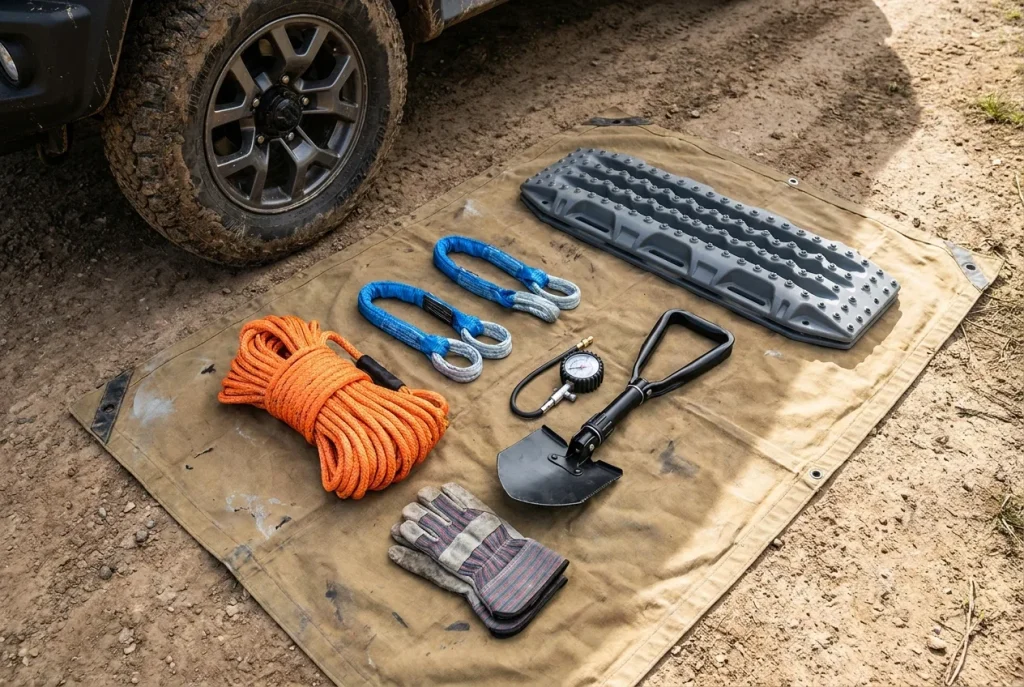
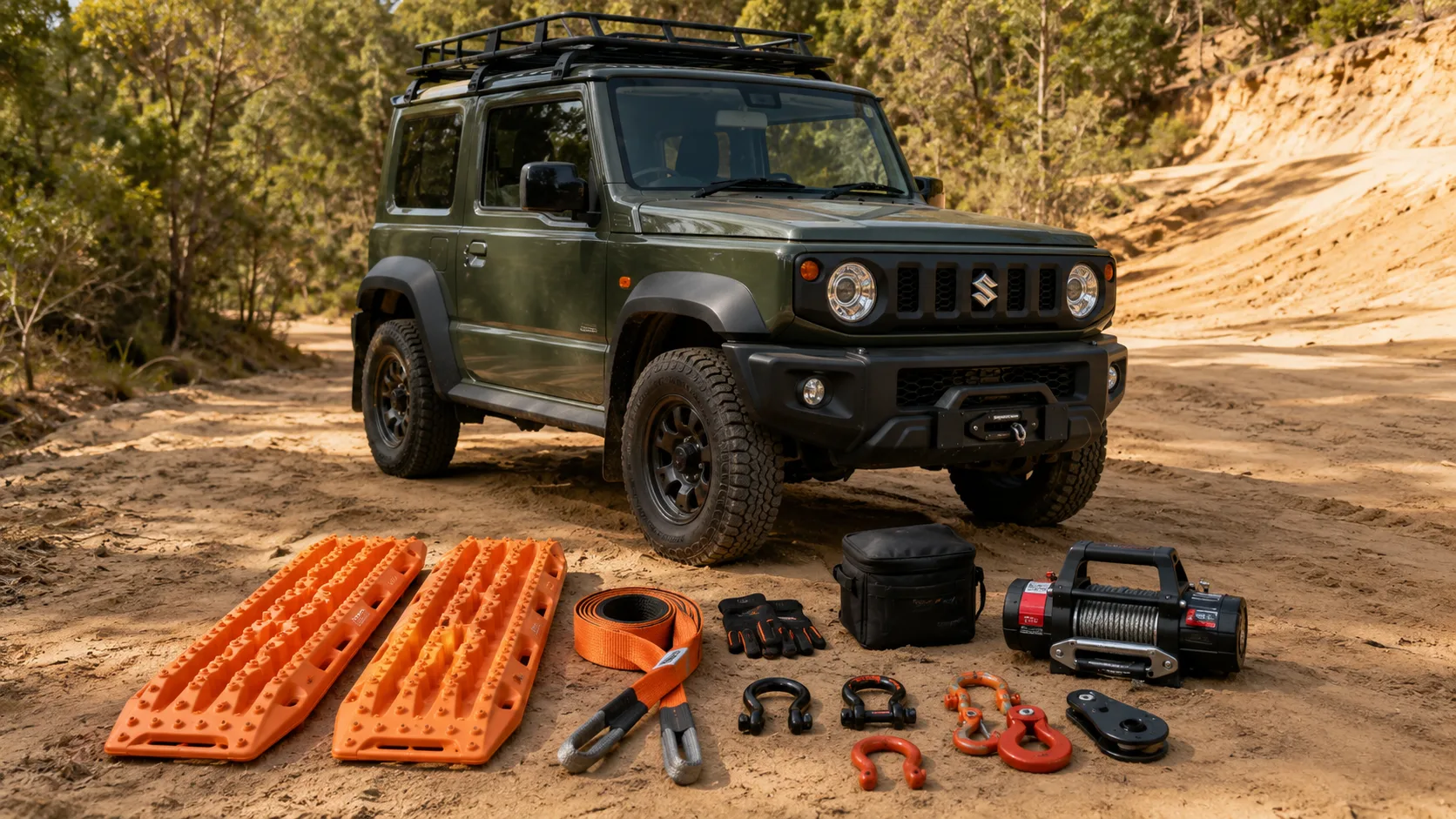
This is the kit every Jimny should carry before leaving tar for the first time. It weighs approximately 12 kg, fits in a medium bag, and handles 90% of solo self-recovery and assisted recovery situations.
| Item | Specification | Why It Matters | Approx. Price |
|---|---|---|---|
| Kinetic Recovery Rope | 9 m, 8,000+ kg rating, 30% stretch | Provides the elastic energy transfer that extracts stuck vehicles. NOT a static tow rope. | R600–R1,000 |
| Rated D-Shackles (x2) | Grade 4.75 t or higher, screw pin | Connect the rope to recovery points. Never use hardware-store chain shackles. | R120–R220 each |
| Snatch Block | 4.5 t rating minimum | Doubles pulling power; changes the pull direction. Essential for self-recovery. | R450–R800 |
| Tree Trunk Protector | 75 mm x 3 m minimum | Protects a tree anchor from the damaging bite of a shackle or strap. | R350–R600 |
| Recovery Boards (x2) | MaxTrax, Bush Mech, or equivalent | Sand, mud, and soft-terrain extraction without a second vehicle. | R1,800–R4,500 (pair) |
| Hi-Lift Jack (48″) | Farm jack rated to vehicle’s GVM | Lifting, winching, and spreading — the most versatile tool in the kit. | R800–R1,400 |
| Hi-Lift Base Plate | Rubber or HDPE, 250×250 mm minimum | Prevents the Hi-Lift foot sinking into soft ground. | R180–R350 |
| Shovel (folding) | Lightweight alloy — D-handle preferred | Clearing sand/mud from around tyres before recovery attempt. | R250–R500 |
| Work gloves | Leather palm — recovery rope gloves | Kinetic ropes under tension cause rope burns on unprotected hands. | R120–R200 |
| First aid kit | SANS 1021 compliant, vehicle-spec | Legal requirement in SA + essential safety item. | R250–R600 |
Understanding Recovery Gear — What Each Item Does
Kinetic Recovery Rope vs Tow Strap
A kinetic recovery rope (also called a snatch strap, kinetic rope, or kinetic tow rope) is fundamentally different from a tow strap. The kinetic rope stretches 20–30% under load, storing potential energy that is released as the rope rebounds — this elastic energy “snatches” the stuck vehicle free of the terrain. A static tow strap transfers the shock load directly to both vehicles’ chassis and recovery points. Use a kinetic rope for vehicle recovery; use a tow strap only for road-speed towing.
Snatch Block: The Force Multiplier
A snatch block is a pulley that routes the kinetic rope around a tree anchor or second vehicle anchor, creating a mechanical advantage. In a direct pull (vehicle to vehicle), the recovery vehicle exerts force X. Through a single snatch block, force X becomes approximately 2X at the stuck vehicle’s recovery point. This is what allows a single Jimny to recover a heavier vehicle, or allows a self-recovery when no second vehicle is available.
Recovery Boards: Self-Recovery Without a Second Vehicle
Recovery boards (MaxTrax, Bush Mech, TJM, Xplore) are rigid traction aids placed under the spinning wheels of a stuck vehicle. The tread pattern bites into the board, providing grip that allows the vehicle to drive out under its own power. They are invaluable for sand extraction and useful in mud. The Jimny’s light weight means a single set of boards is often sufficient for self-recovery in all but the most severe situations.
MaxTrax (Australian-made) remains the quality standard — they are more resistant to deformation under sustained wheel spin and have lasted multiple recovery seasons in harsh conditions. Bush Mech boards are SA-made and offer comparable performance at a lower price point. Cheap Chinese-produced boards frequently crack and deform under aggressive wheel spin.
Hi-Lift Jack: The Multi-Tool
The Hi-Lift jack (also called a farm jack) is the most versatile piece of recovery gear you own. Beyond vehicle lifting, it functions as a come-along winch (using the jack head in reverse), a vehicle spreader, and a fence-wire stretcher. The 48″ version is appropriate for the Jimny — the 60″ is unnecessary given the vehicle’s height. Always use the Hi-Lift with a base plate and on a stable surface; operating a Hi-Lift on unstable ground causes tip-overs.
Advanced Recovery: The Winch
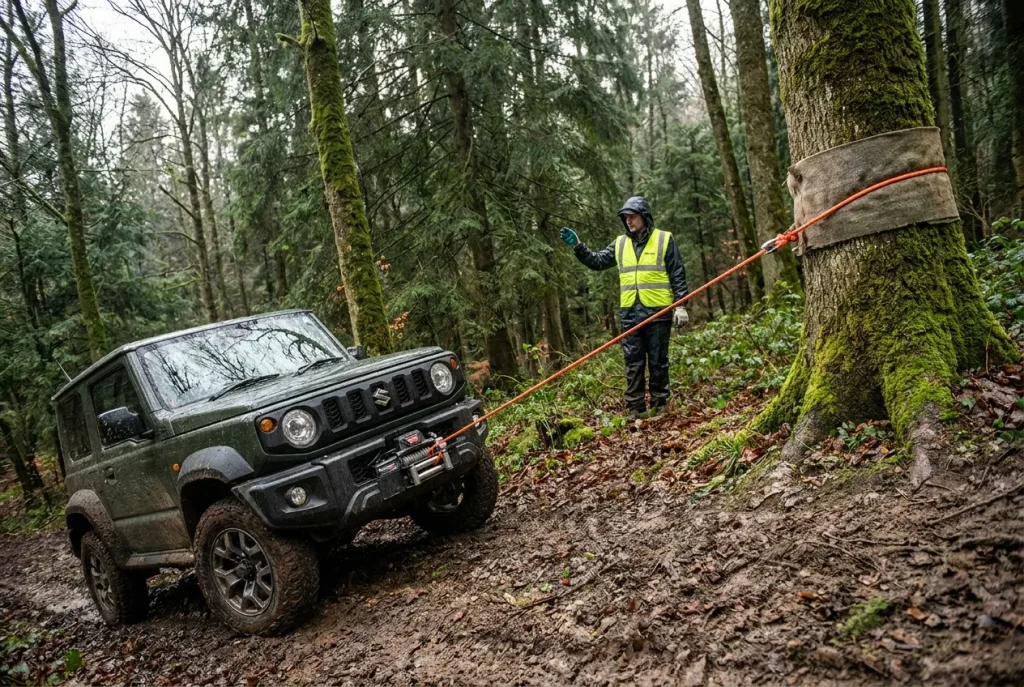
A winch — specifically an electric recovery winch rated to 1.5× the vehicle’s GVM — transforms the Jimny’s self-recovery capability completely. The JB74 at 1,135 kg GVM requires a minimum 4,500 lb (2,045 kg) rated winch; in practice, a 6,000–8,000 lb (2,720–3,630 kg) winch is standard for a built Jimny.
| Winch | Rating | Line Speed (no load) | Approx. Price (bare) | Notes |
|---|---|---|---|---|
| Warn VR EVO 8 | 8,000 lb / 3,600 kg | 5.6 m/min | R8,000–R11,000 | Industry benchmark — Warn quality |
| Warn Zeon 8-S | 8,000 lb / 3,600 kg | 5.0 m/min | R14,000–R18,000 | Premium — synthetic rope standard |
| Ironman Integrated Winch 8500 | 8,500 lb / 3,860 kg | 4.5 m/min | R5,500–R7,500 | Budget accessible, reliable |
| Runva 9.5XP | 9,500 lb / 4,300 kg | 6.5 m/min | R5,000–R7,000 | Popular in SA Jimny community |
| Bushranger X-Bull 9500 | 9,500 lb / 4,300 kg | 4.8 m/min | R4,500–R6,500 | Cost-effective entry into winching |
A winch requires a compatible bull bar with winch cradle, an upgraded electrical system (second battery recommended), synthetic rope (over steel cable — lighter, safer if it breaks), a winch damper bag, and a basic winch extension strap. Total installed cost including compatible bull bar: R15,000–R35,000. It is a Tier 3 modification — plan accordingly.
Recovery Kit Storage in the Jimny
The JB74’s boot space is limited — 85 litres with the rear seat up. Recovery gear must be stored intelligently:
- Recovery rope and shackles in a dedicated bag behind the rear seat or in the spare wheel bay
- Recovery boards mounted externally (roof rack, rear door carrier, or bonnet straps) if interior space is tight
- Hi-Lift mounted externally on the bonnet or rear carrier — they are too long for interior storage
- Shovel under the cargo area floor if your Jimny has a storage well; otherwise on the roof rack
Loose recovery gear in the boot becomes a projectile in an accident or sudden stop. Use a recovery bag with compartments and secure it with a cargo net or bungee.
Frequently Asked Questions
What is the minimum recovery kit for a first trail day?
At minimum: rated recovery points, a kinetic recovery rope, two rated D-shackles, and recovery boards. This handles the most common self-recovery scenarios. Add a Hi-Lift and shovel before any trail that involves loose surfaces or potential for the vehicle to become high-centred.
How do I use a kinetic recovery rope safely?
Attach one end to a rated recovery point on the stuck vehicle; the other end to a rated recovery point on the recovery vehicle. Lay the rope on the ground between the vehicles — never allow slack rope to wind around the stuck vehicle. The recovery vehicle drives forward until the rope is nearly taut, then accelerates smoothly and progressively. Do not jerk the strap tight from full speed. Fit a recovery damper (a wet canvas bag or dedicated damper) over the rope mid-point — if a shackle fails, the damper absorbs the energy and prevents the hardware becoming a projectile.
Should I buy a winch for the Jimny?
A winch is a meaningful safety upgrade for solo remote-area driving. If you trail regularly in remote locations, in thick bush, or in areas without guaranteed mobile coverage, a winch is justified. For club trail days and local tracks within range of assistance, a quality kinetic rope and recovery boards handle 95% of situations at a fraction of the cost and weight.
Are MaxTrax worth the price premium over budget recovery boards?
For regular trail use, yes. MaxTrax are made from 30% glass-fibre-reinforced nylon engineered to resist deformation under prolonged wheelspin. Budget boards (often unbranded Chinese-produced) regularly crack and bend on the first heavy use. Bush Mech boards (SA-made) offer a strong mid-point. If you trail more than quarterly, buy MaxTrax once rather than budget boards twice.
What is a tree trunk protector and is it necessary?
A tree trunk protector (TTP) is a wide (75+ mm) webbing strap that wraps around a tree, distributing the point load of a shackle or strap across a wider area to prevent bark damage and tree death. It’s necessary from an environmental responsibility standpoint, and it’s more robust than a narrow strap for anchoring high-load recoveries. Never attach a recovery strap directly to a tree trunk with a shackle.
Can I carry recovery gear in the cabin instead of the boot?
Recovery gear belongs in the boot — in a secure bag with a cargo net or strap. Unsecured recovery gear in the cabin becomes a serious injury risk in an accident. The exception is small items (gloves, basic first aid) that can be stowed in the glovebox. The Hi-Lift must be mounted externally — it is too large and heavy to safely secure inside the vehicle.
Related Reading
First Mods Priority List
See where recovery gear fits in the full modification priority sequence.
Free Newsletter
The Compact Conqueror Newsletter
Mod guides, trail reports, maintenance tips and Jimny news — free, every week.
Free Jimny Tool
Working out your Jimny’s tyre size?
Check fitment, overall diameter, speedo error and clearance for any tyre size — before you buy or lift.