
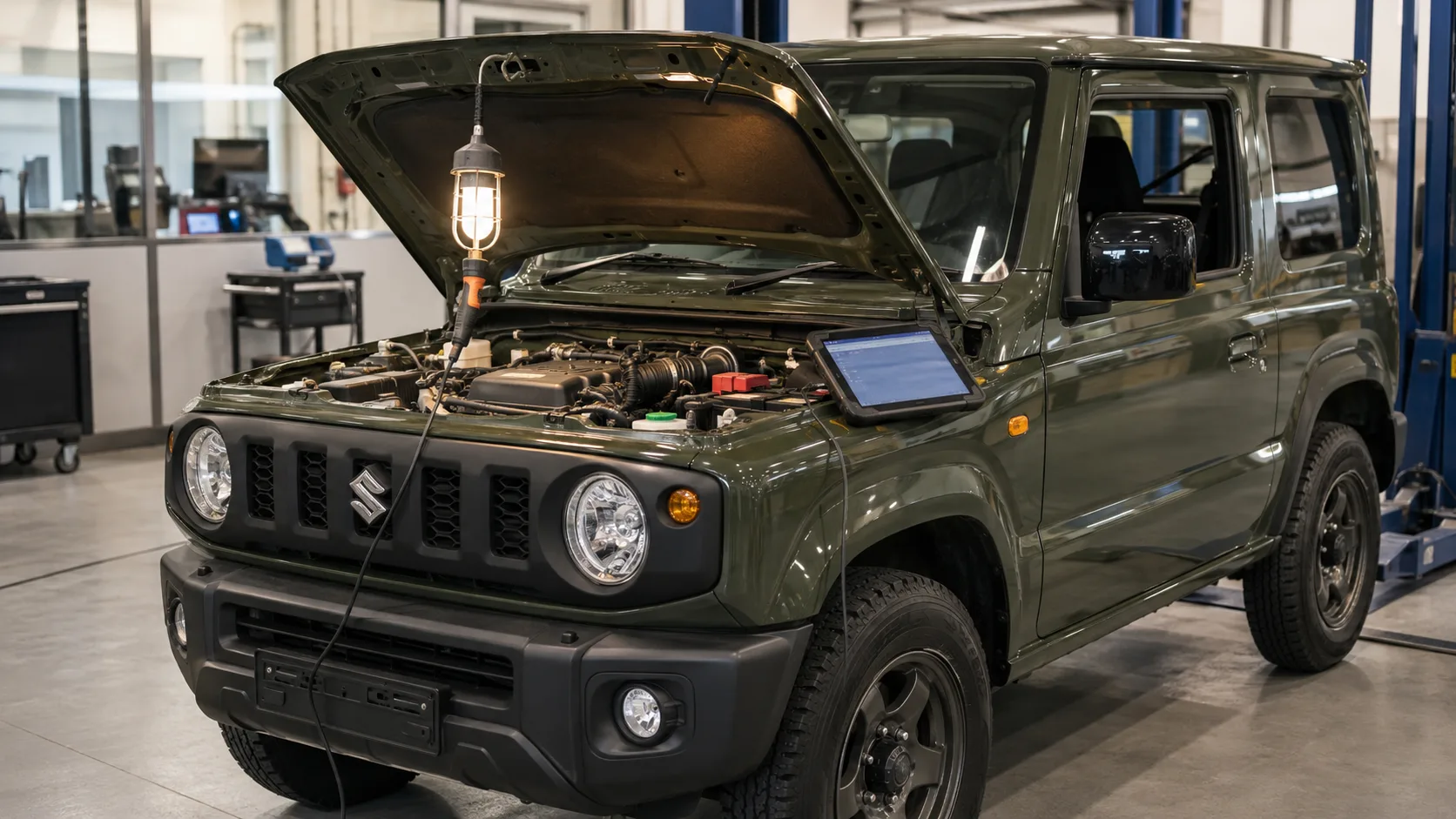
The fourth-generation Jimny is a fundamentally reliable vehicle — but no model is without its quirks. Knowing the JB74’s known issues helps you buy a used one wisely, catch problems early, and separate genuine faults from the vehicle’s normal (if characterful) behaviour. Here is the honest list, from the genuinely important to the merely annoying.
How Reliable is the JB74, Really?
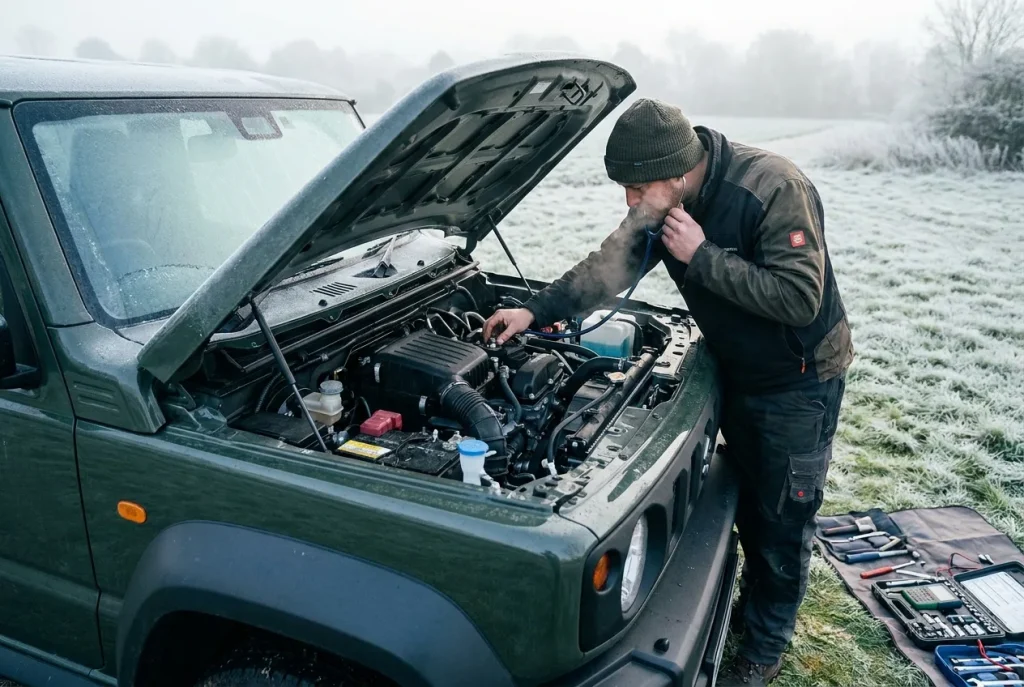
Very. The K15B engine shares its architecture with Suzuki’s proven Swift platform and has an excellent track record. The JB74’s mechanical simplicity — naturally aspirated engine, no turbo, no complex hybrid system — works in its favour for long-term reliability. The issues below are real but mostly minor; none are catastrophic when caught and managed.
Most JB74 “problems” are either early-production niggles Suzuki has fixed, or simply the character of a small, focused off-roader. Know the difference.
James Crawford, Compact Conqueror
1. Timing Chain Rattle on Cold Start
The most-discussed JB74 issue. Some early-production engines exhibit a brief rattle on cold start, attributed to the timing chain tensioner not pressurising instantly. Suzuki addressed this with revised components and software updates.
| Aspect | Detail |
|---|---|
| Symptom | Metallic rattle for a few seconds on first cold start of the day |
| Cause | Timing chain tensioner slow to pressurise (early units) |
| Severity | Low if brief and clears quickly; investigate if persistent |
| Fix | Revised tensioner / software update under warranty on affected units |
| When buying | Start from genuinely cold and listen — confirm warranty work done |
A brief rattle that clears within a few seconds on an early car is generally not a concern, especially if the revised parts have been fitted. A rattle that persists, worsens, or appears on a warm engine warrants investigation by a Suzuki specialist.
2. Air Conditioning in Hot Climates

The JB74’s air conditioning is adequate but not powerful. In very hot conditions — the Lowveld, Northern Cape, or an Australian summer — owners report it struggles to cool the cabin quickly, particularly the small but tall greenhouse that lets in a lot of sun. This is a characteristic of the system’s modest capacity rather than a fault.
- Use the recirculation setting to cool faster in extreme heat
- Consider a quality window tint (within legal limits) to reduce solar load
- Have the system’s gas charge checked if cooling genuinely deteriorates over time
3. Highway Ride, Wind Noise & Wandering

The JB74’s short wheelbase, boxy shape, and recirculating-ball steering produce a busy ride and noticeable wind noise at highway speed, and a tendency to “wander” slightly that requires small steering corrections. This is the nature of the vehicle, not a defect — but it surprises buyers expecting car-like manners.
Larger tyres and lifts can amplify the wander. A correctly set wheel alignment, properly inflated tyres, and a steering damper (a popular accessory) all help. The 5-door’s longer wheelbase is noticeably more settled if highway comfort is a priority.
4. Road-Biased Stock Tyres
Not a fault, but a frequent source of disappointment: the factory 195/80R15 road tyres limit the JB74’s off-road grip. New owners often assume the vehicle “isn’t as capable as expected” when the real culprit is the rubber. An all-terrain tyre upgrade transforms the experience — see our best tyres guide.
5. Limited Power When Loaded or Climbing
The 75 kW 1.5-litre engine works hard when the vehicle is fully loaded, towing, or climbing a long mountain pass — especially at altitude. This is expected for a small naturally aspirated engine and is not a fault. The automatic transmission masks it somewhat by holding lower gears; manual drivers simply learn to plan their gear changes. Plan overtakes with care on highways.
6. Minor Niggles & Recalls
Like any model, the JB74 has been subject to occasional market-specific recalls and service campaigns (covering items that have varied by region and production batch). When buying used, check that any recalls or service campaigns applicable to the vehicle’s VIN have been completed by a Suzuki dealer. Other commonly mentioned niggles include road noise intrusion, firm seats on long trips, and limited cabin storage — all characteristics of a compact, focused vehicle rather than defects.
Keeping a JB74 Healthy
- Stick to the 15,000 km / 12-month service interval (shorten oil changes for off-road or dusty use)
- Use the correct fully synthetic engine oil and never stretch oil change intervals
- Keep up with the 60,000 km major service including drivetrain fluids
- Address any timing chain noise promptly
- Check all recalls/campaigns are completed when buying used
- Inspect the underbody after off-road use for impact damage
See our full JB74 service schedule and maintenance guide for the complete maintenance plan.
Frequently Asked Questions
Is the JB74 Jimny timing chain a serious problem?
Generally no. Some early-production JB74 engines exhibit a brief rattle on cold start from the timing chain tensioner, which Suzuki addressed with revised parts and software updates. A brief rattle that clears within a few seconds on an early car with the revised parts fitted is not usually a concern. A persistent or worsening rattle, or one on a warm engine, warrants investigation by a Suzuki specialist.
Why is my JB74 air conditioning weak?
The JB74’s air conditioning has modest capacity and can struggle to cool quickly in very hot climates, especially given the tall, sunny cabin. This is a characteristic of the system rather than a fault. Use recirculation to cool faster, consider legal window tinting to reduce solar load, and have the gas charge checked if cooling genuinely deteriorates over time.
Does the JB74 wander on the highway?
A degree of “wander” requiring small steering corrections is normal for the JB74, due to its short wheelbase and recirculating-ball steering. It is the nature of the vehicle, not a defect. A correct wheel alignment, properly inflated tyres and a steering damper all help. Larger tyres and lifts can amplify it; the longer-wheelbase 5-door is more settled at speed.
Is the JB74 underpowered?
The 75 kW 1.5-litre engine is modest and works hard when the vehicle is fully loaded, towing or climbing long passes, especially at altitude. This is expected for a small naturally aspirated engine, not a fault. The automatic masks it by holding lower gears; manual drivers plan their changes. For normal driving the power is adequate — plan overtakes with care.
What should I check for when buying a used JB74?
Listen for timing chain rattle on a genuinely cold start, confirm any recalls or service campaigns for the VIN have been completed, check the service history for regular oil changes, test all 4WD modes, and inspect the underbody for off-road damage. Use our pre-purchase checklist for the full process. The JB74 is reliable, so most concerns relate to how an individual car has been used and maintained.
Are JB74 problems expensive to fix?
Most JB74 issues are minor and inexpensive — many are early-production niggles already resolved by Suzuki under warranty, or simply characteristics of the vehicle. The engine and drivetrain are robust and reliable when maintained. The most expensive scenario is a neglected example with deferred servicing, which is why service history and regular maintenance matter most.
Service intervals, fluid grades and capacities vary by engine variant, model year and market. Always confirm the correct specification for your specific vehicle against the owner’s manual or a factory/Haynes service manual before carrying out any work.
Related Reading
JB74 Service Schedule & Maintenance
Keep the JB74 reliable with the right intervals and fluids.
Best Tyres for Suzuki Jimny
Fix the most common “it’s not capable” complaint — upgrade the tyres.
Free Newsletter
The Compact Conqueror Newsletter
Maintenance reminders, DIY guides, mod picks and Jimny news — free, every week.
Free Jimny Tool
What will your Jimny really cost to own?
Fuel, insurance, tyres and servicing — get a realistic monthly and annual running-cost estimate in under a minute.
Related: the full JB74 buyer’s guide →