Affiliate Disclosure: Compact Conqueror earns a small commission on qualifying purchases made through links on this page — at no extra cost to you. We only recommend products we’ve tested or our community has verified. See our full affiliate disclosure.
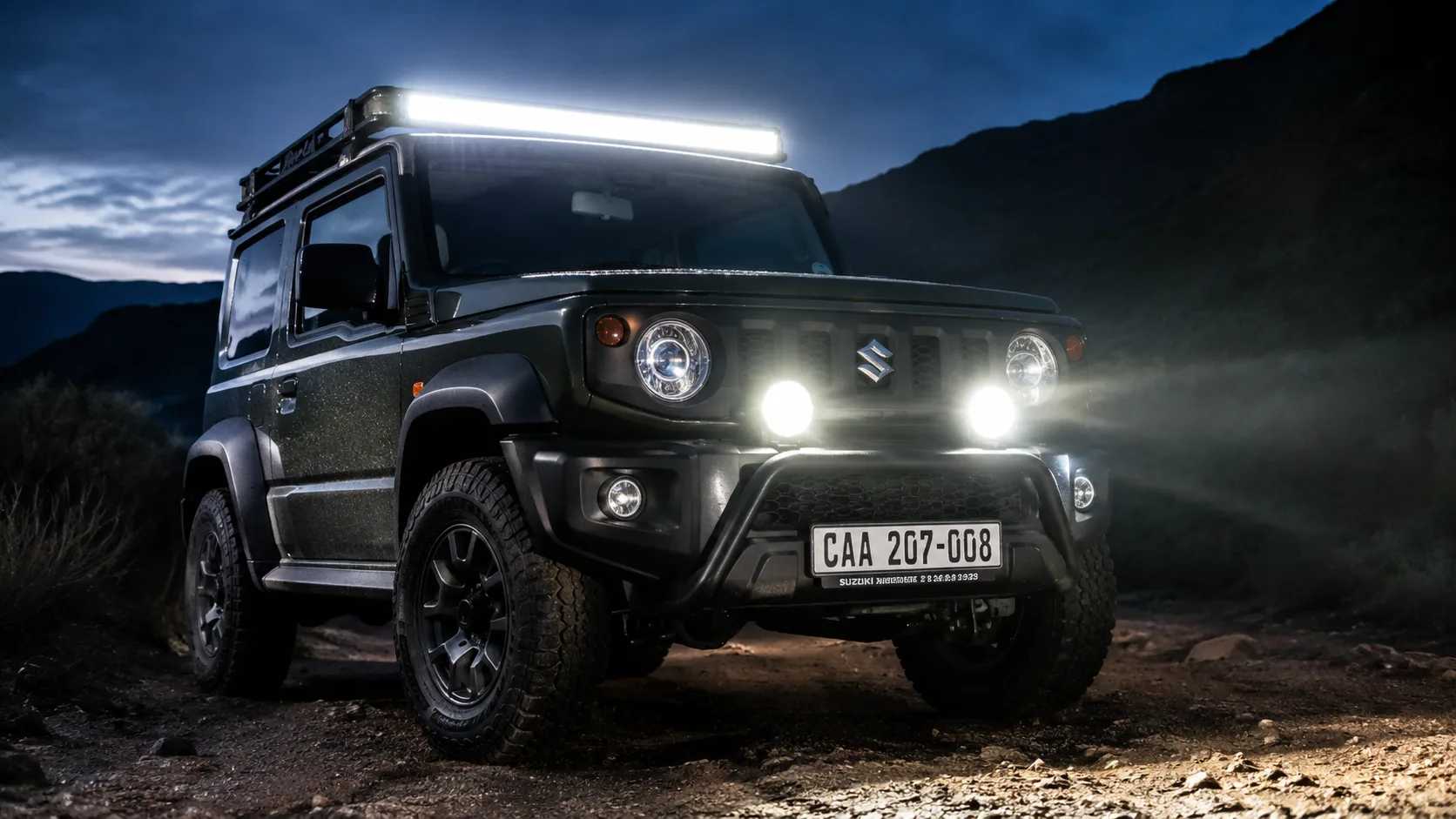
The Jimny’s factory headlights are adequate for normal road use. They are not adequate for driving dirt roads at speed after dark, navigating a narrow mountain trail in the early hours, or lighting up the campsite perimeter on an overland trip. Auxiliary lighting transforms the Jimny’s usability after sundown — but the options range from genuinely useful to expensive and pointless. Here’s how to choose well.
Light Types: What’s What
| Type | Beam Pattern | Best Use | Mounting | Approx. Price |
|---|---|---|---|---|
| LED Light Bar (curved/straight) | Combo: flood + spot | High-speed gravel, track lighting | Roof rack, roof, bull bar | R800–R8,000 |
| Round LED Spotlights | Long-throw spot | Distance lighting on fast gravel and tar | Bull bar, A-pillar, roof | R600–R3,500 (pair) |
| Square/Rectangle LED Work Lights | Wide flood | Camp lighting, work, recovery | Rear, sides, roof | R400–R1,800 (pair) |
| Driving Light Pods | Spot or combo | Trail approach lights, ditch lights | Lower bumper, A-pillar | R800–R2,500 (pair) |
| Lightforce HID Spotlights | Extreme long-throw spot | Very fast open-road driving | Bull bar or bonnet mount | R3,500–R7,000 (pair) |
Which Light Type Does the Jimny Actually Need?
Before specifying a lighting upgrade, be honest about where and how you drive after dark:
- Gravel road driving at speed (80–100+ km/h): Long-throw spot lights or a combo bar — you need to see obstacles at 150+ m to have time to react
- Slow trail work and camp approaches: A wide-flood bar or pair of flood pods mounted low — illuminating the trail edge and obstacles close to the vehicle
- Recovery at night: Wide-flood work lights mounted rearward or to the side — lighting the ground around the vehicle without blinding the recovery team
- Camp setup and living: High-output flood bars on the roof or awning rail — directing light down and outward from the vehicle
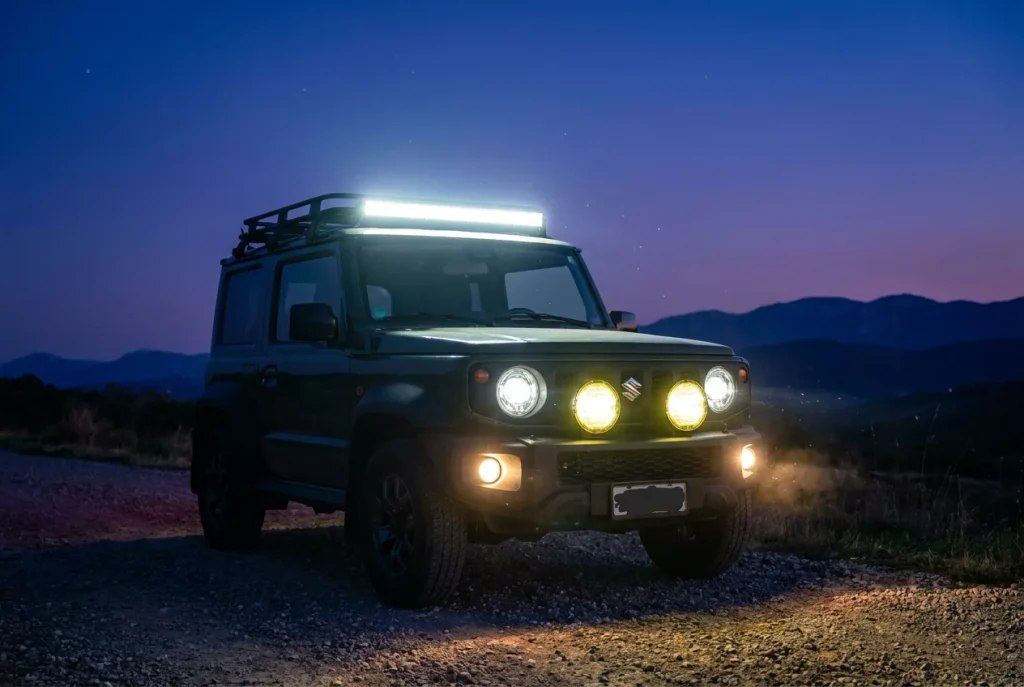
Most owners need two things: a forward-facing combination bar (spot + flood) for trail driving, and rear/side work lights for camp and recovery. A single well-specified bar and two work lights cost R2,500–R6,000 total and meet 95% of use cases.
Two quality lights wired correctly outperform five cheap lights wired badly. Spend money on wiring and switches, not just light units.
James Crawford, Compact Conqueror
LED Light Bar Comparison — 20-Inch (SA Market)
| Brand | Lumen Output | IP Rating | Beam | Approx. Price | Notes |
|---|---|---|---|---|---|
| Lightforce Viper 20″ | 19,200 lm | IP68 | Combo | R5,500–R7,500 | Australian benchmark — genuinely built tough |
| ARB Intensity | 9,680 lm per unit | IP68 | Spot or flood | R2,200–R3,200 each | Premium quality, strong SA support |
| Bushranger Night Hawk 20″ | 13,600 lm | IP68 | Combo | R3,800–R5,200 | Strong real-world performance |
| Ironman Hyperdrive 20″ | 9,000 lm | IP67 | Combo | R1,800–R2,800 | Good value mid-tier |
| Narva Explora 20″ | 11,400 lm | IP68 | Combo | R3,200–R4,500 | Quality brand, wide SA availability |
| Osram LEDriving 20″ | 5,200 lm | IP69K | Combo | R2,500–R3,500 | Conservative lumen rating but accurate |
| Generic / No-name 20″ | Claimed 50,000 lm+ | Often IP65 actual | Combo | R400–R800 | Exaggerated specs, poor longevity, warranty issues |
Avoid no-name bars with inflated lumen claims. A bar claiming 50,000 lumens for R600 is not delivering 50,000 lumens — it is claiming an input lumens figure (before lens losses) from all LEDs at peak laboratory conditions. Real-world output is 20–30% of that figure. A quality 9,000–14,000 actual-lumen bar from ARB, Bushranger, or Lightforce outperforms a “50,000 lumen” generic unit every time.
Mounting Positions — JB74
Roof / Roof Rack Mount
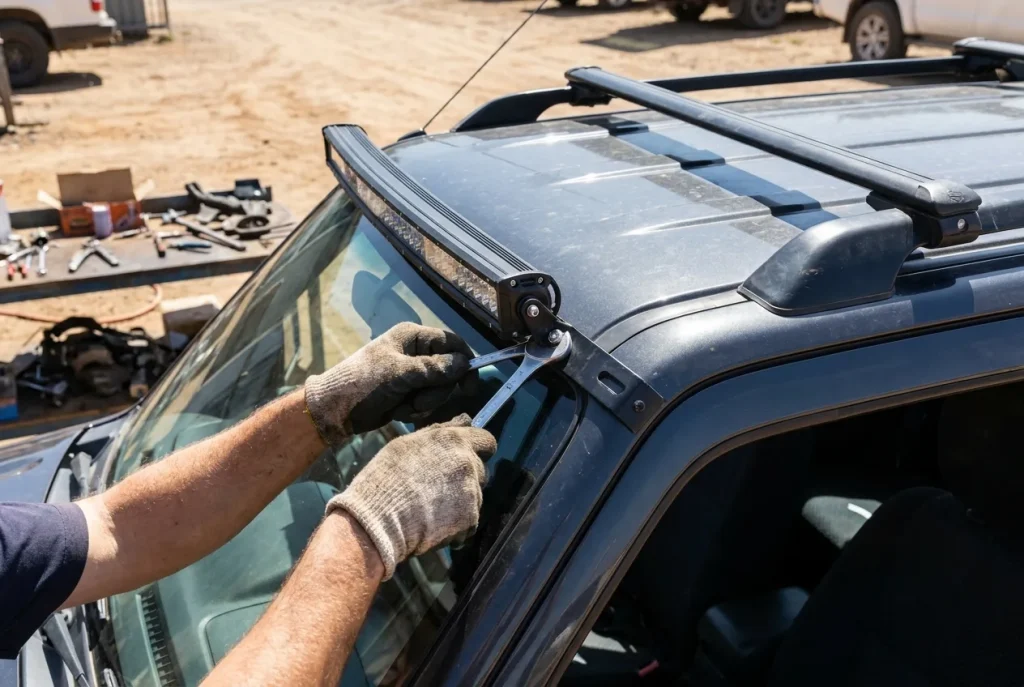
The most common mounting position. A 20-inch bar on the roof rail or front rack crossbar sits above the bonnet line and illuminates the road ahead without the bonnet casting shadows. Requires roof rack fitment first. Wiring runs through the A-pillar or under the bonnet to the fusebox.
Bull Bar Mount
A bar or pod lights mounted on the bull bar sit low — below bonnet height — which creates better “fill” lighting close to the vehicle and reduces harsh reflections off road dust. The trade-off: insects, mud, and debris reach the light units more readily. Pod lights (rather than a full bar) are the standard bull bar mount choice.
A-Pillar Mount
Driving light pods mounted on A-pillar brackets provide a wide spread of light from an elevated forward position. They are useful for illuminating tight corners and trail edges without requiring a roof rack. Ensure the mounting brackets do not obscure the mirror or forward vision.
Wiring — The Critical Step
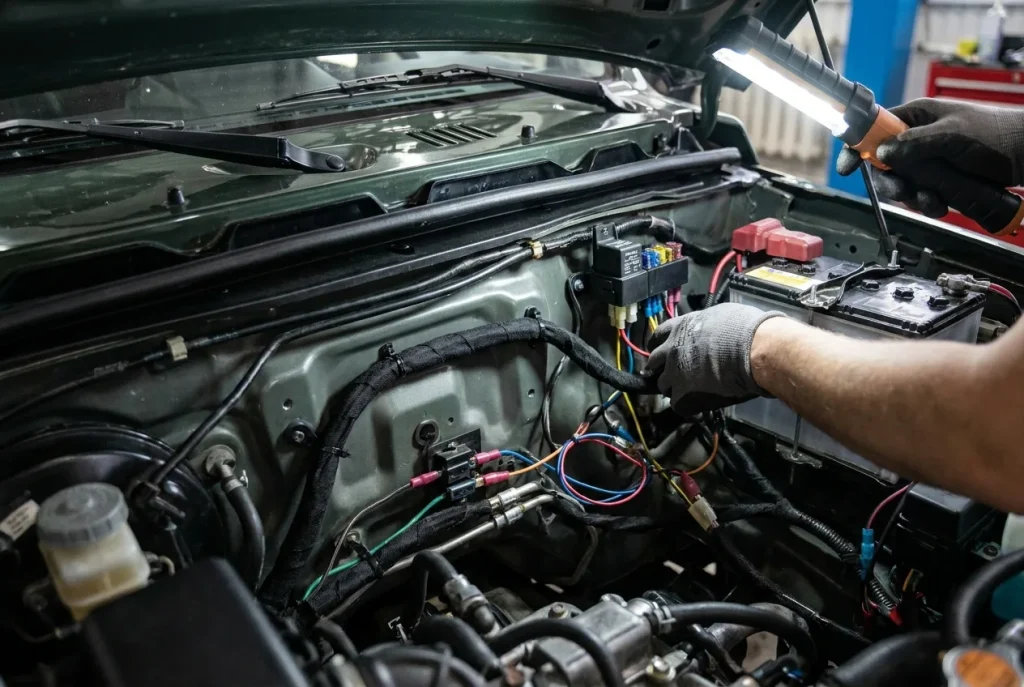
Poor wiring causes more auxiliary light problems than poor light quality. Undersized wiring overheats, voltage drop reduces light output, and incorrect fusing creates fire risk. Non-negotiable wiring requirements:
- Size the cable correctly: a 50W LED bar draws approximately 4.2A at 12V. A 100W draw (two 50W units) requires minimum 4 mm² cable for runs up to 4 m.
- Use a dedicated fused supply from the battery (not tapped from an existing circuit)
- Fit a quality switch — illuminated rocker or push-button rated for the load, not a household switch
- Use an ISO relay harness for bars drawing more than 20W — this protects the switch from high current
- Earth directly to the chassis at the light mounting point — a poor earth causes more flicker and output loss than almost any other fault
- Protect all connections with heat-shrink (not electrical tape) and use weatherproof connectors
Have an auto-electrician run the wiring if you’re not confident. The cost (R500–R1,200) is trivial relative to the risk of a poorly wired system. Specify that you want proper fusing, a relay harness, and correctly sized cable.
Legal Requirements — SA
Auxiliary lights in South Africa must comply with the National Road Traffic Act. Key rules:
- Additional headlights (driving/fog) must be wired so they cannot operate when main headlights are off
- Spot lights may only be used where they do not dazzle oncoming traffic — treat them as high-beam supplements, not independent lights
- No more than four headlights (original + auxiliary) may illuminate simultaneously
- Lights fitted to the outside of the vehicle must not extend beyond the widest point of the vehicle body
Frequently Asked Questions
What size light bar fits the Jimny without a roof rack?
A 20-inch (approximately 500 mm) bar fits neatly across the Jimny’s bonnet rail or roof with appropriate mounting brackets, even without a full roof rack. Purpose-made Jimny roof mount brackets are available through 4×4 suppliers. A 32-inch or wider bar overhangs the body and requires a rack to position correctly.
Is a curved or straight light bar better for the Jimny?
A curved bar matches the shape of the Jimny’s roof profile better and provides a wider spread of peripheral light. A straight bar provides a more focused, forward-throw beam. For trail driving where seeing the road edges matters, the curved bar’s peripheral spread is preferable. For open high-speed gravel, a straight bar’s focused throw is stronger.
How many lumens do I need?
For trail driving at 40–80 km/h, 9,000–14,000 actual (not claimed input) lumens from a quality bar is more than sufficient. More lumens from a quality manufacturer means better visibility. More claimed lumens from a no-name brand means nothing. Focus on real-world reviews and the manufacturer’s IP rating (IP67 minimum, IP68 preferred for water submersion resistance).
Will fitting auxiliary lights affect my insurance?
Notify your insurer of significant modifications — auxiliary light bars are a theft risk. An undisclosed modification that contributes to an accident (e.g., a poorly wired light causing an electrical fire) could complicate a claim. Document the installation with receipts and photos.
Can I wire a light bar to the existing driving light switch?
Only if the existing circuit is rated for the additional load (check the fuse rating and cable size). Most factory auxiliary light circuits are fused at 15A. A 100W bar draws approximately 8.5A — this fits within a 15A fuse, but the factory wiring may not be sized for a sustained additional 8.5A draw on long trail nights. A dedicated relay harness from the battery is the correct approach for any significant light bar.
Related Reading
Jimny Bull Bar & Roof Rack Guide
Mount points for your lights — bull bar and roof rack options explained.
Free Newsletter
The Compact Conqueror Newsletter
Mod guides, trail reports, maintenance tips and Jimny news — free, every week.
Free Jimny Tool
Working out your Jimny’s tyre size?
Check fitment, overall diameter, speedo error and clearance for any tyre size — before you buy or lift.