Affiliate Disclosure: Compact Conqueror earns a small commission on qualifying purchases made through links on this page — at no extra cost to you. We only recommend products we’ve tested or researched thoroughly. See our full affiliate disclosure.
New Jimny owners face an overwhelming aftermarket. Lift kits, tyre upgrades, roof racks, bull bars, snorkels, lockers — the options are endless and the budget is finite. This guide cuts through the noise: here is what to buy first, what to save for second, and what to skip entirely.
The Modification Philosophy
Every modification decision on the Jimny should be driven by one question: does this make the car more capable in the conditions I actually drive? A 100 mm lift kit is impressive on a photo, but if you drive 80% on tar and 20% on graded tracks, you would get more value from all-terrain tyres and a set of quality floor mats.
The modification sequence below is designed around a typical South African enthusiast who does weekend trips and occasional trail runs, with daily commuting on tar in between. Adjust to your use case, but use this as your starting framework.
The most capable off-road upgrade you can make is learning to drive properly. Every other modification is secondary.
James Crawford, Compact Conqueror
Tier 1: Buy Before Your First Trail (R0–R5,000)

These are the essentials — safety and function items that every Jimny should have before leaving the tar.
1. Quality Floor Mats and Cargo Liner
Start unglamorous. The Jimny’s carpet is thin and difficult to clean. Heavy-duty rubber floor mats (Sakura, Hase, or custom-moulded options) protect the floor and are easily hosed down after muddy trail days. Budget: R600–R1,200.
2. Tow / Recovery Points
The JB74’s factory bumpers have rated tow hooks front and rear — check that yours are fitted and in good condition. If you have an aftermarket bull bar, verify that recovery rings are rated for the car’s weight (1,135 kg). A front D-shackle rated to 3,250 kg or better is the minimum. Never hook a recovery strap to a tow ball. Budget: R300–R600 for rated D-shackles.
3. Basic Recovery Kit
You do not need a full expedition kit for local trails, but carry the basics:
- Kinetic recovery rope (9 m, 8,000 kg rating minimum) — R600–R900
- Two rated D-shackles — R250–R400
- Folding shovel — R300–R500
- Hi-Lift jack (60″ recommended) — R800–R1,400
- Hi-Lift base plate (prevents sinking in soft ground) — R200–R350
4. Tyre Pressure Monitor (TPMS) or Gauge
Tyre pressure management is the single most impactful off-road technique. Airing down to 1.0–1.2 bar on sand and soft surfaces dramatically increases traction. Carry a quality analogue gauge (Micrometer or equivalent) and a 12V compressor to re-inflate before returning to tar. Budget: R200–R1,500 depending on compressor quality.
Tier 2: First Upgrade Season (R5,000–R20,000)
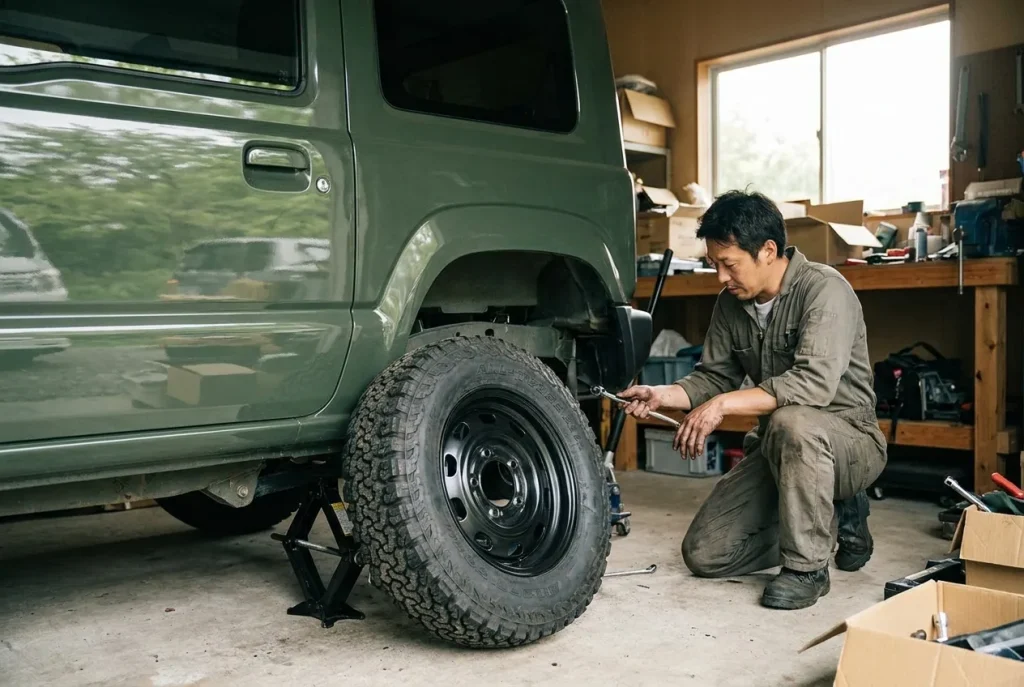
Once you’ve run your first few trails and know your use case, these upgrades deliver the most per-rand improvement in capability and comfort.
5. All-Terrain Tyres
The JB74’s stock 195/80R15 road tyres are a deliberate compromise. Moving to a quality all-terrain tyre is the single highest-impact capability upgrade you can make. The 215/75R15 size fits without modification and is the most popular choice in the South African Jimny community.
| Tyre | Size | Pattern | Best For | Est. Price (each) |
|---|---|---|---|---|
| BF Goodrich KO2 | 215/75R15 | Aggressive AT | Gravel, mud, rock | R2,800–R3,400 |
| Cooper Discoverer AT3 | 215/75R15 | Moderate AT | Gravel, sand, daily | R1,900–R2,400 |
| Falken Wildpeak AT3W | 215/75R15 | Moderate AT | All-round AT, wet | R2,100–R2,600 |
| Goodyear Wrangler AT | 215/75R15 | Moderate AT | Daily + light trail | R1,700–R2,200 |
| Mickey Thompson Baja Boss AT | 215/75R15 | Aggressive AT | Mud + rock bias | R2,600–R3,200 |
Fit all four simultaneously and have the spare converted to match. A mismatched spare causes unnecessary stress when you’re forced to use it on uneven terrain.
6. Bash Plates (Underbody Armour)
The Jimny’s engine sump, transfer case, and fuel tank are exposed. A quality bash plate set protects these components from rock strikes. Options range from 3 mm steel (budget) to 6 mm aluminium-alloy (premium). Key coverage areas:
- Front skid plate: sump and gearbox protection
- Transfer case skid: the most commonly struck component on rocky trails
- Fuel tank plate: essential if you run mountain passes
Recommended South African suppliers: Opposite Lock, 4×4 Mega World, and Trail-Gear importers. Budget for a three-piece set: R2,500–R5,500 depending on material and brand.
7. Suspension Lift Kit — 40 mm
A 40 mm (1.5″) lift is the sweet spot for the JB74 running 215/75R15 tyres. It increases clearance meaningfully, improves approach and departure angles, and keeps the geometry within acceptable limits without requiring CV joint replacement or radius arm correction.
Avoid lifting beyond 50 mm without addressing the CV angle and fitting extended brake lines — this is where lift kits start creating problems rather than solving them.
- Old Man Emu (ARB): R8,500–R12,000 fitted — benchmark choice for combined on/off road
- Tough Dog: R7,000–R9,500 fitted — good performance per rand
- Ironman 4×4: R5,500–R7,500 fitted — budget-friendly with acceptable performance
- Kings (Superior Engineering): R9,000–R13,000 fitted — premium performance
Always fit a quality wheel alignment immediately after any suspension modification. Budget R600–R900 for a 4-wheel alignment at a 4×4-specialist workshop.
Tier 3: Advanced Capability (R20,000+)
These are serious upgrades for owners who trail regularly and want to tackle more demanding terrain.
8. Rear Differential Lock
The JB74 does not come with a factory diff lock (unlike some international-spec models). A rear locker transforms the Jimny’s ability on difficult terrain — particularly in rock gardens and deep cross-axle situations where open differentials send power to the wheel with least traction.
ARB Air Locker kits are available for the JB74 rear axle through ARB South Africa. Full installation including an onboard compressor system costs R18,000–R26,000. This is a significant investment, but the capability gain on serious trails is dramatic.
9. Roof Rack and Lighting
A quality roof rack (Rhino Rack, Front Runner, or Expedition Rails) adds recovery gear, a rooftop tent option, and camping kit without consuming the cargo area. LED light bars or spot/flood combos mounted on the rack or bull bar extend driving hours on remote trails.
Front Runner makes an excellent Jimny-specific platform rack with built-in mounting points. Budget: R7,500–R14,000 for rack + installation.
10. High-Lift Jack Mounting and Accessories
As trail difficulty increases, Hi-Lift utility increases. Add a proper bonnet or roof rack mount so the jack is accessible and secure, and invest in an ARB base plate and handle keeper to prevent bounce-related accidents. Total additional investment: R800–R1,500.
What to Avoid

Not every popular mod is a good mod for the Jimny. These are the most common mistakes new owners make:
- Oversized tyres (235/75R15 and above): Requires guard trimming, longer lift height, possible speedo recalibration. The performance gain over 215/75R15 is marginal on most South African trails. Save the budget.
- Cheap suspension lifts: A R1,200 spacer lift kit binds the CV joints, wears tyres unevenly, and compromises handling. If you can’t afford quality suspension, wait.
- Body lifts: Separate body from frame — increases gap aesthetically but adds zero chassis clearance. No ground clearance benefit whatsoever.
- Dual-battery without a proper isolator: A second battery wired directly to the main battery will drain it. Fit a proper DC-DC charger (Redarc, Projecta) or smart isolator.
- Snorkel without an engine tune: A snorkel is a meaningful crossing safety measure but does not improve performance on dry trails. Prioritise capability-critical mods first.
Modification Budget Guide
| Phase | Upgrades | Approx. Budget |
|---|---|---|
| Tier 1 — Immediate | Recovery kit, mats, TPMS | R3,000–R5,000 |
| Tier 2 — Season 1 | AT tyres, bash plates, 40 mm lift | R15,000–R22,000 |
| Tier 3 — Advanced | Rear locker, roof rack, lighting | R25,000–R40,000 |
| Total (full build) | All of the above | R43,000–R67,000 |
Frequently Asked Questions
What is the best first modification for a Suzuki Jimny?
All-terrain tyres, without question. Moving from the stock road tyres to a quality 215/75R15 AT tyre transforms the Jimny’s trail capability more than any other single upgrade. It’s also reversible — if you sell the car, you can refit the originals.
Will modifying my Jimny void the warranty?
In South Africa, consumer protection legislation means a manufacturer cannot void your warranty simply because you’ve fitted aftermarket parts. However, if a modification causes a specific component failure, the manufacturer may decline that specific claim. Use reputable brands, have work done by qualified workshops, and keep all invoices. Consult Suzuki Auto SA directly for their specific policy.
How much lift does the Jimny need for 215/75R15 tyres?
Zero — 215/75R15 tyres fit the JB74 at stock height with no rubbing under normal articulation. A 40 mm lift simply provides better clearance under compression and improves the visual stance. You don’t need to lift the car before fitting these tyres.
Are Old Man Emu (OME) suspension kits worth the premium?
For most owners, yes. OME kits use Dakar-bred shock absorber technology and are specifically tuned for the Jimny’s weight and spring rates. They maintain a reasonable on-road ride quality while providing improved off-road performance. If you trail regularly, the OME investment pays for itself in longevity and performance.
Can I fit a rear diff lock myself?
The mechanical fitment of an ARB Air Locker requires welding of the locker ring gear into the diff housing and precise setup of the bearing pre-load — this is a workshop job. The compressor wiring can be DIY’d by an experienced auto-electrician. Budget for professional fitment of the locker unit itself.
Do aftermarket tyres affect the Jimny’s fuel consumption?
Yes. Moving from stock 195/80R15 road tyres to 215/75R15 all-terrain tyres adds approximately 0.5–1.0 L/100 km in real-world driving due to increased rolling resistance, rotational mass, and aerodynamic drag from the aggressive tread pattern. At current pump prices, factor this into your running cost calculations.
Related Reading
Complete Buyer’s Guide 2026
Everything to know before buying — new vs used, generation guide, variant comparison, and SA pricing.
Jimny Service Schedule & Maintenance Guide
Keep your modded Jimny healthy — service intervals, fluid specs, and common DIY jobs.
Modifications & Accessories Hub
Full modifications hub: suspension, tyres, electrical, exterior, and interior upgrades.
Free Newsletter
The Compact Conqueror Newsletter
Mod guides, trail reports, maintenance reminders and Jimny news — free, every week.
Free Jimny Tool
Working out your Jimny’s tyre size?
Check fitment, overall diameter, speedo error and clearance for any tyre size — before you buy or lift.